VAT Deductible at Source in Bangladesh: A Guide by Tahmidur Rahman Remura Law Firm
In Bangladesh, the Value Added Tax (VAT) Act of 2012 introduced provisions for VAT Deductible at Source (VDS). These regulations outline the circumstances under which VAT should be deducted by the recipient of a service or the person paying the price of the service or commission.
Tahmidur Rahman Remura Law Firm, a leading law firm in Bangladesh, specializes in VAT-related matters and provides comprehensive guidance on VAT Deductible at Source. In this article, we will explore the key aspects of VDS and why hiring Tahmidur Rahman Remura Law Firm can ensure compliance and optimize VAT-related procedures.
Understanding VAT Deductible at Source
According to Section 49(5) of the VAT Act-2012, VAT is payable by the recipient of a service, and if the recipient or the person paying the price of the service deducts or collects VAT at source, they must deposit it to the Government Treasury on behalf of the supplier. This provision aims to streamline the collection of VAT and reduce the burden on suppliers, ensuring proper compliance with VAT regulations.
Exemption for Sub-Contractors
One important aspect of VAT Deductible at Source is the exemption for sub-contractors. When a main contractor appoints a sub-contractor, agent, or another service provider to complete a project or service, the main contractor cannot deduct any further VAT from the sub-contractor’s bill.
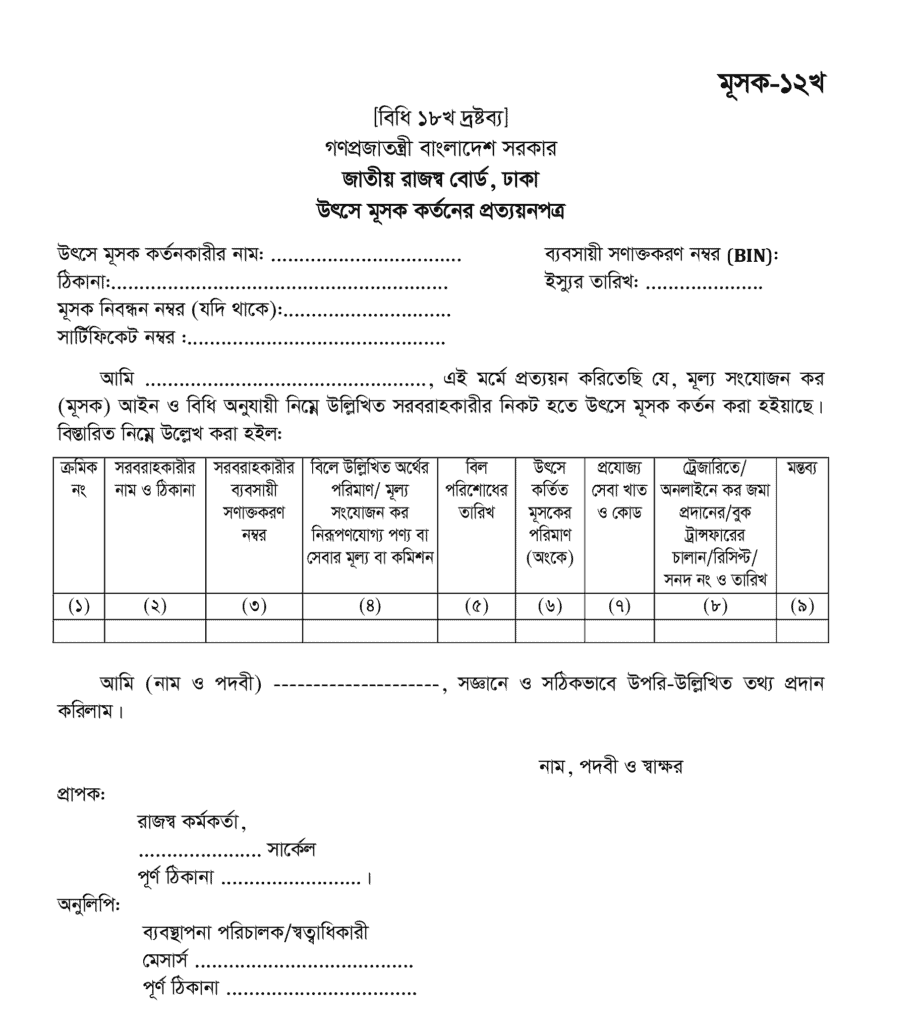
This exemption applies if the project authority has already deducted VAT at source from the main contractor’s bill and provided proper evidence, such as Mushak-6.6 certificate and treasury challan, to the sub-contractor. This exemption aims to avoid double taxation and simplify VAT procedures in cases of subcontracting.
VAT Deducted at Source in Projects
VAT Deductible at Source also applies to government projects or private-level activities that resemble projects. In the case of private projects, where tendering takes place and a contractor is selected through the tendering process, VDS regulations apply.
This means that VAT should be deducted at source from the contractor’s payments, but if the contractor appoints a sub-contractor for the same project, VDS should not be deducted from the sub-contractor’s bill if proper evidence of VAT payment by the main contractor is provided. This clarification helps eliminate confusion at the field level and ensures compliance with VAT regulations.
If the prime contractor mentions the outsourcing of raw materials in its VAT documents or treasury submissions, the revenue authorities will not charge the subcontractors separately for VAT.
Several ongoing projects, such as the metro rail, the Rooppur nuclear power plant, the Bangabandhu Tunnel, and the Padma Bridge approach road, involve local firms as subcontractors or in collaborative ventures with foreign firms. The National Board of Revenue was deducting VAT from the invoices of both the general contractor and the subcontractor, resulting in double taxation.
Foreign development partners, who financed the infrastructure works, have been seeking a solution to the double taxation issue, according to Revenue Board officials.
According to the law, VAT will be applicable to any VAT-eligible company that provides non-VAT-exempt services pursuant to a contract, bid, or work order. However, the law does not specify whether VAT will apply to the bill of a contracted firm, agent, or service provider working for a VAT-eligible business.
The ambiguity led both the general contractor and subcontractors to include VAT on their invoices and vouchers.
In accordance with the most recent changes to the VAT law, hired firms or agents will not be required to pay VAT, but the primary contractor will be required to submit documentation mentioning VAT payments against outsourcing.
After several rounds of meetings with local subcontractors, the VAT law was amended once in 2020, according to an official of the revenue board’s VAT department. The lack of clarity in the law regarding VAT-paying entities led to the complications. The issue has been resolved through amendments to the finance measure.
According to industry insiders, the majority of local companies working on megaprojects are subcontractors for foreign contractors. The subcontractors supply food and lodging, labor, and other products and services. They also offer building materials.
On the invoice for these services, the principal contractor of the project pays the revenue board 5% to 10% VAT.
In contrast, revenue officials require VAT from subcontracts when separate returns are submitted. As a consequence, construction industry businesses have been dissatisfied for an extended period of time.
Organizations that are accountable for VAT Deduction at Source (withholding entity).
Ten distinct entities have been assigned the responsibility of deducting VAT at the source.
These include the following:
(1) Government organizations; (2) Semi-Government organizations; (3) Autonomous bodies; (4) Non-Government organizations (NGOs); (5) Banks; (6) Insurance companies; (7) Financial institutions; (8) Limited company (both private limited company and public limited company but not proprietorship firm); (9) Educational institutions (all types of educational institutions from KG, nursery to university, both public and private); (10) Establishment with more than Taka one crore in annual turnover. (In VAT law, turnover refers to the entire amount of money received from sales during a given period, in this case one year).
When these withholding entities pay for their purchases of goods and services, they must implement the VDS rules to determine whether VDS must be deducted from the payment. If the obligation to deduct VDS remains, it must be satisfied. Despite having the obligation to deduct VDS, if it is not done, it can be recovered with 2% interest from the entity neglecting to deduct.
Moreover, the VAT Act, 1991 [Section 37Kha(Kha)] stipulates that if deducted money is not deposited to the government treasury following deduction, the Commissioner may impose a personal penalty of BDT 25,000 (Taka twenty-five thousand) on the person who deducted VDS, the person responsible for depositing the deducted amount to the government treasury, and the Chief Executive Officer of the entity.
Therefore, the employees of the negotiation, procurement, accounts, payables, audit, post-audit, etc. departments of the withholding entities must be aware of the most recent VDS provisions.
Provisions of the VDS for the Supply of Goods:
If you are presented with a bill for the purchase of a service, as previously discussed, you must adhere to the aforementioned regulations. However, if you are presented with a bill for the purchase of products, you must adhere to the provisions outlined below. If a bill for the purchase of products is presented to you, your first task is to identify the supplier.
The supply can be made by one of three parties: (a) a manufacturer, (b) a trader, or (c) a procurement provider. For the supply of these three entities, there are distinct VDS provisions that will be discussed in greater detail below. We are aware that although procurement provider is a service, in practice it provides products.
A procurement provider acquires products from one location, transports them to a withholding entity, and delivers them. Therefore, he offers the service of acquiring and transporting the products. Thus, the procurement provider service is presented to you as products.
Consequently, we will discuss procurement provider in the goods segment of this article. The following discussion is pertinent to comprehending when a supplier of products is considered a procurement provider.
Procurement provider service
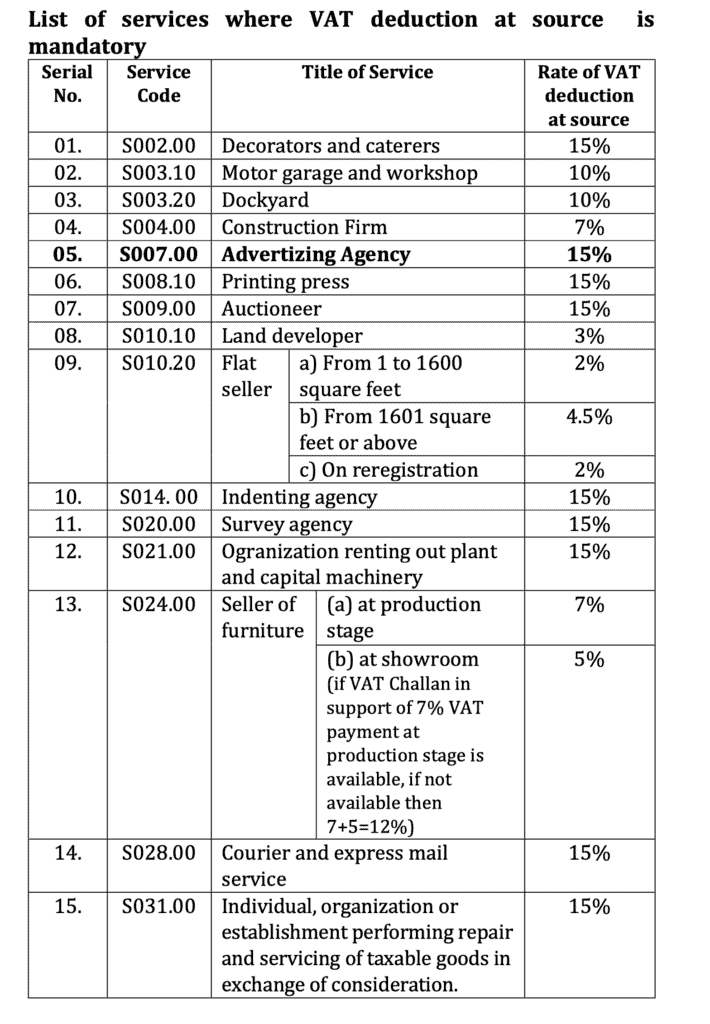
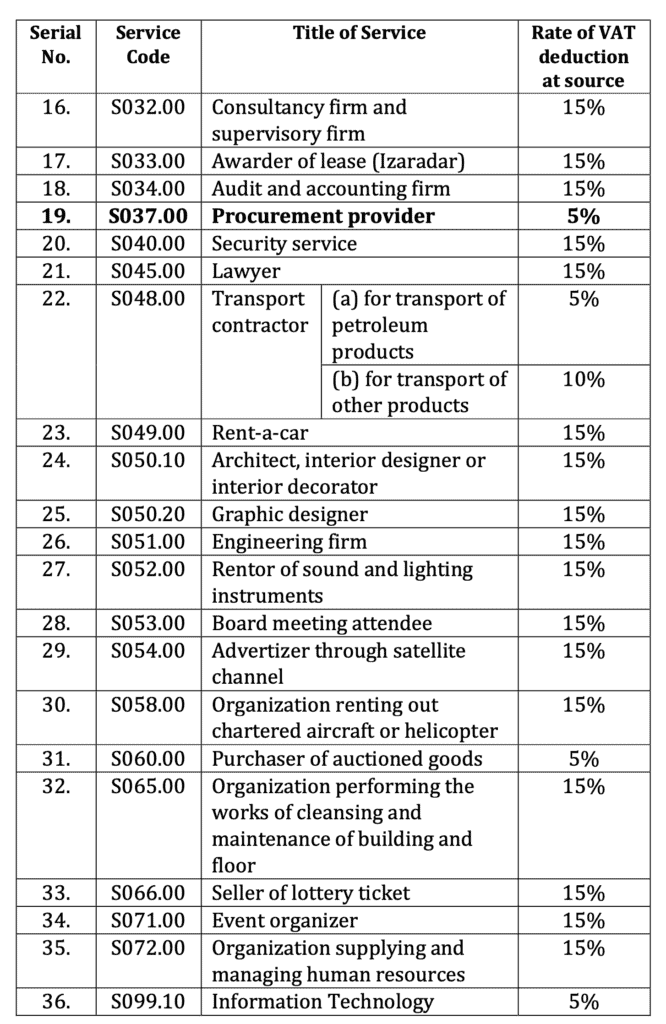
The procurement provider service, which remains on the preceding list of 39 services, is a vital component of our VAT administration system. Regarding this service’s VDS provisions, confusion persists among the general public. Consequently, the provisions regarding VDS deductions for the provider of procurement services are discussed in detail below.
Notably, the definition of procurement provider has been modified to some extent during 2013-14 budgetary measures, and as a result, VDS provisions have also been modified. Please locate a detailed explanation of this below.
Difference Between Trader and Procurement Provider:
To identify procurement provider, it is necessary to distinguish procurement provider from merchant. A merchant has an establishment, which may be owned or rented, with a structure (small or large), personnel, utilities, and inventory. Typically, a procurement provider lacks such an establishment.
A trader stocks the products and then sells them; an acquisition provider does not stock. The procurement provider acquires, transports, and then supplies the client directly. A merchant sells to all types of consumers, whereas a procurement provider only supplies against competitive bid. A trader participates in a tender for the goods he handles, whereas a procurement provider may participate in a tender for any goods.
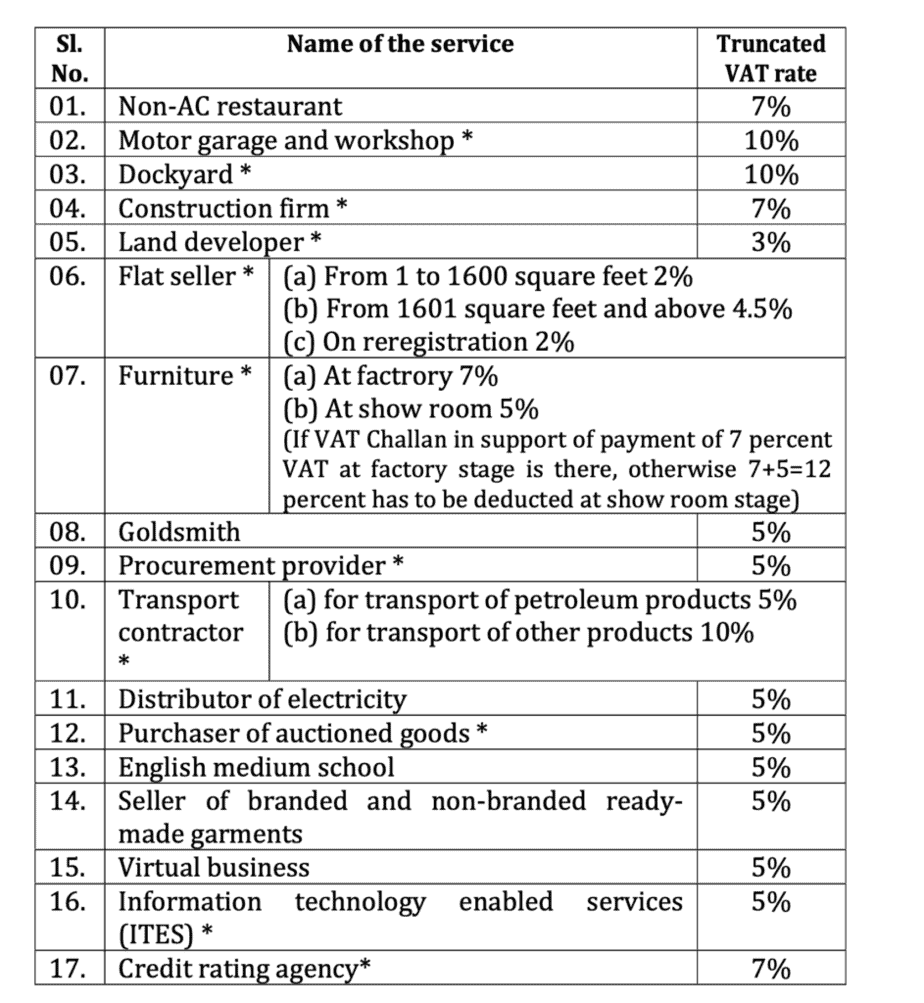
If commodities are supplied by a producer or merchant issuing a VAT Challan, then the supplier will not be considered a Procurement Provider and VAT will not need to be deducted at the source. Before deducting VAT at source, one must be certain of the supplier’s status. 5% VAT must be deducted at the source if the supplier is a Procurement Provider.
Deduction of VAT at Source on Goods Supplied by a Manufacturer or Trader:
In the interim, we have discussed which entities have been assigned responsibility for VAT decution at source. In addition, we have covered 37 services from which VDS deduction is required. We have discussed special VDS advertising agency provisions. We have discussed the VDS procurement provider provisions. Then, VDS provisions beyond these 39 services were discussed. Then, we began discussing VDS provisions regarding the supply of products.
As seen, products are supplied by the manufacturer, the merchant, and the procurement provider. In the case of the supply of products, we have also seen who is considered a procurement provider and who is not. If the supplier is deemed a procurement provider, VAT at the rate of 5% must be deducted at the point of sale. If the supplier is not deemed a procurement provider, no VAT is typically required to be deducted at the source.
In the continuation of our discussion, we noted that if a supplier of goods is also the manufacturer, and if he makes the supply by issuing a VAT Challan, he will not be considered a procurement provider, and therefore VAT will not be required to be deducted at the point of sale. Similarly, if a merchant makes a supply with a VAT Challan, he will not be considered a procurement provider, and VAT will not be required to be deducted at the source.
Examining the VAT registration certificate
In other words, if a withholding entity receives a shipment of goods, it must first ascertain whether the shipment was made by a manufacturer, a trader, or a procurement provider before making payment. Examining the VAT registration certificate
(Business Identification Number-BIN), the Taxpayer Identification Number (TIN), the trade license, the Memorandum, or any other document, and, if necessary, visiting the supplier’s business location, is required to determine whether the supplier is a manufacturer, a trader, or a procurement provider. )
This task is not difficult. Such scrutiny is not necessary while paying each and every expense. There are enlisted vendors in each entity withholding taxes. The vendors are selected in advance. When vendors are selected, it can be determined whether they are manufacturers, traders, or procurement providers.
Consider that the Sonargaon Hotel will appoint a vendor to procure a steady supply of edible oil. A solicitation has been issued for this purpose. Many organizations participated in the solicitation. There is Bangladesh Edible Oil Industries Ltd. among them. There exists Prince Bazar Private Limited.
Additionally, Rahmania Enterprise exists. Document examination reveals that Bangladesh Edible Oil Industries Ltd. is a manufacturer, Prince Bazar (Pvt) Ltd. is a trader, and Mrs. Rahmania Enterprise is a provider of procurement services.
Whenever a bill for the supply of edible oil is submitted, it could be presumed that it has been submitted by the manufacturer if Bangladesh Edible Oil Industries Ltd. is chosen in the bid. It shall not be necessary to scrutinize each and every measure. The same holds true for both the vendor and the procurement provider.
Dispositions for VAT deduction at source in the case of multiple-component supplies:
On occasion, multiple components are observed within a particular supply. However, price is mentioned entirely. There are complexities regarding the VDS deduction on such supply. So, provisions have been made so that if there is a supply with multiple components, each component must be listed separately in the bid, quotation, or invoice. Each component must be treated as a separate supply, and VDS regulations must be applied accordingly to each supply.
As an illustration, it is sometimes the case that the awarding of a contract stipulates that machinery must be installed and serviced for several years. These two components of the work have been solicited by a single bid. In such a circumstance, one component, namely the installation of machinery, must be counted as one supply, and the servicing of those machines for several years must be counted as a separate supply.
In the bid documents and invoices, the costs of both of these components must be listed separately. On these two components, separate VDS regulations must be applied.
We have concluded our discussion of the initial section. Few topics have been presented sequentially. Which entities are allowed to deduct VDS? VDS is required to be deducted from 37 services. The provisions regarding the advertising service VDS deduction.
The provisions pertaining to VDS deduction on the provider of procurement. Provisions governing VDS deductions for services beyond these 39. Provisions regarding the VDS deduction for a few additional supplies. Modifications to the VDS deduction on products. Now, we will begin discussing the second section that was previously mentioned.
Cases in which VAT deduction at source is not required (a) If any producer or manufacturer of goods supplies the goods directly to any at source VAT deducting authority issuing VAT Challan, then the seller shall not be regarded as a procurement provider, and VAT shall not be deducted at source on such supply. As an example, Bikash Bread and Biscuit Factory Limited is a biscuit manufacturer.
Manusher Jonnyo NGO has issued a request for proposals to acquire biscuits for distribution to impoverished children. The bid is won by Bikash Bread and Biscuit Factory Limited. Bikash Bread and Biscuit Factory Limited will provide biscuits to Manusher Jonnoyo NGO while issuing a VAT Challan, i.e., paying production stage VAT as a producer.
Manusher Jonnoyo NGO shall not deduct VAT at the source when making payment for the supply. The Bikash Bread and Biscuit Factory Limited must receive full payment, including VAT. There is no VAT deduction at the source. Thus, we have learned an important principle of VDS, namely that VDS is not required to be deducted when a manufacturer directly supplies products with a VAT Challan.
Supplying commodities directly:
If a trader supplies commodities directly to a source VAT deducting authority issuing a VAT Challan, he shall not be considered a procurement provider, and therefore VAT shall not be deducted at source on such a supply.
Suppose S. R. Enterprise is a commercial enterprise. S. R. Enterprise acquires soap from Unilever Bangladesh Limited and distributes it on a wholesale or retail basis, issuing a VAT Challan and remitting the correct amount of VAT at the trading stage. If such a trader supplies goods to any at-source VAT deducting authority that issues VAT Challans and pays appropriate trade VAT, such an organization shall not be considered a procurement provider, and VAT shall not be deducted from such a supply.
Suppose that Agrani Bank Limited has issued an invitation to bid for 5,000 bars of detergent. S. R. Enterprise was awarded the contract. S. R. Enterprise has provided the product to Agrani Bank by issuing a VAT Challan, i.e., by paying the correct amount of VAT. In such a circumstance, S. R. Enterprise shall not be regarded as a supplier.
Therefore, Agrani Bank will not be required to deduct VAT when paying the account for soap supply. It is important to note that the same rules apply to merchants who issue Challans considered to be VAT Challans. For example, Agora is a merchant.
Agora concerns Challan is produced by Point of Sale (POS). A Challan generated at the point of sale (POS) is deemed a VAT Challan under certain conditions.
Therefore, if such a supply is made by Agora with a POS-generated Challan to a source VAT deducting authority, the supply shall not be considered a supply made by a procurement provider, and VAT shall not be deducted at source when making payment. Here, we have learned another principle of VDS, namely that VDS is not required to be deducted at source when a supplier issues a VAT-11 for a supply of products.
Organizations enrolled under Turnover Tax issue
Organizations enrolled under Turnover Tax issue their own currency memos bearing their Turnover Tax enrollment number. If such an organization makes a supply directly to a VAT-deducting authority that issues its own cash memo bearing a Turnover Tax registration number, it will not be considered a procurement provider, and VAT will not need to be deducted at source from the payment for the supply.
It is important to note that the number of organizations subject to Turnover Tax is restricted. These institutions are minor institutions. Typically, they do not make a supply to a source-based VAT deduction authority.
Requirement to identify a Turnover Tax organization:
Nevertheless, they have the authority to supply. Therefore, individuals involved in purchase, bill payment, etc. in organizations that deduct VAT at source must be able to identify a Turnover Tax organization.
If the second digit of the 11-digit (old) Business Identification Number (BIN) is 2, the organization is subject to Turnover Tax. The phrase ‘Turnover Tax’ persists on the new 9-digit online Turnover Tax registration certificate.
Therefore, it is simple to determine the status of the supplier upon viewing the BIN. Therefore, we now comprehend another principle of VDS, namely that VDS is not required to be deducted when a supply is made by an entity enrolled for Turnover Tax and accompanied by its own cash memo bearing the enlistment number.
Organizations registered under cottage industry are required to issue their own cash memos bearing their registration number. If such an organization makes a supply directly to any at-source VAT deducting authority issuing its own cash memo bearing its enlistment number, it will not be considered a procurement provider, and VAT will not be deducted from the payment for the supply.
It is important to note that there are very few organizations listed under cottage industry. These organizations are extremely modest in size. In general, they do not make supplies to authorities that deduct VAT at the source. Nonetheless, they are permitted to make such a supply. Therefore, individuals involved in the purchase, payment of bills, etc. at any withholding entity must be able to identify a cottage industry. According to the former BIN, the second digit of the cottage industry’s eleven-digit registration number is 3. They issue their own format for payment memos. There is currently no provision for cottage industry in the online BIN.
The Role of Tahmidur Rahman Remura Law Firm
Navigating the intricacies of VAT Deductible at Source can be challenging, especially for businesses and individuals involved in complex projects or subcontracting arrangements. Hiring Tahmidur Rahman Remura Wahid Law Firm can provide several benefits in this regard.
The law firm has a team of experienced lawyers who specialize in VAT matters and have in-depth knowledge of the VAT Act-2012 and its provisions. Their expertise ensures accurate interpretation of the law and adherence to VAT regulations.
Tahmidur Rahman Remura Law Firm’s reputation for professionalism and integrity makes them a trusted partner for VAT-related matters. They provide personalized attention to clients, understanding the unique aspects of their projects or businesses and offering tailored solutions. Their emphasis on clear communication and regular updates ensures that clients are well-informed and involved in the decision-making process.
Moreover, Tahmidur Rahman Remura Law Firm’s familiarity with VAT Deductible at Source and their experience in dealing with the National Board of Revenue (NBR) enables them to provide effective guidance and representation. They can assist clients in obtaining the necessary certifications and documents, such as Mushak-6.6 certificates and treasury challans, to ensure compliance with VAT regulations and avoid any potential issues or penalties.
VAT Deductible at Source plays a significant role inensuring proper collection of VAT in Bangladesh. Understanding the regulations and complying with the requirements can be complex, especially in cases of subcontracting or project-based activities. Hiring a reputable law firm like Tahmidur Rahman Remura Law Firm can provide valuable support and guidance throughout the process.
Their expertise, personalized approach, and commitment to client satisfaction make them a reliable partner for VAT-related matters. By entrusting your VAT Deductible at Source requirements to Tahmidur Rahman Remura Law Firm, you can navigate the complexities of VAT regulations with confidence and optimize your VAT-related procedures in Bangladesh.
GLOBAL OFFICES: DHAKA: House 410, ROAD 29, Mohakhali DOHS DUBAI: Rolex Building, L-12 Sheikh Zayed Road LONDON: 1156, St Giles Avenue, 330 High Holborn, London, WC1V 7QH
Declaratory Suit in Bangladesh: Clearing Legal Confusion and Establishing Rights
In the realm of legal disputes concerning property rights or legal character, a declaratory suit can serve as a powerful tool for seeking clarification and resolution. Under Section 42 of the Specific Relief Act 1877 in Bangladesh, individuals who find their rights to property or legal character denied or in question have the right to approach a civil court and seek a declaration to establish their rights.
This article will delve into the concept of a declaratory suit, its essential elements, consequential relief, binding effects, procedure, and its significance in the civil legal framework of Bangladesh.
Understanding Declaratory Suit
A declaratory suit is initiated when a party seeks an authoritative pronouncement from a court regarding their right to property or the status of their legal character. Section 42 of the Specific Relief Act provides the legal framework for filing a declaratory suit in Bangladesh.
If an individual is entitled to any legal character or any right to property, but that right is denied by another person, the aggrieved party can file a suit seeking a declaration from the court.
The term “right to property” encompasses any legally recognized right, such as the right to a position or the right to an easement. On the other hand, “right to legal character” refers to rights acquired through personal qualification or association with a personal library.
Essential Elements of a Declaratory Suit
To file a declaratory suit, certain essential elements must be met:
Legal Rights: The plaintiff must possess legal rights pertaining to property or legal character.
Pre-Existing Rights: The rights claimed by the plaintiff must be pre-existing at the time of the suit, meaning they must have existed before the suit was filed and not as a result of a contract.
Present Danger or Denial: There must be a present danger, denial, or claim against the plaintiff’s rights.
Communication of Denial: The denial must be communicated to the plaintiff to provide a cause of action.
Consequential Relief in Declaratory Suit
Consequential relief refers to the relief that is necessary for the complete enjoyment of the right after the declaration is made. It aims to avoid multiple suits and resolve matters comprehensively. A plaintiff cannot seek mere declaration without consequential relief when it is essential for the full enjoyment of the property.
For instance, if a person has no possession of their immovable property and files a suit solely for the declaration of title, the suit would not be maintainable unless the recovery of possession is added as consequential relief. Section 8 of the Specific Relief Act allows the plaintiff to seek the recovery of possession along with the declaration under Section 42.
Binding Effects of Declaration
According to Section 43 of the Specific Relief Act, a declaration, if granted by the court, is not binding on everyone in general. It is only binding on the parties to the suit and those claiming under them. Additionally, if a party to the suit is a trustee, the declaration is binding on the beneficiaries of the trust.
Procedure and Limitation
The period of limitation for a declaratory suit is not explicitly defined in the Specific Relief Act. Therefore, the general rule of limitation applies, which is six years as per Article 120 of the Limitation Act.
In terms of court fees, since a declaratory suit solely seeks a declaration, the fixed court fee is Taka 300. However, if consequential relief is added to the suit, ad-valorem court fees must be paid for that additional relief.
Significance of Declaratory Suit
The declaratory suit holds significant importance in the civil legal framework of Bangladesh. It provides an avenue for individuals whose legal status has been violated, where direct remedies may not be available. Section 42 has widespread use
in civil suits, offering a means to establish and protect legal rights. To effectively utilize this provision, it is essential to have a thorough understanding of the law and its implications to ensure that time and effort invested yield fruitful outcomes.
The declaratory suit, as provided by Section 42 of the Specific Relief Act in Bangladesh, serves as a powerful legal recourse for individuals facing conflicts or confusion regarding their property rights or legal character. By seeking a declaration from the court, individuals can establish their rights and seek consequential relief.
Understanding the essential elements, binding effects, and procedural aspects of declaratory suits is crucial for navigating the civil legal system effectively.
Desire, requirement, and Object
The purpose of requesting such declaratory relief is to maintain the status quo between the parties. In a particular case, the court proposed a threefold classification for determining the scope of declaratory relief. First, it defines rights but provides no immediate relief. Second, it restores the plaintiffs’ lost rights and provides immediate relief. The court grants this as a preliminary measure of relief.
In addition, one of the primary goals is to circumvent the multiplicity of procedures. It is important to note, however, that a declaratory decree is a form of relief that can only be granted in the absence of specific performance and compensation.
In conclusion, it is evident that the purpose of a declaratory decree is to protect the legal status and legal rights from adverse consequences and allow the party to enjoy them peacefully, as well as to protect the peace and order when adverse possession is discovered.
Conditions
It is important to note that although the court has the discretion to grant relief, there are few conditions that appear to be met prima facie based on the facts of the case.
As is evident from a simple reading of the section, the first condition is that the plaintiff possesses a vested legal right or legal character, and the second condition is that the defendant has denied such a legal right or character, or that the defendant has an interest in denying such a legal right or character.
However, even if the conditions are met, it does not obligate the court to grant the requested relief. Nonetheless, the courts retain discretion in this regard. The plaintiff must demonstrate this privilege not only at the time of the lawsuit, but also at the time of the judgment. And that any relief sought after filing the lawsuit was not the one that should have been sought beforehand.
The fundamentals of declaratory relief
Important elements of declaratory relief include:
There must be an actual, existing interest, as opposed to an abstract privilege.
It is not sufficient for there to be no present interest based solely on a nearby possibility.
It must not be based on speculative grounds and a denial of the same, i.e. there must be an immediate threat to the interest.
The party requesting a declaratory judgment cannot also seek an execution judgment.
In furtherance of the aforementioned factors, the declaratory decree is not granted in the following instances:
Authorities are likely to frustrate the relief if:
It results in an injustice for the opposing party.
It gives the aspirant an unfair advantage over the opposing party.
It causes an undue loss to the opposing party.
Sphere and extent
The issuance of a declaratory judgment is circumscribed and should not be granted when the plaintiff has access to a remedy for consequential relief. In instances where this is not the case and no executor decree can be issued, the plaintiff may also be granted a declaration of his present and future rights.
In order to acquire a declaratory judgment, it is not necessary to have a right to relief of a consequential nature that could have been sought from the same court or one that is preparatory to seeking relief in other courts.
In addition, the provision only applies to lawsuits and not to applications, and it does not include all declaratory lawsuits. This indicates that the scope of this section is extremely broad. In another case, it was determined that there is no basis for declaratory relief when the plaintiff is not entitled to legal personality or any similar privilege.
This implies that declaratory relief is not a right of the plaintiff that would compel the court to grant it. The same was reaffirmed by the Gujarat High Court.
The decree obtained pursuant to this section is in personam, as opposed to in rem. This implies that it only binds the party who denies the other party’s authority.
Who can suit and who can be sued
Any person who has been denied the legal personality, but not necessarily the legal right, may file a lawsuit against the denier. Thus, the character or status should have been conferred by law, i.e., by birth and not by contract, on the individuals. Additionally, a legal privilege can be either personal or proprietary.
The declaratory relief is limited to legally enforceable rights only.
This action may be brought against anyone who has denied the right or character or has an interest in doing so.
How to Hire the best law firm in Bangladesh for Declaratory Suit in Bangladesh:
In legal matters, it is essential to have competent representation in order to achieve a favorable outcome. If you need to file a declaratory judgment action in Bangladesh, Tahmidur Rahman Remura Law Firm is a prominent choice. There are compelling reasons why you should consider employing them for your declaratory suit, given their extensive experience and commitment to client satisfaction.
In the first place, the Tahmidur Rahman Remura Law Firm has a team of highly competent and experienced lawyers who specialize in declaratory actions. Their extensive knowledge of the legal complexities involved in such cases enables them to offer comprehensive and strategic advice throughout the process.
Whether it’s determining the essential elements of your case or constructing a persuasive argument, their attorneys have the knowledge and skill to navigate the complexities of declaratory actions.
In addition, the law firm’s reputation advocates for itself. Numerous clients have been successfully represented by Tahmidur Rahman Remura Law Firm in declaratory actions, resulting in favorable outcomes.
Their demonstrated ability to obtain favorable outcomes for their clients is evidence of their competence and efficacy. You can be confident that by engaging them, you are entrusting your case to a firm with a track record of success.
GLOBAL OFFICES: DHAKA: House 410, ROAD 29, Mohakhali DOHS DUBAI: Rolex Building, L-12 Sheikh Zayed Road LONDON: 1156, St Giles Avenue, 330 High Holborn, London, WC1V 7QH
A Complete Guide to Partition Suit in Bangladesh Between The Co-Sharers
Co-ownership of property is widespread in Bangladesh, which frequently results in disagreements amongst co-sharers over how to divide the assets. Co-owners have a legal avenue to demand a just and equitable allocation of jointly owned assets through partition lawsuits. This post from the legal team of Tahmidur Rahman Remura Wahid attempts to offer a thorough overview of partition suits in Bangladesh, covering the regulatory environment, steps, and important factors.
I. Partition Suit Legal Framework in Bangladesh:
The principal body of law guiding partition cases in Bangladesh is the Partition Act of 1893. The rights and remedies available to co-sharers wishing to divide jointly owned properties are described in this statute. In addition, the Code of Civil Procedure, 1908’s regulations have a big impact on how partition lawsuits are filed and decided.
II. Justifications for Bringing a Partition Case:
Co-sharers may bring a partition action for a number of reasons, such as:
Desire for division: When a co-owner desires to achieve exclusive ownership by separating their portion from the jointly owned property.
ownership dispute: A partition suit can be brought to settle a disagreement between co-sharers regarding ownership or usage of the property.
Property sale: A partition suit can be started to split the property and make the sale possible when co-sharers want to sell the property but cannot agree on the terms.
III. The Partition Suit Filing Process:
Writing and submitting the plaint:
The first stage in starting a partition lawsuit is writing the plaint, which must include crucial information such the names of all co-shareholders, a description of the property, and the relief sought. The competent court having jurisdiction is subsequently presented with the plaint.
The court’s assessment of the plaint:
After receiving the plaint, the court reviews its information and confirms that it complies with the law. If any flaws are found, the court may order the plaintiff to make them good.
Court issues summonses to all defendants after accepting the plaint, informing them of the partition litigation and the date of the first hearing.
Pleadings and evidence:
In the next phases of the partition lawsuit, both parties must exchange pleadings and provide evidence. Each side has the chance to argue their position and back it up with pertinent evidence and witnesses.
Court evaluation:
The court assesses the merits of the partition lawsuit after reviewing the evidence and arguments put forth by the parties. A commissioner may be appointed by the court to survey the property and produce a report.
Decree and property division:
If the court is pleased with the evidence and determines that the partition suit is legitimate, it issues a decree for the property division. The court decides how much each co-sharer will receive, making ensuring that the allocation is fair and equitable.
Factors Taken into Account During Partition Proceedings:
To achieve a just and equitable split during the partition proceedings, the court considers a number of issues, including:
Co-sharers’ shares: When calculating each co-sharer’s share in the partition, the court takes into account the scope of their individual ownership rights.
Property’s current market value is a key aspect in calculating how much each co-sharer’s share is worth in terms of money.
renovations made: The court may think about fairly compensating any co-sharer who made significant renovations or additions to the property.
Co-sharers’ agreement: If there is a co-sharer agreement on the split of the property, the court may take that into consideration when making its decision. the order.
V. Appeals and Decree Enforcement
If any party disagrees with the court’s ruling, they have a certain amount of time to appeal it to a higher court. The co-sharers can move on with the property divide in accordance with the decree once it has become final and the court has the authority to enforce it.
Co-owners in Bangladesh who want to divide jointly owned property fairly have an effective legal remedy in partition actions. For people and organizations managing property conflicts, it is essential to understand the legal structure, processes, and important factors involved in partition suits. The law company “Tahmidur Rahman Remura Wahid” advises people to get expert legal counsel to make sure their rights are safeguarded and their interests are appropriately represented throughout partition processes.
A co-sharer who is in possession of more land than his share is obligated to part with it, but a co-sharer who is in possession of less land than his share is always allowed to ask for partition by filing a lawsuit in a court of competent jurisdiction. If his claim is supported by evidence, he is entitled to have the land divided.
Source/origin of the partition suit:
Someone makes the false assumption that the 1983 Partition Act is where and how the partition lawsuit originated. However, based on a plain reading of the 1983 Partition Act, we deduce that the Act only applies to the pre-emption of homestead lands in the event that any portion of it is sold to third parties, as well as to the partition of some impartibles by sale through courts. There is nothing else in this Act save these two points of view.
Because of this, even though some people incorrectly believe that the 1983 Partition Act is what gave rise to partition lawsuits, we are unable to prove this.
Furthermore, according to our research thus far, there is no particular statutory provision of law pertaining to the genesis and source of a partition claim. It is important to note that even though there isn’t a single, clear statute or codified law on partition of joint property, it is a very frequently used form of lawsuit in our nation.
The judges of the highest courts in this subcontinent have made significant contributions to this area of law in the absence of legislative legislation, and as a result, a solid, regular practice of law has been established.
The main source of the claims for partition is the dictums formed by the judicial decisions, which are founded on considerations of equity and convenience. Whatever the case, there are a few scattered statutory provisions, such as Section 54, Order 26 rr. 13 & 14 of CPC, Section 44 of the TPA, Article 144 of the Limitation Act, Sections 7 ViA and 7 iv (c) of the Court Fees Act, etc.
However, only a portion of the claims for partition are addressed by these statutes, entirely. In addition, legal rulings’ dicta serve as another important foundation for partition lawsuits.
But we can also point out that Section 143B of the State Acquisition and Tenancy Act states: "(1) Persons acquiring movable property through inheritance according to their separate personal laes must peacefully effect partition of the property among them following the death of the propositus. Following such a partition, a partition document must be registered under the Registration Act of 1908.

According to the provisions of this section, individuals who have acquired immovable property jointly through inheritance are entitled to an amicable division of that property; if one of the parties to that division objects, that right may be recognized by a civil court under Section 9 of the CPC, and that party may seek refuge in a civil court to obtain that right.

Therefore, our research suggests that this section 143B of the SAT Act should be regarded as the cause of the partition litigation under the existing laws of the land.

If anybody is wronged by such exclusive possession of a portion of joint land, they should seek redress through a partition litigation (12DLR708, 6BLD 155) in our favor.
How is a property divided among co-owners?
Every divided property receives a new title, and each sharer renounces his or her mutual consent in favor of other sharers. Therefore, partition is a combination of giving up and transferring some estate rights, with the exception of easement-related rights.
After that, the transferee is free to do anything he wants with the property. As the sole owner of the property, he has the right to sell, trade, give, or transfer it. A partition deed is signed by the co-owners when a partition is agreed upon by both parties.
As with any other registration controlled by Section 17 of the Registration Act, 1908 in connection to an immovable property, the partition deed must be registered at the office of the sub-registrar of the location where the property is situated. It is also necessary to register a court order approving a compromise or settlement in which the parties’ shares are divided up according to metes and bounds.
The warishan certificate, also known as a legal heir certificate, is the second important document the heirs must gather. This document is necessary to establish the number of legal heirs and the percentage of the estate that will go to each legal heir. Such a document is crucial when it comes to property division, property mutation, declaratory actions, pension collection, etc.
Obtaining Succession certificate
The succession certificate is another crucial document required to confirm the legitimacy of the heirs and grant them the right to inherit any debts, securities, or other property that the deceased may have left behind. According to the Succession Act of 1925, such a certificate must be obtained from the Court of Joint District. The succession certificate can now be requested through the online court.
Registration fee for Partition deed in Bangladesh
If the market value of the property is between Tk 300,000 and Tk 500, the registration fee for a partition deed is Tk 500. The cost will be Tk 700 if the property is worth between Tk 300,000 and Tk 1,000,000. The charge is Tk 1,200 for amounts between Tk 1,000,000 and Tk 3,000,000, and Tk 1,800 for amounts between Tk 3,000,000 and Tk 5,000,000.
Despite the fact that each owner has an equal or partial ownership of the entire property, the physical boundaries of each owner’s portion are not clear.
There is no requirement that co-owners’ shares of a property be equal. Whether they invest in the property relies on the terms of the purchase agreement.
Shares of property owned by co-owners are transferable and inevitable. Each co-owner’s investment in the property should be expressly stated, as should their undivided part of the right, interest, and title to the property. By doing this, transfer, alienation, inheritance, and tax issues are reduced. The proper court must be contacted to launch a partition lawsuit.
Important things to note about Partition deed in Bangladesh
A partition deed should be written in clear, unambiguous language and executed on stamp paper. Each person’s portion must be expressed in a direct and explicit manner. A partition deed transfers ownership of property to new owners, and in order to be legally binding, it must be registered at the sub-registrar’s office.
The effective date of the partition should be specifically stated in the deed. The parties’ and their respective sharers’ names should be provided in detail. Additionally, the deed must be signed in front of two witnesses. The split of immovable property is invalid and void due to an unregistered partition deed.
On the basis of the registered partition deed, they can also request that changes be made to their respective shares in the MCD records.
It is probably preferable for co-owners to resolve any differences about how to use, divide, or sell a piece among themselves rather than squandering time and resources in court.
A mediator, who acts as a third-party impartial and assists the parties in their negotiations, may be able to find a more reasonable solution than a court and do it for a lot less money than protracted litigation. If someone wants to maintain good relations with a co-owner, for instance if that co-owner is a relative, mediation is a very useful tool.
The right to divide property is a “absolute right” that can only be curtailed by the law, a written waiver, or a clause in a will. Even if the right isn’t mentioned in a contract, it can still be exercised whenever you like. In order to keep the peace between the parties, courts typically favor partition as a remedy.
Row
Topic
Description
1
Legal Framework
Discusses the legal framework governing partition suits in Bangladesh, including the Partition Act of 1893 and other relevant statutory provisions. Highlights the source and origin of partition suits and the role of judicial verdicts in establishing legal principles.
2
Grounds for Filing
Outlines the grounds on which a partition suit can be filed, such as disputes over possession, excess land, unequal distribution, or co-sharers’ convenience. Covers situations where co-sharers seek a fair division of jointly owned properties.
3
Procedure
Explains the step-by-step procedure for filing and pursuing a partition suit in Bangladesh. Covers drafting and filing the plaint, court’s examination of the plaint, issuance of summons to defendants, filing of pleadings and evidence, evaluation by the court, and the final decree. Includes information on division of property and enforcement of the decree.
4
Drafting and Filing the Plaint
Focuses on the process of drafting and filing the plaint in a partition suit. Explains the necessary details and documents required, such as identification of co-sharers, property description, and sought reliefs. Highlights the importance of engaging legal professionals for accuracy and effectiveness.
5
Court’s Examination of the Plaint
Highlights the court’s role in examining the plaint filed in a partition suit. Explains how the court reviews the plaint’s admissibility, jurisdiction, and compliance with legal requirements. Mentions the court’s power to make necessary amendments or clarifications if required.
6
Summons to Defendants
Focuses on the issuance of summons to defendants in a partition suit. Explains the process of serving summons to co-sharers and other interested parties, notifying them about the suit, and directing them to appear before the court. Mentions the consequences of non-appearance by the defendants.
7
Pleadings and Evidence
Discusses the stage of pleadings and evidence in a partition suit. Explains the filing of written statements, counterclaims, and the exchange of documents between the parties. Addresses the submission and examination of evidence, such as oral testimony, documents, and expert opinions.
8
Evaluation by the Court
Focuses on the court’s evaluation of the partition suit based on the presented evidence, arguments, and legal principles. Highlights the court’s role in determining the shares of the co-sharers, resolving disputes, and ensuring a fair and equitable division of the property.
9
Decree and Division of Property
Explains the issuance of the final decree by the court in a partition suit. Discusses the content and implications of the decree, including the division of the property among the co-sharers, determination of each party’s share, and any specific directions or restrictions mentioned.
10
Appeals and Enforcement of Decree
Addresses the right to appeal the court’s decision in a partition suit. Explains the procedure for filing an appeal before a higher court and the timeframe for doing so. Covers the enforcement of the final decree and subsequent actions required to implement the division of the property.
Scope of Works of Tahmidur Rahman Remura in Property law in Bangladesh and Partition Suit:
i. Solution to Landlord/tenant disputes;
ii. Notices for defaults;
iii. Conduct legal proceedings;
iv. Drafting contracts;
v. Vetting of different types of land related contracts and documents;
vi. Legal advice on loan or mortgage documents;
vii. Filing petition for injunctions;
viii. Searching genuineness of land documents in the land offices;
ix. Any other task relating to land.
The Governing Laws and Ministry Relating to Real Estate and Property in Bangladesh
The Land Survey Act 1875
The Bengal Tenancy Act 1885
The Transfer of Property Act 1882
The Public Demands Recovery Act 1913
The State Acquisition and Tenancy Act 1950
The Land Development Tax Ordinance 1976
The Land Reforms Ordinance 1984
Immovable Property (Acquisition and Requisition) Act 2017 [previously, the Immovable Property (Acquisition and Requisition) Ordinance 1982]
The Land Management Manual 1990.
Contact Tahmidur Rahman Remura Wahid for your partition suit in Bangladesh:
GLOBAL OFFICES: DHAKA: House 410, ROAD 29, Mohakhali DOHS DUBAI: Rolex Building, L-12 Sheikh Zayed Road LONDON: 1156, St Giles Avenue, 330 High Holborn, London, WC1V 7QH
Salary Deduction and Obligation to Pay the Wages of Employees
When a worker or employee work in any organization for any period or for any completing any specific job or any part of job as per the written agreement or verbal agreement, then the employer has obligation to pay wages for that period or for that part of job.
Salary Deduction from the Wages by Employer
Deduction from wages of a worker for being absent from the place of work [Which is called unauthorized absent from the duty] may be made only, when he, by the terms of his employment, is required to work, but he is absent thereof.
The Amount of Salary Deduction for Absenteeism
The amount of such deduction shall not be more than the amount of remuneration payable to him for the period of absent. That is literally for what time an employee is absent in his work place from his duty, the employer can deduct only for this specific time.
Here also mentionable that if 10 (Ten) or more employees collectively absent themselves from work without any notice and reasonable causes, the employer may deduct wages additionally of up to 8 (Eight) days. (Bangladesh Labour Act, 2006, Section-126)
Calculation of Deduction Form Wages
To calculate the deduction amount, due to absenteeism, the employer will divide the monthly wages with dearness allowance and ad-hoc allowances by 30 (Thirty). And it has to be informed to the related worker/employee.
Wages cannot be deducted due to absent except for the cases that are regulated by law or code of the institute. (Bangladesh Labour Rules, 2015, Rule 115)
Utilization of Deducted Amount (Fines)
All fines and all realizations thereof shall be recorded by the employer in the register prescribed by the rules and all fines realized shall be spent only for the welfare of the employees employed in the establishment. (Bangladesh Labour Act, 2006, Section-25)
Minimum Wage
The Labour Act of 2006 establishes a mechanism for determining minimum wage rates for different industries, but it does not define the term minimum wage.
In accordance with recommendations made by the Wages Board, a specialized tripartite board established pursuant to article 138 of the Labour Act of 2006, minimum wage rates are announced by the government on an industry-by-industry basis.
The Wages Board takes into account the cost of living, standard of life, cost of production, productivity, price of goods, business capacity, inflation rate, economic and social conditions of the nation and the location in question, among other pertinent aspects, while making its proposal. If any of the aforementioned criteria change (within one to three years), the Minimuqm Wages Board (MWB) is required to update its recommendations.
Every five years, the government may require that the minimum pay rates for any industry be revised. Industry-specific minimum pay rates are established and are binding on all employers. Failure to pay employees the required minimum wage is penalized by up to a year in jail, a fine of up to 5,000 Bangladeshi taka, or both.
Inspectors of labor are permitted to monitor compliance with labor laws, notably those relating to minimum wage. Within a year of the date the sum became owed to the employee, a worker who is paid less than the minimum wage may file an application with the Labour Court to recover the difference.
Additionally, an employer that pays their employees’ salary at a lower rate can be penalised with up to a year in prison, a fine up to 5,000 taka, or both.
Source: The Labour Act of 2006, as revised in 2013, sections 138 to 142, 148 to 149, 289(1), and 329.
The Minimum Wage section contains the most recent minimum wage rates.
ORDINARY PAY
The phrase “wages” refers to all financial advantages, such as salary, bonuses, pay for overtime work, paid holidays or time off, termination money, and any other additional pay due under the terms of employment. The payment of salaries to employees is the responsibility of every employer.
If a contractor does not pay the salary of a person they have hired, the establishment’s employer is responsible for doing so. One month is the longest possible salary period. Every employee’s wages must be paid by the end of the seventh working day following the end of the wage period for which they are due.
The earnings owed to a worker who has had his employment ended by retirement or by the employer—whether through retrenchment, discharge, removal, dismissal, or another method—must be paid before the end of the 30th working day from the date that his employment was terminated.
Wages must be paid in legal money, via check, or, in some circumstances (depending on the needs of the workers), by electronic transfer to the employee’s bank account or through any other digital means. A working day must be used to pay wages. Only the deductions permitted by Section 125 of the Labour Act may be taken from a worker’s pay.
How to hire the best law firm in Bangladesh for your labour law issues:
TAHMIDUR RAHMAN REMURA WAHID Associates, which has the top employment lawyers in Bangladesh, focuses on providing employment and labor legal services.
The law firm in Bangladesh has gained great expertise dealing on employment and labor law issues in Bangladesh and has also been recognized as the “Best Employment and Labour Law Firm in Bangladesh” by a prestigious award. When it comes to employment, labor legislation, and compliances in Bangladesh, TAHMIDUR RAHMAN REMURA WAHID partners considers itself to be among the greatest and most reputable law firms in Bangladesh.
The scope of TAHMIDUR RAHMAN REMURA WAHID Associates’ employment and labor legal services in Bangladesh includes advising foreign and domestic employers and employees on various employment law aspects, including the creation of HR policies and the creation and implementation of all procedures in accordance with national and international standards, as well as providing examples of what could be accomplished.
TAHMIDUR RAHMAN REMURA WAHID Associates has also taken part in employment-related litigation in labor courts and through other conflict resolution processes. TAHMIDUR RAHMAN REMURA WAHID frequently offers legal advice on matters such as HP policy, employee conduct codes, hiring and firing practices, gratuities, provident funds, charitable funds, situations of discrimination at work, sexual harassment, vicarious liability, etc.
Additionally, TAHMIDUR RAHMAN REMURA WAHID frequently offers advice on issues pertaining to provident funds, gratuities, workers’ compensation, maternity benefits, and employees’ rights to corporate earnings, among other things.
GLOBAL OFFICES: DHAKA: House 410, ROAD 29, Mohakhali DOHS DUBAI: Rolex Building, L-12 Sheikh Zayed Road LONDON: 1156, St Giles Avenue, 330 High Holborn, London, WC1V 7QH
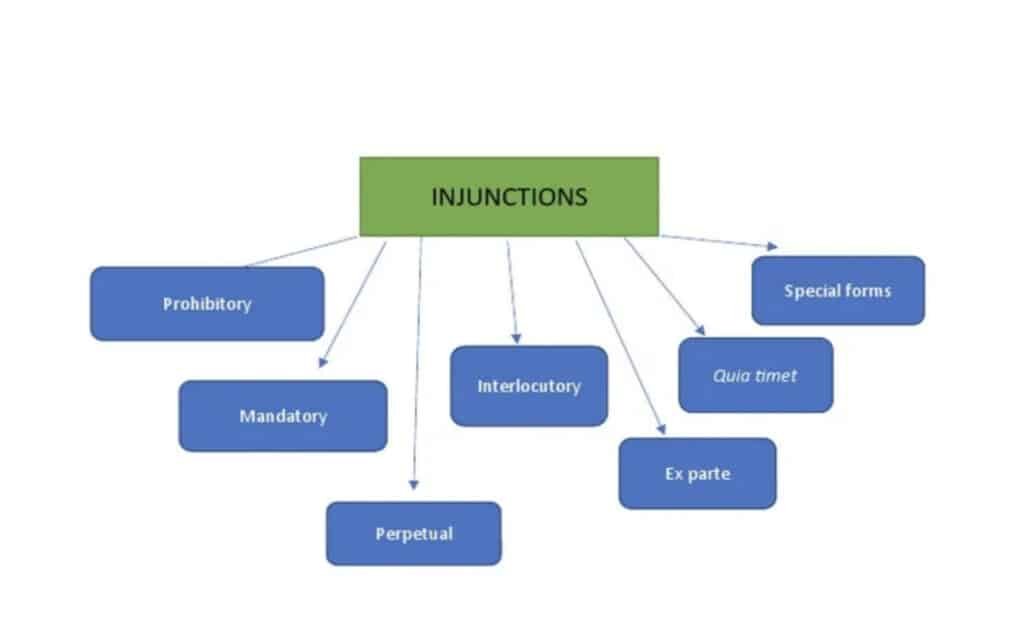
In legal disputes, time plays a crucial role in determining the rights and interests of the parties involved. While civil suits can take a significant amount of time to reach a final decision, there are situations where immediate action is necessary to prevent irreparable harm or prejudice to the subject matter of the suit or the rights of the parties.
To address such situations, the legal system in Bangladesh allows for the granting of interim relief, such as temporary injunctions.
Temporary injunctions serve as a means to protect the interests of the parties until the suit is disposed of or further orders are given by the court. This article provides an in-depth understanding of injunction suits in Bangladesh, exploring their legal framework, principles, and conditions for grant.
The Legal Framework: Order 39 of the Code of Civil Procedure 1908
The provisions governing temporary injunctions in Bangladesh are outlined in Order 39 of the Code of Civil Procedure 1908. Rule 1 of Order 39 establishes the circumstances under which a temporary injunction may be granted.
It states that a temporary injunction may be granted when it is proven, by affidavit or other means, that:
(a) any property in dispute is in danger of being wasted, damaged, or alienated by any party to the suit or wrongfully sold in execution of a decree, or (b) the defendant threatens or intends to remove or dispose of their property with the purpose of defrauding their creditors.
Based on this provision, the court has the power to grant a temporary injunction to restrain such acts or make any other order deemed necessary to prevent wasting, damaging, alienation, sale, removal, or disposition of the property until the suit is disposed of or further orders are issued.
Applying for Temporary Injunctions and Nature of Relief
Typically, the plaintiff is the party that prays for temporary injunctions. However, in appropriate circumstances, the defendant may also seek and obtain an order of temporary injunction against the plaintiff. It is important to note that the relief of temporary injunction is of an equitable nature and is not granted if the party applying for it does not come with clean hands.
Parties Bound by an Order of Injunction
An injunction can only be issued against a party to the suit. However, in certain cases, it may be issued against a person outside the jurisdiction of the court.
On the other hand, an injunction cannot be issued against a stranger who is not a party to the suit or against a court. Government officers exercising their rights in the course of their duty are generally exempt from injunctions, unless bad faith can be established.
An order of injunction is binding on the parties to the suit, as well as their agents or servants. However, individuals who were neither parties to the suit nor named in the injunction order cannot be held liable for violation of the order unless they were aware of its existence and willfully disobeyed it.
Operation and Duration of Temporary Injunctions
A temporary injunction order takes effect from the date it is made, and any party with notice or knowledge of the order is bound by it from that time. Temporary injunctions can be granted until the disposal of the suit or until further orders are given by the court.
The injunction is dissolved when a further order is made or when the suit comes to an end. If the duration of the injunction is not specified or vacated earlier, it terminates when the suit concludes.
Principles Governing the Grant of Injunctions
The court has the authority to impose reasonable terms and conditions on the granting of an injunction. However, these conditions must not make it impossible for the party to comply, thus denying the relief they would otherwise be entitled to. Before granting an injunction, the court must be satisfied with certain aspects:
Prima Facie Case:
The applicant must demonstrate a prima facie case supporting the right claimed. This does not require the case to be proven conclusively but rather that, if the evidence presented is believed, it supports the claimed right. The court does not delve into resolving conflicts of evidence or deciding complex questions of fact and law at this stage. It focuses on whether a possible conclusion can be reached based on the evidence presented.
Actual or Threatened Violation:
The applicant must show an actual or threatened violation of the right claimed. There should be a reasonable apprehension of irreparable or serious damage if the injunction is not granted.
Fair and Honest Conduct:
The applicant’s conduct must be fair and honest. There should be no acquiescence or undue delay in seeking the injunction.
Balance of Inconvenience:
The court considers whether granting the injunction would cause greater inconvenience compared to refusing it. This balance of inconvenience analysis aims to determine the most equitable outcome.
Lack of Equally Efficacious Relief:
The court assesses whether there are alternative means or proceedings available to obtain an equally effective remedy. If such alternatives exist, the injunction may not be granted.
Situations Where Temporary Injunctions Can be Granted
Temporary injunctions can be granted in various circumstances, including:
Protection of Property: When property in dispute is at risk of being wasted, damaged, alienated, or wrongfully sold in execution of a decree.
Defrauding Creditors: If the defendant threatens or intends to remove or dispose of their property to defraud their creditors.
Breach of Contract or Injury: When the defendant is about to commit a breach of contract or cause injury of any kind.
Interest of Justice: When the court determines that the interest of justice necessitates the granting of an injunction, even if the specific situations mentioned above are not applicable.
Instances Where Injunctions Cannot be Granted
Injunctions cannot be granted under certain circumstances, including:
Vague or Indefinite Allegations:
If the allegations made in the application are vague or indefinite, an injunction cannot be issued. The description of the property should be specific and not ambiguous.
Special Enactment: Injunctions cannot be granted in matters covered by provisions in a special enactment.
Interference with Public Duties:
Injunctions should not interfere with the performance of public duties.
Infructuous Orders:
Temporary injunctions cannot be granted when the act sought to be restrained has already been done, rendering the order ineffective.
Important roles played by injunction suit
Injunction suits play a vital role in protecting the rights and interests of parties in legal disputes. In Bangladesh, temporary injunctions serve as interim relief during the pendency of a civil suit, safeguarding against potential irreparable harm or prejudice.
The legal framework provided by Order 39 of the Code of Civil Procedure 1908 governs the granting of temporary injunctions. Courts exercise discretion when deciding whether to grant an injunction, considering factors such as prima facie case, irreparable injury, balance of inconvenience, and the unavailability of equally efficacious relief.
Res judicata precludes complaint injunction:
When res judicata presumptively precludes a lawsuit, no preliminary injunction can be issued. Nonetheless, in a number of decisions it was ruled that, at the interlocutory stage, the court is only to consider whether the plaintiff has raised triable issues and whether there are substantial questions that require investigation.
When there is no uncertainty about the application of res judicata, it cannot be said that the applicant has a prima facie case, according to the argument. On the other hand, if an applicant’s possession was determined in a prior lawsuit, he may be entitled to an injunction based on the prior determination.
Similarly, B cannot obtain a temporary injunction against A if A was determined to be the true proprietor of the disputed property in a previous lawsuit. In light of the earlier ruling in the writ petition that the plaintiff lacked title, his request for a temporary restraining order regarding the subject land is without merit.
Question of maintainability of litigation in temporary injunction application:
It has been held that the court is not required to examine the maintainability of a suit at the time of hearing an injunction matter; this determination is to be made after the filing of a written statement and the formulation of the issue at hand.
In another case, it was held that the maintainability of a lawsuit should not be addressed at the interlocutory stage, especially when evidence will be required at the trial of the lawsuit to correctly decide the issue.
It is argued that the principle is expressed too broadly. It is true that the question of maintainability must be postponed when additional evidence is required to determine the issue, but there may be instances in which the suit is not maintainable and a temporary injunction cannot be issued. A plaintiff cannot have a prima facie case if the lawsuit cannot be maintained ex facie.
Impact of admittance:
In determining an application for temporary injunction, an admission made by a party in a prior proceeding may be considered at face value, and if such an admission destroys the applicant’s case, temporary injunction cannot be granted.
The plaintiff cannot obtain a temporary injunction to safeguard his alleged possession if, according to his own evidence, he transferred the land prior to the completion of his own settlement.
Cohabitation for Injunction Granting:
Circumstances in which a temporary restraining order may be granted:
An order of temporary injunction may be issued if (i) the property in dispute is in danger of being wasted, damaged, alienated, or wrongfully sold in execution of a decree; (ii) the defendant threatens or intends to remove the property to defraud his creditors; (iii) the defendant is about to commit a breach of contract or other injury of any kind; or (iv) the court is of the opinion that the interest of justice so requires.
Property in contention
The property over which an injunction can be issued must be the property that is directly at issue in the lawsuit and no other property, nor property that is indirectly affected by the property at issue. In order to obtain an injunction regarding immovable property, it must be specified in a manner that allows it to be readily identified.
To obtain an injunction, the applicant must have an interest in the disputed property.When the defendant is in possession of the suit property claiming title, he is permitted to alter the nature and character of the property so long as it does not detract from its value.
He is also permitted to construct on the property at his own risk and cannot be restrained. One cannot obtain an injunction to prevent an alleged debtor from disposing of his property.
Injunction in particular performance litigation
Contract of sale does not confer title to the vendee; therefore, a transferee under a sale deed cannot be prevented from enjoying possession of the property by a person alleging to have a prior agreement of sale in his favor.
During the pendency of a suit for specific performance, the defendant may be restrained from conveying the suit property or allowing third parties to construct on it.
It has been determined, however, that in a petition for specific performance, an order of injunction prohibiting alienation is unnecessary because section 52 of the Transfer of Property Act is a sufficient safeguard. Favor by constructing the structure, and the court would not in equity order the structure’s demolition.
Subsequently, the Appellate Division distinguished those cases and ruled that a co-owner cannot continue construction if he possesses more land than his share.
In Hashem Ali v. Begum Nurjahan, 9 MLR, the Appellate Division determined that the principle that in urban areas no co-sharer should be restrained by injunction from constructing is inapplicable when the right to construct is founded on a fraudulent deed.
When one co-owner invites a tenant onto the property without the consent of the other co-owner and the tenant operates a workshop without permission and a license from the Municipal Corporation, the court may prohibit the tenant from operating a workshop on the property.
Steps of an Injunction Suit in Bangladesh:
No.
Aspect
Description
1
Relevant Law
Order 39 of the Code of Civil Procedure 1908 deals with the provisions of Temporary Injunctions in Bangladesh.
2
Purpose
To provide interim relief during the pendency of a civil suit, protecting the rights and interests of the parties involved.
3
Who can apply?
Generally, the plaintiff is the party that prays for a temporary injunction. In certain situations, the defendant may also seek and obtain an order of temporary injunction against the plaintiff.
4
Nature of the relief
The relief of temporary injunction is of an equitable nature. It is not granted if the party applying for it does not come with clean hands.
5
Parties involved
An injunction can be issued only against a party to the suit. In exceptional cases, an injunction may be issued against a person outside the jurisdiction of the court.
6
Injunction against strangers
An injunction cannot be issued against a stranger who is not a party to the suit or against a court. It also does not apply to government officers bona fide exercising their rights or alleged rights in the course of their duty.
7
Binding of the injunction
An order of injunction is binding on the parties to the suit and their agents or servants. However, persons who were not party to the suit nor named in the injunction order cannot be proceeded against for violation of the order.
8
Operation of the injunction
An order of temporary injunction operates from the date it is made, and any party who has notice or knowledge of the order is bound by it. It remains in effect until the disposal of the suit or until further orders from the court.
9
Duration of the injunction
Unless its duration is specified or vacated earlier, an order of temporary injunction terminates as soon as the suit comes to an end. It takes effect upon communication to the party injuncted.
10
Principles governing grant
The grant of a temporary injunction is at the discretion of the court and must be based on sound legal principles. The court must be satisfied that the applicant has a prima facie and arguable case, will suffer irreparable injury or loss without the injunction, and that the balance of inconvenience favors the applicant. The court considers various factors such as the prima facie case, irreparable injury, and balance of inconvenience while granting the injunction.
This table provides a comprehensive overview of the key aspects of injunction suits in Bangladesh, helping to understand the relevant legal provisions and the factors considered by the court when granting temporary injunctions.
How to Hire the best law firm in Bangladesh to initiate your injunction suit in Bangladesh:
Tahmidur Rahman Remura Wahid (TRW) is widely regarded as one of the finest law firms in Bangladesh, and it provides superior legal services to clients who wish to file an injunction suit.
There are numerous reasons why TRW is the best option for individuals and businesses requiring effective legal representation in injunction cases. In the first place, TRW has a team of highly competent and seasoned attorneys who specialize in civil litigation, including injunction cases.
The firm’s attorneys have a comprehensive comprehension of the legal framework surrounding temporary injunctions in Bangladesh, including the pertinent provisions of the Civil Procedure Code of 1908. Their expertise enables them to navigate the complexities of injunction cases with precision and efficiency, guaranteeing their clients the best possible outcome.
The attorneys at TRW have a history of success in injunction cases. They have a thorough understanding of the principles governing the issuance of injunctions and are familiar with the relevant legal precedents and case law. This extensive experience gives them a competitive advantage and enables them to craft persuasive arguments and case-specific strategies.
Additionally, TRW is known for its customer-centric approach. The firm places a premium on gaining a thorough understanding of clients’ objectives, concerns, and priorities. They take the time to attend to their clients and give each case individualized attention.
This client-centered approach enables them to develop effective legal strategies that correspond with their clients’ objectives, protecting their clients’ interests throughout the injunction suit process.
In addition to their legal knowledge, TRW is renowned for its professionalism and honesty. The firm adheres to the utmost ethical standards in all of its dealings, fostering trust and openness between its attorneys and clients.
They maintain open channels of communication, keeping clients apprised of the status of their cases and providing timely counsel and direction. Clients can rely on TRW’s attorneys to provide straightforward assessments of their cases and reasonable expectations, enabling them to make well-informed decisions.
In addition, TRW has established a solid reputation for its commitment to social responsibility. The firm’s dedication to making a positive impact beyond the courtroom is evidenced by its participation in pro bono work and community service.
This commitment to social justice correlates with the values of many clients who seek legal representation from a firm that prioritizes both their individual needs and the general welfare of society.
Tahmidur Rahman Remura Wahid (TRW) is the finest law firm in Bangladesh for pursuing an injunction.
With its team of skilled and seasoned attorneys, client-centered approach, dedication to excellence, and commitment to social responsibility, TRW provides the highest level of legal representation for clients seeking to protect their rights and interests through injunction proceedings.
Whether navigating a complex legal landscape or advocating for the best interests of clients, TRW consistently delivers exceptional results, making it the firm of choice for individuals and businesses in need of expert legal counsel in injunction matters.
GLOBAL OFFICES: DHAKA: House 410, ROAD 29, Mohakhali DOHS DUBAI: Rolex Building, L-12 Sheikh Zayed Road LONDON: 1156, St Giles Avenue, 330 High Holborn, London, WC1V 7QH