Nonbank Financial institutions in Bangladesh, MicroFinance and NBFI formation in Bangladesh:
Nonbank Financial Institutions (NBFIs) in Bangladesh have played an important part in the country’s financial system (NBFI formation in Bangladesh). Due to the rapidly growing
need for long-term finance and equity-type services, this sector has evolved as an increasingly vital component of the financial system. NBFIs offered differentiation to Bangladesh’s bank-based financial market.
Parallel to the saturation of the banking industry, the emergence of NBFIs has ushered in a new chapter of strengthening the country’s financial system. Consequently, this sector has emerged as a key participant in preserving the health of our financial and economic sectors.
In recent years, NBFIs have experienced rapid growth, which reflects the significance of financial innovation and holds the prospect of enhancing financial intermediation through meeting long-term financing demands.
A nonbank financial institution (NBFI) is a financial institution that lacks a full banking license and is therefore unable to take public deposits. NBFIs facilitate alternative financial services, including collective and individual investments, risk sharing, financial advice, brokerage, money transmission, and check cashing.
NBFIs serve as a conduit for consumer credit (along with licensed banks). Insurance companies, venture capitalists, currency exchanges, certain microlending groups, and pawnshops are examples of nonbank financial institutions. These non-bank financial firms offer services that are not necessarily fit for banks, compete with banks, and specialize in particular industries or groups. (NBFI formation in Bangladesh)
Risk pooling institutions and Insurance Firms
Insurance firms underwrite economic risks related to mortality, disease, property damage or loss, and other types of loss. They offer a contingent guarantee of financial protection in the event of a loss. Life insurance and general insurance firms are the two most common categories of insurers. General insurance contracts are often short-term, but life insurance contracts are lengthier and terminate upon the insured’s death.
Life and property insurance are accessible to all segments of the population. Due to the nature of the insurance sector (companies must access a vast amount of information to assess the risk in each instance), insurance companies enjoy a high level of information efficiency.
Life insurance firms insure against financial loss resulting from the insured’s untimely death. Each term, the insured will pay a specified amount as an insurance premium. Because the likelihood of mortality grows with age but premiums remain constant, the insured overpays in the beginning and underpays in the end.
The overpayment made during the first few years of the contract represents the monetary worth of the insurance policy. (NBFI formation in Bangladesh)
Two subcategories comprise general insurance: market and social insurance. Social insurance protects against the risk of income loss resulting from unemployment, disability, disease, or natural calamities.
Due to the unpredictability of these risks, the ease with which the insured can conceal relevant information from the insurer, and the presence of moral hazard, private insurance companies frequently do not offer social insurance, leaving a void in the insurance industry that is typically filled by the government.
In industrialized Western societies, social insurance is more prevalent than family networks and other organic social support organizations.
Market insurance is a form of property insurance that has been privatized. Insurance providers accept a single premium payment. In exchange, the insurance companies will make a defined amount contingent on the insured event. Examples include burglary, fire, property destruction, and natural disasters.
Contractual institutions for savings
Contractual savings institutions (also known as institutional investors) enable individuals to invest in collective investment vehicles in a fiduciary capacity as opposed to a principal capacity. Collective investment vehicles invest the pooled funds of individuals and businesses in a variety of equities, debt, and derivatives securities. However, the individual has equity in the CIV itself as opposed to the specific investments made by the CIV. Mutual funds and private pension plans are the two most prevalent instances of contractual savings institutions.
Open-end and closed-end mutual funds are the two most common varieties. Open-ended mutual funds generate fresh investments by permitting the public to purchase more shares at any time. Shareholders may liquidate their holdings by selling their shares back to the open-ended fund at the net asset value.
In an IPO, closed-end funds issue a specified number of shares. By selling their shares on a stock exchange, the shareholders capitalize on the value of their holdings.
One can categorize mutual funds according on the nature of their investments. Some funds, for instance, invest in high-risk, high-return assets, while others concentrate on tax-exempt securities. Others focus on speculative trading (hedge funds), a particular industry, or cross-border investments.
Pension funds are mutual funds that restrict the investor’s access to their investment until a specified date in the future. In exchange, pension funds receive substantial tax incentives to encourage the working population to set aside a portion of their present income for a time when they are no longer employed (retirement income).
Other nonbank financial institutions
Market makers are broker-dealer institutions that quote purchase and sell prices for an inventory-held item. Among these assets are stocks, government and corporate debt, derivatives, and foreign currencies (NBFI formation in Bangladesh). The market maker instantly sells from its inventory or makes a buy to offset the inventory loss upon receiving an order.
The bid-offer spread, or the gap between the purchasing and selling bids, is how the market maker generates a profit. Market makers enhance the liquidity of any asset in their stock.
Specialized sectoral financiers offer a limited array of financial services to a certain industry. For instance, leasing businesses provide funding for equipment, whereas real estate financiers give prospective homeowners with access to funds. Leasing businesses have two distinct benefits over other sector-specific specialized financiers. Because they possess the leased equipment as part of their collateral agreement, they are partly shielded against the danger of default.
In addition, leasing companies enjoy favorable tax treatment on their equipment investments.
Other providers of financial services include mortgage and securities brokers, management consultants, and financial advisors. They charge a fee for their services. The majority of financial service providers enhance the investor’s informational efficiency. In the case of brokers, however, they do provide a service that enables investors to liquidate existing assets.
NBFI’s role in the economic system
NBFIs augment banks in providing individuals and businesses with financial services. They can present banks with competition in the supply of these services. While banks may offer a collection of financial services as a bundle, NBFIs unbundle these services and customise their offerings to specific populations.
Individual NBFIs may also specialize in a particular industry, so acquiring an informational advantage. By unbundling, targeting, and specializing, NBFIs increase competition in the financial services sector.
A financial system that incorporates non-bank financial institutions can insulate economies against financial shocks and allow them to recover from them. NBFIs offer several options for converting an economy’s savings into capital investments, which serve as backup facilities in the event that the primary form of intermediation fails.
However, in countries where adequate regulations are lacking, non-bank financial institutions (NBFI formation in Bangladesh) can increase the financial system’s fragility. Even though not all NBFIs are weakly regulated, those that make up the shadow banking system are. In the run-up to the recent global financial crisis, regulators mainly ignored entities such as hedge funds and structured investment vehicles, focusing instead on pension funds and insurance firms.
If a significant portion of the financial system consists of NBFIs that operate largely unchecked by government regulators and anybody else, the entire system’s stability may be at stake. Weaknesses in NBFI regulation can feed a credit bubble and asset overpricing, followed by a collapse in asset prices and loan defaults.
Integration of banks and non-banks and supervisory integration
The banking, securities, and insurance markets have grown increasingly interconnected, and inter-market connections are expanding rapidly. In response, one of the most significant changes in financial sector regulation over the past two decades has been a shift from the traditional sector-by-sector approach to supervision (with separate supervisors for banks, securities markets, and insurance companies) to a greater cross-sector integration of financial supervision (ihák and Podpiera, 2008). This has a significant impact on monitoring and regulation practices worldwide.
A three-pillar or “sectoral” model (banking, insurance, and securities), a two-pillar or “dual peak” model (prudential and business behavior), and an integrated model are utilized globally (all types of supervision under one roof).
According to the World Bank’s Bank Regulation and Supervision Survey, one of the most noteworthy trends of the previous decade has been a shift from the three-pillar model to either the two-pillar model or the integrated model (with the twin peak model gaining traction in the early 2000s). In a recent study, Melecky and Podpiera (2012) examined the drivers of supervisory structures for prudential and business conduct supervision over the past decade in 98 countries.
They discovered, among other things, that countries progressing to a higher stage of economic development tend to integrate their supervisory structures, small open economies tend to opt for more integrated supervisory structures, and financial deepening causes countries to integrate supervision progressively more. (The relevant information on the framework of supervision is accessible at https://www.worldbank.org/en/publication/gfdr.)
How do these diverse institutional systems compare with regard to the occurrence of crises and the mitigation of their effects? Cross-country regressions utilizing data from a large number of emerging and established economies provide some evidence in support of the twin peak model and against the sectoral model (Cihák and Podpierer, 2008).
During the global financial crisis, several twin peak jurisdictions (especially Australia and Canada) have been comparatively untouched, but the United States, a jurisdiction with a fractionalized sectoral approach to supervision, has been at the center of the crisis.
However, the crisis experience is anything but black and white, since the Netherlands, one of the twin peaks model’s instances, was involved in the bankruptcy of Fortis, one of the largest European bank failures. It is too early to draw a definitive conclusion, and it is notoriously difficult to separate the effects of supervisory architecture from other consequences.
The major difference between banks and NBFIs are as follows (NBFI formation in Bangladesh):
Basis for Comparison
NBFI
Bank
Incorporated under
Financial Institution Act, 1993
Bangladesh Bank Order, 1972.
Demand Deposit
Not Accepted
Accepted
Foreign Investment
Allowed up to 100%
Allowed up to 74% for private sector banks
Payment and Settlement system
Not a part of system.
Integral part of the system.
Maintenance of Reserve ratios
Not required
Compulsory
Deposit insurance facility
Not available
Available
Credit creation
Not a part of system.
Integral part of the system.
Transaction services
Not required
Compulsory
Exiting NBFI’s in Bangladesh:
Agrani SME Financing Company Limited
Bangladesh Finance & Investment Company Limited
Bangladesh Industrial Finance Company Limited
Bangladesh Infrastructure Finance Fund Limited
Bay Leasing & Investment Limited
CAPM Venture Capital and Finance Limited
Delta Brac Housing Finance Corporation Limited
Fareast Finance & Investment Limited
FAS Finance & Investment Limited
First Finance Limited
GSP Finance Company (Bangladesh) Limited
Hajj Finance Company Limited
IDLC Finance Limited
Industrial and Infrastructure Development Finance Company Limited
Industrial Promotion and Development Company of Bangladesh Limited
Infrastructure Development Company Limited
International Leasing and Financial Services Limited
Islamic Finance and Investment Limited
Lanka Bangla Finance Limited
Meridian Finance and Investment Limited
MIDAS Financing Limited
National Finance Limited
National Housing Finance and Investments Limited
People’s Leasing and Financial Services Limited
Phoenix Finance and Investments Limited
Premier Leasing & Finance Limited
Prime Finance & Investment Limited
Reliance Finance Limited
Regulatory Authority of NBFI in Bangladesh:
The Bangladesh Bank is the regulatory body for both banking and non-banking financial institutions including for NBFI formation in Bangladesh. Bangladesh Bank is the Central Bank of Bangladesh, which was formed on December 16, 1971 by Bangladesh Bank Order 1972-President’s Order No. 127 of 1972. (Amended in 2003, NBFI formation in Bangladesh).
The general supervision and control of Bangladesh Bank’s affairs and business have been assigned to a nine-member Board of Directors led by the Governor, who is also the institution’s chief executive officer. There are 45 departments and 10 branch offices at Bangladesh Bank.
Bangladesh Bank’s vision is stated in its Strategic Plan (2010-2014):
“To develop continuously as a forward-looking central bank with competent and committed professionals of high ethical standards, conducting monetary management and financial sector supervision to maintain price stability and financial system robustness, supporting rapid broad-based inclusive economic growth, employment generation, and the eradication of poverty in Bangladesh.”
1. to formulate and implement monetary policy;
2. to formulate and implement intervention policies in the foreign exchange market;
3. to advise the Government on the interaction of monetary policy with fiscal and exchange rate policy, on the impact of various policy measures on the economy, and to propose legislative measures it deems necessary or appropriate to attain its objectives.
4. to keep and administer Bangladesh’s official foreign reserves; 5. to promote, regulate, and guarantee a secure and effective payment system, including the issuance of bank notes.
5. to monitor and oversee financial institutions and banking institutions.
The Key functions of Bangladesh Bank on NBFI in Bangladesh:
The primary responsibilities of this department are outlined below:
The Financial Institutions Act of 1993 authorizes the issuance of licenses for the establishment of new nonbank financial institutions and branches of existing nonbank financial institutions.
Formulation of prudential regulations to ensure the soundness of nonbank financial institutions.
Corporate governance is ensured through the monitoring of NBFI activities.
Conducting off-site supervision of NBFIs by routinely collecting, evaluating, and monitoring a variety of data/information to ensure compliance with policies, regulations, and practices.
Evaluation of the financial and management health of NBFIs using the CAMEL rating and assessment of their potential to absorb shocks using stress testing.
Evaluation and oversight of the financial instruments issued by NBFIs, including Zero Coupon Bonds, Asset-backed Securitization Bonds, etc.
BASEL Accord implementation in NBFIs to achieve risk-based capital adequacy.
In Bangladesh, NBFIs were established under the Companies Act of 1913 and were governed by the rules of Chapter V of the Bangladesh Bank Order of 1972. The ‘Financial Institution Act, 1993’ and the ‘Financial Institution Regulation, 1994’ were enacted in 1993 and 1994, respectively, to address the regulatory void and broad scope of operations to be covered by NBFIs (NBFI formation in Bangladesh), respectively. The Financial Institutions Act of 1993 licenses and regulates nonbank financial institutions.
There are 34 NBFIs authorized under this act. According to the Financial Institution Regulation, 1994, the minimum paid-up capital for NBFIs is now one billion Taka.
Twenty-one NBFIs have raised money by issuing IPOs, whereas three are exempt from launching IPOs. Other significant sources of funding for NBFIs include term deposits, credit facilities from banks and other NBFIs, call money, bonds, and securitization. Compared to banks in Bangladesh, the business focus of NBFIs is limited. Currently, NBFIs operate as multi-product financial institutions.
Sector Performance of NBFIs and Business Expansion
Outreach: Currently, three of the thirty-one NBFIs are government-owned, ten are joint ventures, and the remainder are privately owned. As of 30 June 2012, the branch network expanded to 164 locations. There are no NBFIs established outside of Bangladesh.
In 2011 and 2012, the asset base of NBFIs rose significantly. 2011 saw a gain of 14.7% in aggregate industrial assets, from Taka 251.5 billion in 2010 to Taka 288.4 billion in 2011. The growth rate for 2012 is likely to exceed that of 2011. By the end of June 2012, total assets had grown to 309 billion Taka (NBFI formation in Bangladesh).
NBFIs invest in several economic sectors, however their investments are primarily concentrated in the industrial sector. In June 2012, the various industries in which NBFIs invested were industry (42.6%), real estate (18.5%), margin loans (8.0%), trade and commerce (10.4%), merchant banking (1.4%), farm sector (1.3%), and others (others) (17.8 percent)
Liabilities and Equity:
The industry’s aggregate liability climbed to Taka 235.7 billion in 2011 from Taka 206.8 billion in 2010, while equity increased to Taka 52.7 billion in 2011 from Taka 44.7 billion in 2010, representing increases of 14.0 and 17.9 percent, respectively. At the end of June 2012, total liabilities and equity amounted to 252,2 billion Taka and 56,8 billion Taka, respectively.
The total deposits of NBFIs increased by 19.3 percent, from Taka 94.4 billion (45.7 percent of total liabilities) in 2010 to Taka 112.6 billion (47.8 percent of total liabilities) in 2011. On 30 June 2012, total deposits reached 124,2 billion taka (49.2 percent of total liabilities).
INSTRUCTIONS FOR ESTABLISHING A NONBANK FINANCIAL INSTITUTION:
The Financial Institution Act of 1993 and the Financial Institution Regulations of 1994 govern the prerequisites and process for establishing a financial institution (NBFI formation in Bangladesh).
Before creating a financial institution in Bangladesh, the following actions must be taken:
i) Obtain name clearance from Bangladesh Bank ii) Shareholder or Director Personal Information iii) Form a Memorandum and obtain Bangladesh Bank’s permission. iv). Apply for Registration of the proposed firm at the Registrar of Joint Stock Companies (RJSC) under the Companies Act, 1994, as a Public Limited Company by providing all the pertinent documents and government fees, and acquire a Certificate of Incorporation from RJSC. v) License from Bangladesh Bank vi) Acquire a VAT, TIN certificate from the National Board of Revenue and a business license from the city government.
Bangladesh Bank has complete authority over whether or not to give any license. Prior to issuing a license, Bangladesh Bank may consider the financial condition of the applicant, management qualities, capital and future earnings prospects, objectives outlined in the memorandum of association, and whether the establishment of the financial institution is in the public’s best interest.
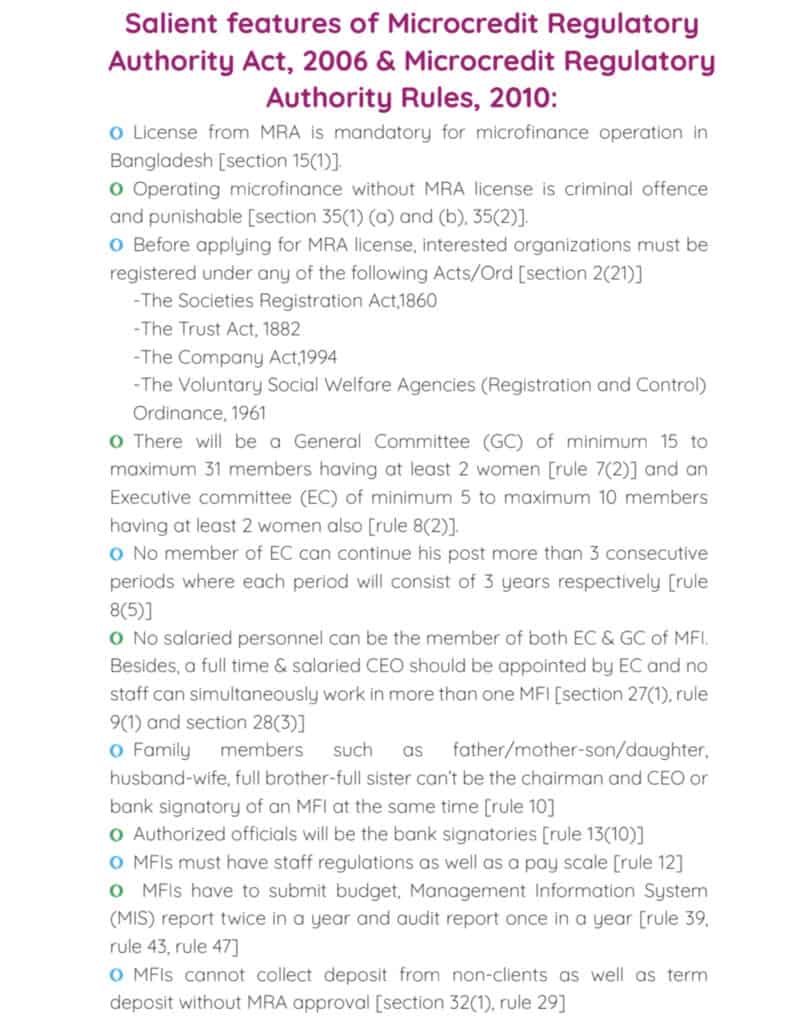
In addition, specific legislative requirements must be met in order to form a non-governmental organization/NGO. Micro Finance Institution NGSOs (MFI-NGO) are NGOs that engage in microcredit operations; a license is required from the Micro Credit Regulatory Authority (MRA) under the MRA Act 2006 to operate such a program.
This organization’s mission is to reduce poverty, create employment opportunities, and aid aspiring small business owners.
Legal issues related to NBFI and NBFI formation in Bangladesh:
As stated previously, the difficulties of the banking business are not limited to the incorporation procedure. The difficulties also extend to the operational role. To successfully operate in this field without experiencing any legal repercussions, one must be knowledgeable of its legal issues.
The proprietors of a financial institution must comply with the banking regulations and the legislation applicable to their institution in order to avoid penalties.
Despite the fact that both banks and non-banking financial institutions are considered financial institutions, their incorporation, operation, regulation, and methodology are separate.
This implies that all financial institutions are banks, but not all banks are financial institutions. Therefore, when a person decides to form his institution, he must comply with the Bank Companies Act 1991 and the Guidelines to establish a banking company in Bangladesh in the case of a bank, or the Financial Institution Act 1993 and the Financial Institution Regulation 1994 in the case of a non-banking financial institution.
In the Bangladeshi banking industry, dishonor of checks is a fairly regular issue. As per the Negotiable Instruments Act, a person or business must never pay another person with a bank cheque for an amount that exceeds the balance remaining in his bank account or there were insufficient funds in his bank account to cover the cheque. Otherwise, he would be subject to imprisonment or a fine of up to three times the amount of the cheque, or both.
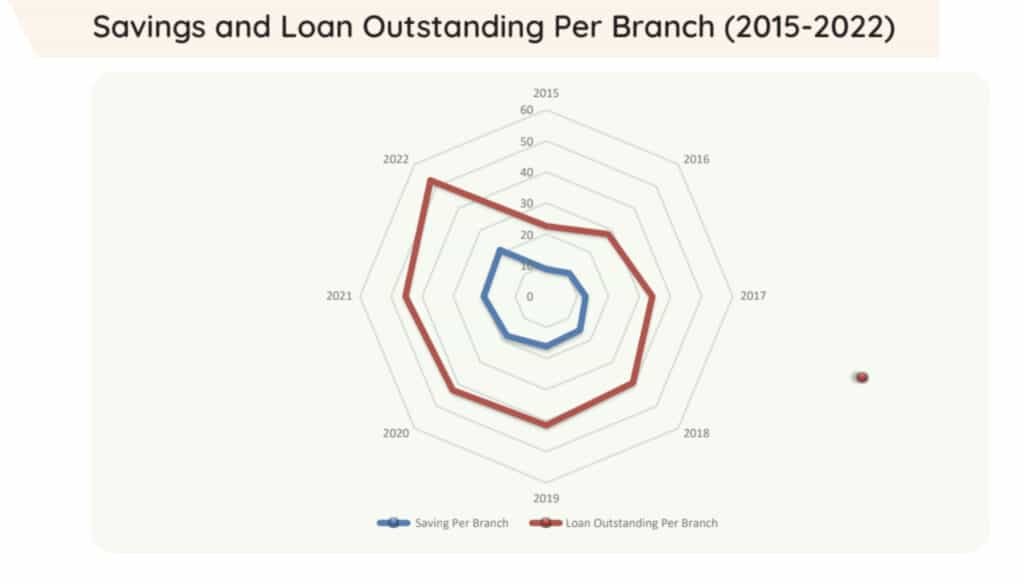
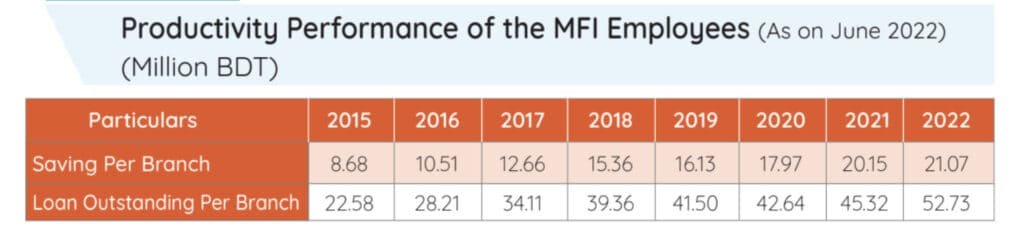
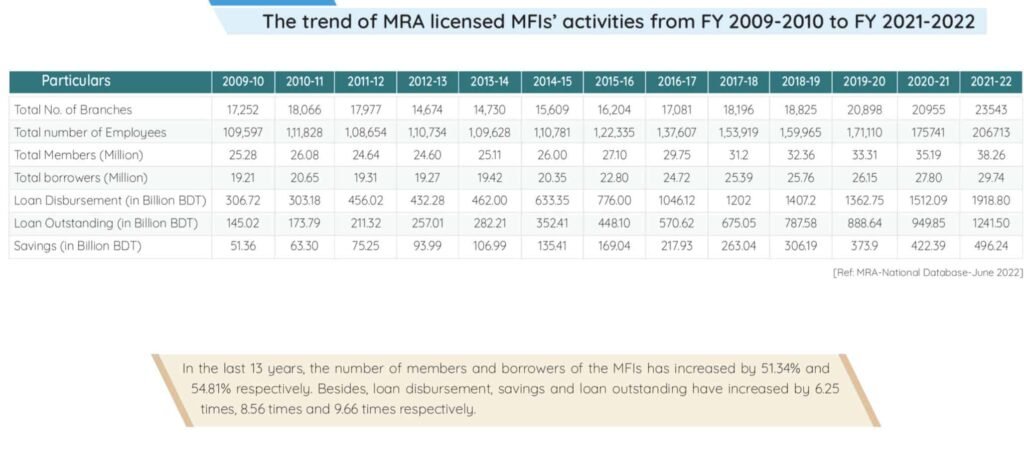
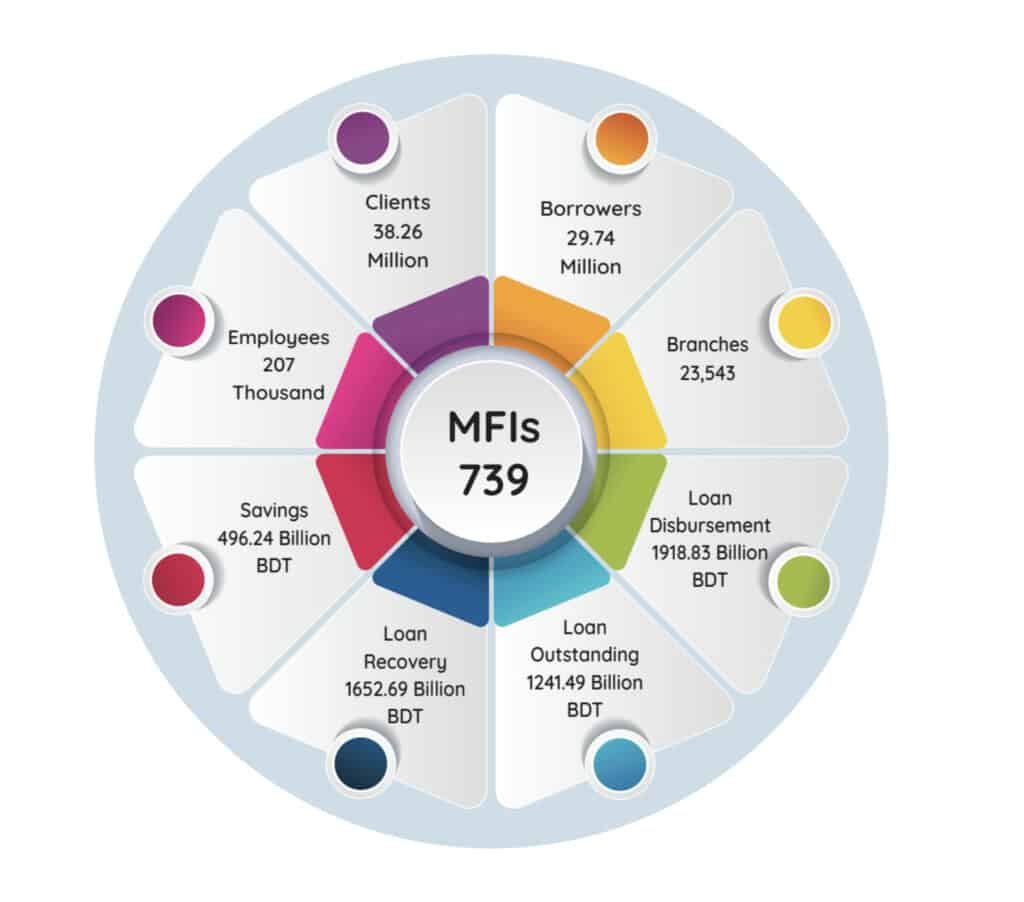
It is possible to gain insight into microcredit performance by tracing the link between branch staf and the savings, loan disbursement, and loan outstanding cycle observed at the branch level.
From 2015 to 2023 , productivity as measured by the savings-to-loan ratio increased, while client-to-staf and borrower-to-staf ratios showed small changes.
In June 2023 , the client-to-employee ratio was 183, while the borrower-to-employee ratio was 141. In addition, it was noticed that a disproportionate amount of MFI employees were stationed in the headquarters.
Because of their larger size, larger MFIs place a heavier strain on their headquarters, which is responsible for things like system administration and lending management.
A signiûcant chunk of each branch’s workforce is dedicated to accounting and other operationalactivities, and all employees work relentlessly to increase their branch’s recovery rate.
Increasing the number of field employees per branch can help MFIs increase their loan disbursement rate, which in turn reduces the amount of resources spent on collection and debt recovery.
Bangladesh bank has the authority to suspend or freeze transactions of any account, to issue necessary directions from time to time to the reporting organizations for the prevention of money laundering, to monitor whether directions imposed on the reporting organizations have been complied with and, if necessary, to conduct on-site inspections to determine the same, to impose fines/suspend license of the reporting agency for failing to provide information in a timely fashion, etc.
Whenever there is a foreign transaction between parties, banking laws must be observed. According to the Foreign Exchange Regulation Act of 1947, it is illegal for anyone other than an authorized dealer, a bank authorized by the Bangladesh Bank to deal in foreign exchange, to buy or borrow from, sell or lend to, or exchange foreign exchange with a person who is not an authorized dealer.
This will demonstrate that the investment was made through the proper channels, and when remitting the profit, these initial investment paperwork and information will facilitate a smooth transfer in accordance with Bangladesh Bank regulations.
Legal process of establishing a Non-bank Financial institution in Bangladesh:
The Financial Institution Act of 1993 and the Financial Institution Regulations of 1994 govern the prerequisites and process for establishing a financial institution.
Before creating a financial institution in Bangladesh, the following actions must be taken:
i) Obtain name clearance from Bangladesh Bank ii) Shareholder or Director Personal Information iii) Form a Memorandum and obtain Bangladesh Bank’s permission. iv. Apply for Registration of the proposed firm at the Registrar of Joint Stock Companies (RJSC) under the Companies Act, 1994, as a Public Limited Company by providing all the pertinent documents and government fees, and acquire a Certificate of Incorporation from RJSC. v) License from Bangladesh Bank vi) Acquire a VAT, TIN certificate from the National Board of Revenue and a business license from the city government.
Bangladesh Bank has complete authority over whether or not to give any license. Prior to issuing a license, Bangladesh Bank may consider the financial condition of the applicant, management qualities, capital and future earnings prospects, objectives outlined in the memorandum of association, and whether the establishment of the financial institution is in the public’s best interest.
In addition, specific legislative requirements must be met in order to form a non-governmental organization/NGO. In regards to NBFI formation in Bangladesh, Micro Finance Institution NGSOs (MFI-NGO) are NGOs that engage in microcredit operations; a license is required from the Micro Credit Regulatory Authority (MRA) under the MRA Act 2006 to operate such a program. This organization’s mission is to reduce poverty, create employment opportunities, and aid aspiring small business owners.
Legal issues in regards to NBFI formation in Bangladesh:
As stated previously, the difficulties of the banking business are not limited to the incorporation procedure. The difficulties also extend to the operational role. To successfully operate in this field without experiencing any legal repercussions, one must be knowledgeable of its legal issues. The proprietors of a financial institution must comply with the banking regulations and the legislation applicable to their institution in order to avoid penalties. Despite the fact that both banks and non-banking financial institutions are considered financial institutions, their incorporation, operation, regulation, and methodology are separate.
This implies that all financial institutions are banks, but not all banks are financial institutions. Therefore, when a person decides to form his Institution, he must comply with the Bank Companies Act 1991 and the Guidelines to establish a banking company in Bangladesh in the case of a bank, or the Financial Institution Act 1993 and the Financial Institution Regulation 1994 in the case of a non-banking financial institution.
In the Bangladeshi banking industry, dishonor of checks is a fairly regular issue. As per the Negotiable Instruments Act, a person or business must never pay another person with a bank cheque for an amount that exceeds the balance remaining in his bank account or there were insufficient funds in his bank account to cover the cheque.
Otherwise, he would be subject to imprisonment or a fine of up to three times the amount of the cheque, or both.
Bangladesh bank has the authority to suspend or freeze transactions of any account, to issue necessary directions from time to time to the reporting organizations for the prevention of money laundering, to monitor whether directions imposed on the reporting organizations have been complied with and, if necessary, to conduct on-site inspections to determine the same, to impose fines/suspend license of the reporting agency for failing to provide information in a timely fashion, etc.
Whenever there is a foreign transaction between parties, banking laws must be observed. According to the Foreign Exchange Regulation Act of 1947 (NBFI formation in Bangladesh), it is illegal for anyone other than an authorized dealer, a bank authorized by the Bangladesh Bank to deal in foreign exchange, to buy or borrow from, sell or lend to, or exchange foreign exchange with a person who is not an authorized dealer. (NBFI formation in Bangladesh)
This will demonstrate that the investment was made through the proper channels, and when remitting the profit, these initial investment paperwork and information will facilitate a smooth transfer in accordance with Bangladesh Bank regulations for NBFI formation in Bangladesh.
FAQ about MRA in Bangladesh:
Here’s a table of 10 frequently asked questions about the Micro-credit Regulatory Authority (MRA) and the requirements for establishing a Non-Banking Financial Institution (NBFI) in Bangladesh:
Question
Answer
What is the Micro-credit Regulatory Authority (MRA)?
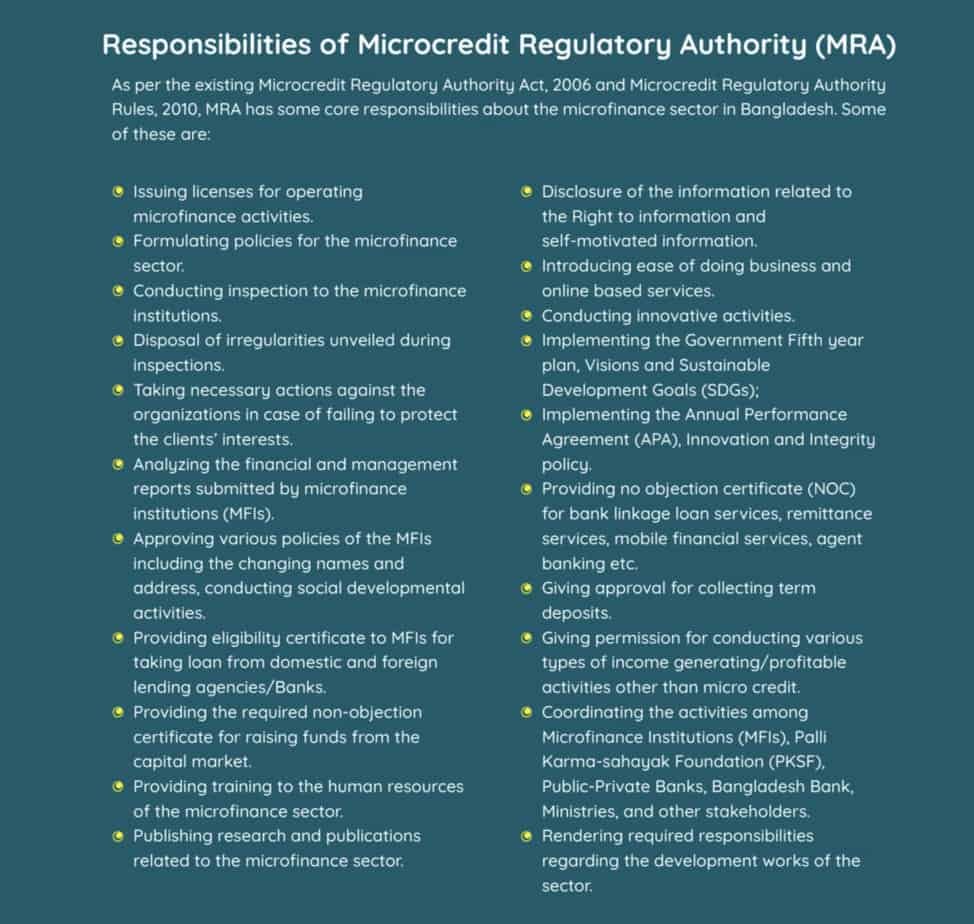
The MRA is the regulatory body responsible for overseeing the micro-credit and micro-finance sector in Bangladesh. The MRA was established under the Micro-credit Regulatory Authority Act, 2006 and is responsible for ensuring that the micro-credit and micro-finance institutions in Bangladesh operate in a fair, transparent and sustainable manner.
According to the Financial Institution Act 1993 and the Financial Institution Regulation 1994, entities interested in establishing an NBFI in Bangladesh must comply with the following requirements:
1. The minimum paid-up capital must be BDT 1 Billion. 2. The company must have a minimum of five directors. 3. The company must have a registered office in Bangladesh. 4. The company must appoint a CEO, who is a Bangladeshi citizen. 5. The company must submit an application to the MRA for approval. 6. The company must comply with the Bangladesh Bank regulations for NBFI formation in Bangladesh.
What is a Micro-credit organisation in Bangladesh under MRA act 2006?
Micro Credit Organisation means any micro credit organization, in whatever name it is called, certified to operate run micro credit program under this Act, (and) registered under —
(a) The Societies Registration Act, 1860 (Act XXI of 1860); (b) The Trust Act, 1882 (Act II of 1882); (c) The Voluntary Social Welfare Agencies (Registration and Control) Ordinance, 1961 (Ord. No XL VI of 1961); (d) Samabaya Samity Ain (cooperative societies act) (Act no 47 of 2001); or (e) Company Ain (company act) (act 18 of 1994).
“Micro Credit” means loan facilities offered by micro credit organization certified under this Act for poverty alleviation, employment generation and facilitate a small entrepreneur. Domination of the Act — Whatever is laid down in other laws valid for the present, the regulations of this Act shall be enforced.
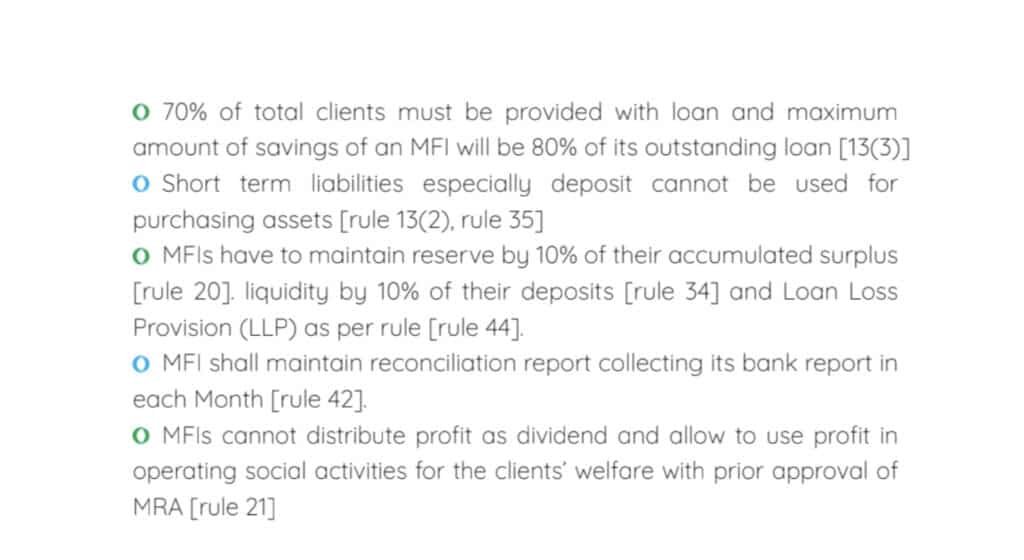
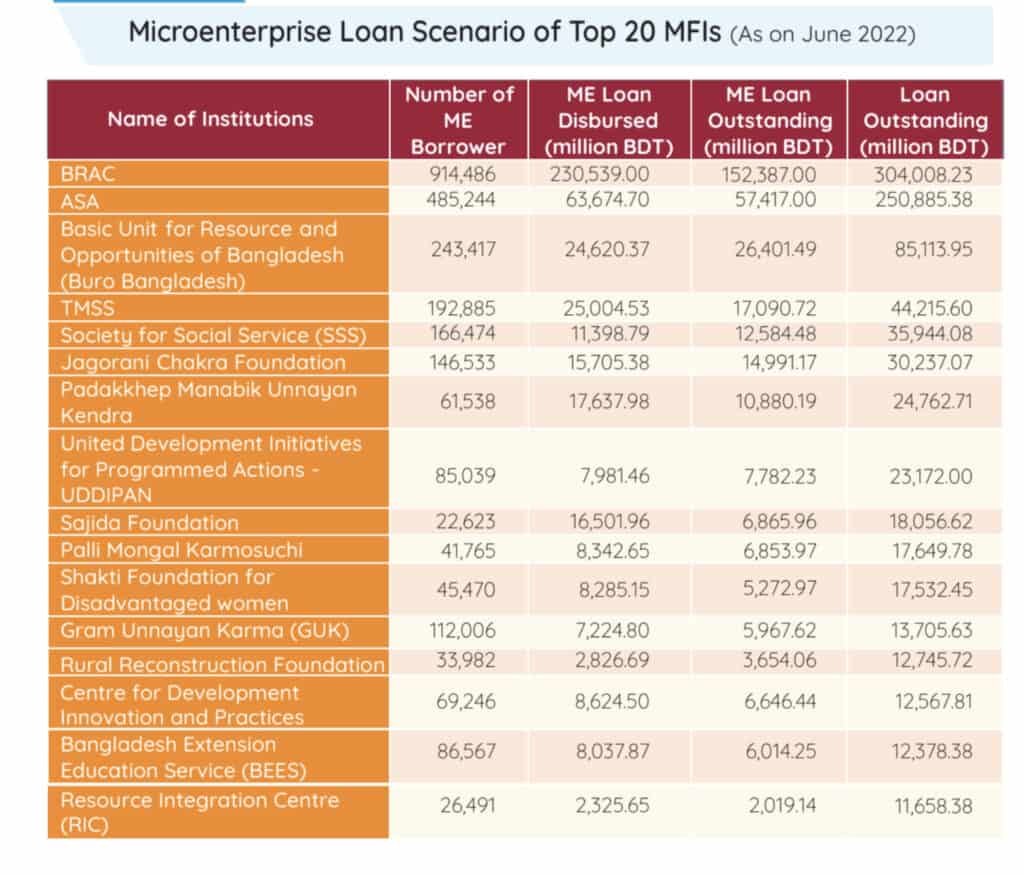
How much MFI’s can can disburse micro-enterprise loans and what is the the mandatory liquidity reserve ?
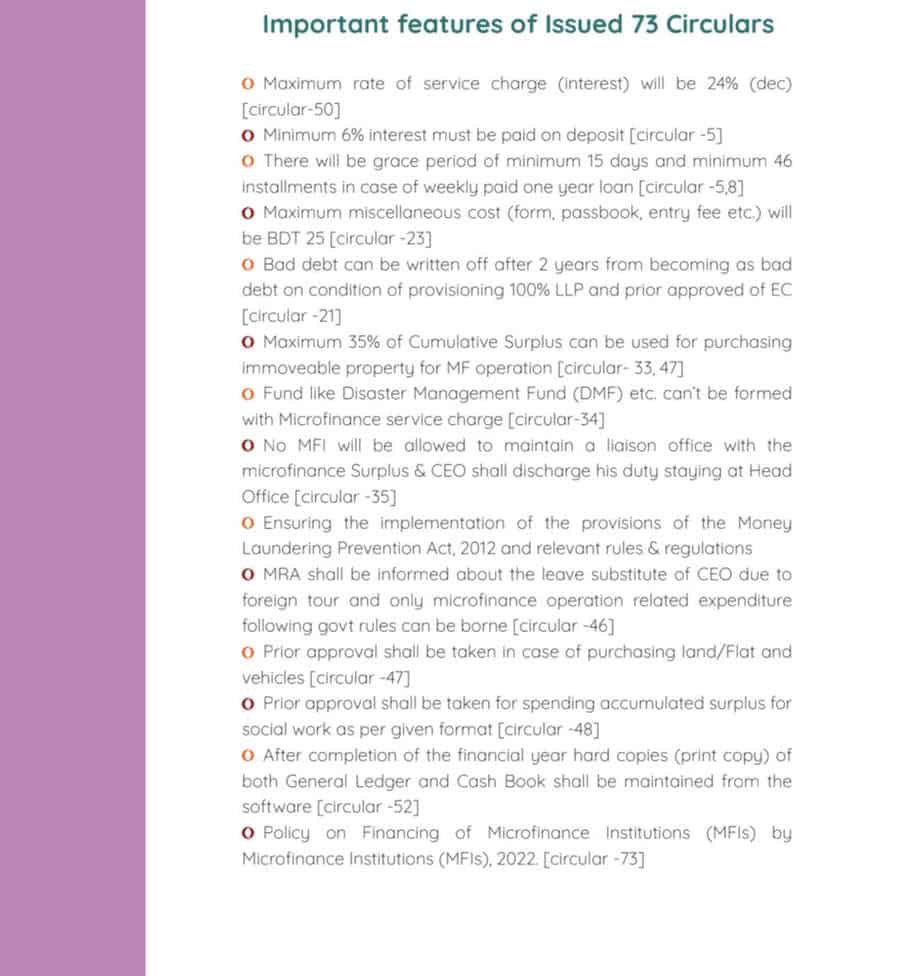
In accordance with this, the Microcredit Regulatory Authority, Bangladesh’s regulatory body for the microfinance sector, recently rolled out its policy incentives for the microfinance sector by amending several rules of the existing Microcredit Regulatory Authority Rules, 2010.
According to the amendments, the mandatory liquidity reserve of MRA-licensed MFIs has been reduced from 15% to 10%. MFIs can now disburse microenterprise loans up to 60% of their total business portfolio, up from 50% previously, and can draw 50% of their capital from term deposits and 40% from voluntary deposits. This policy change is expected to inject additional funds into the microfinance sector, thereby stimulating rural economic growth.
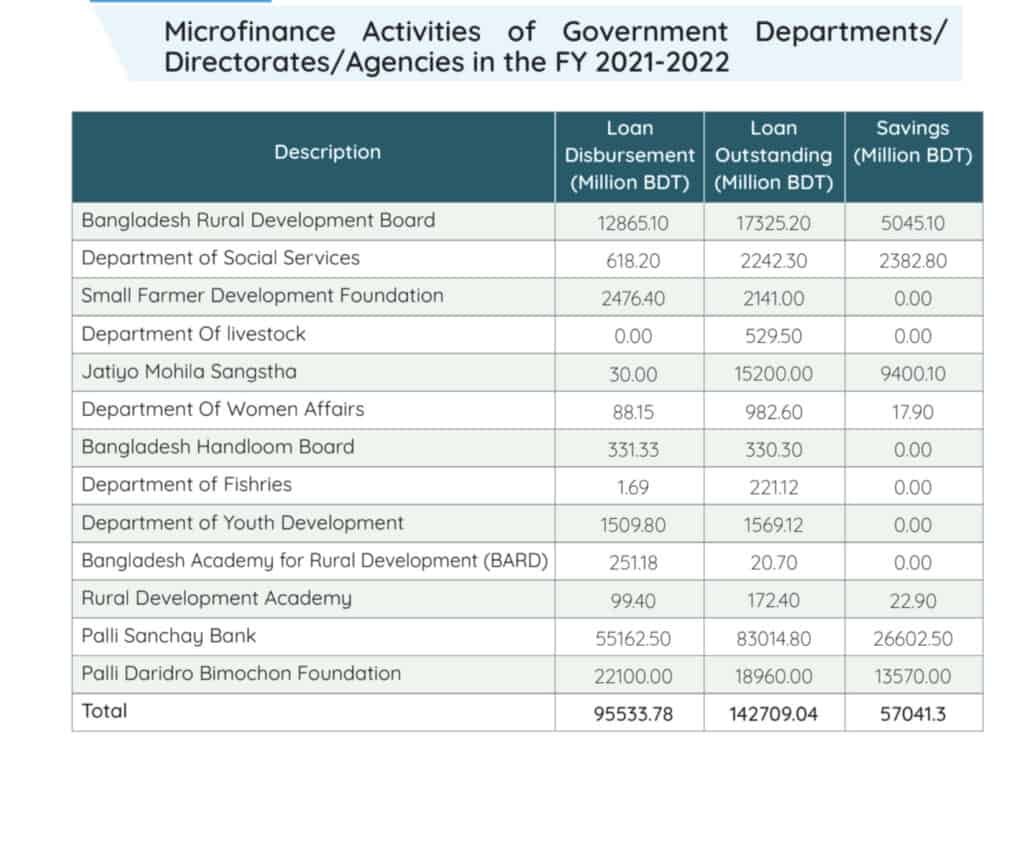
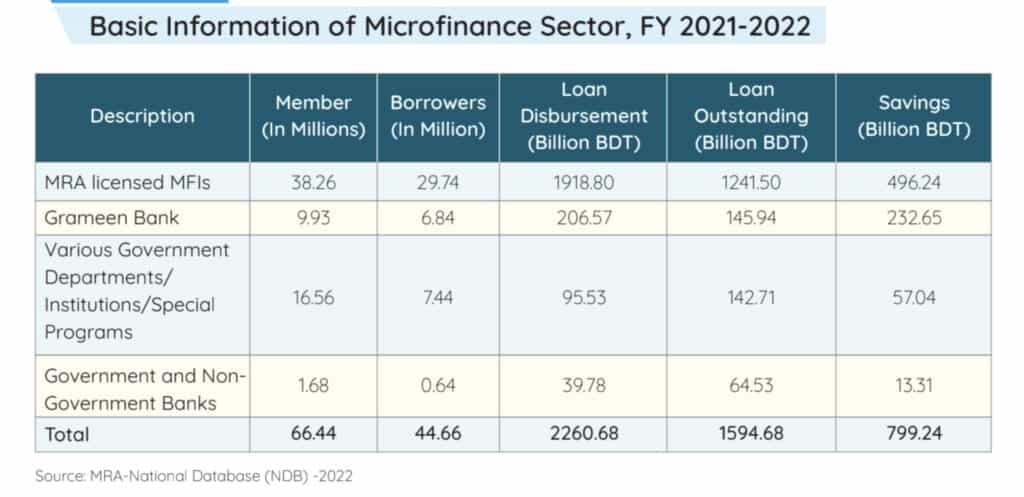
In Bangladesh, the microfinance sector is comprised of MRA-licensed MFIs, various banks and non-bank financial institutions, Grameen Bank, and various government agencies under various ministries. Along with MRA-licensed MFIs, these organizations provide microcredit to help people get out of poverty.
This microfinance sector has become a model of financial inclusion, with 66.447 million members and 44.66 million borrowers. The loan outstanding and loan disbursement of the microfinance sector in FY 2021-22 were BDT 1594.68 billion and BDT 2260.68 billion, respectively, with MRA licensed MFIs contributing 77.90% and 84.90%.
What is the role of Bangladesh Bank in NBFI formation?
Bangladesh Bank is the central bank of Bangladesh and plays a crucial role in the formation of NBFIs. Bangladesh Bank is responsible for ensuring that all NBFIs comply with the Bangladesh Bank regulations for NBFI formation and operate within the guidelines set out by the Financial Institution Act 1993 and the Financial Institution Regulation 1994.
What is the Negotiable Instruments Act in Bangladesh?
The Negotiable Instruments Act is a legislation in Bangladesh that governs the issuance and payment of negotiable instruments, such as cheques.
According to this act, a person or business must never pay another person with a bank cheque for an amount that exceeds the balance remaining in his bank account or there were insufficient funds in his bank account to cover the cheque.
What is the Money Laundering Prevention Act of 2012?
The Money Laundering Prevention Act of 2012 is a legislation in Bangladesh aimed at preventing and combating money laundering and terrorist financing activities in Bangladesh. The Bangladesh Financial Intelligence Unit is responsible for implementing this act and ensuring that all financial institutions comply with its provisions.
What is the Foreign Exchange Regulation Act of 1947?
The Foreign Exchange Regulation Act of 1947 is a legislation in Bangladesh that regulates the foreign exchange transactions in Bangladesh.
According to this act, it is illegal for anyone other than an authorized dealer, a bank authorized by the Bangladesh Bank to deal in foreign exchange, to buy or borrow from, sell or lend to, or exchange foreign exchange with a person who is not an authorized dealer.
What are the requirements for foreign investors to invest in NBFIs in Bangladesh?
Foreign investors interested in investing in NBFIs in Bangladesh must comply with the following requirements: 1. The initial investments must be made through proper banking channels. 2. The foreign investors must remit the share capital amount from their foreign bank account to the Company’s bank account in Bangladesh, along with a note stating “investment in the share capital of (Name of the Company)”. 3. The investment paperwork and information must demonstrate that the investment was made through proper channels.
How does the MRA regulate the micro-credit and micro-finance sector in Bangladesh?
The penalties for non-compliance with regulatory requirements by NBFIs in Bangladesh may include fines, suspension or revocation of license, and legal action.
Can NBFIs offer loans to microfinance or SME clients in Bangladesh?
How does the MRA ensure the sustainability of NBFIs in Bangladesh?
The MRA ensures the sustainability of NBFIs in Bangladesh by implementing measures to promote financial stability, encourage responsible lending practices, and ensure the soundness of the institutions.
Are you planning to do NBFI formation in Bangladesh?
The legal team of Tahmidur Rahman, The Law Firm in Bangladesh: TRW, The Law Firm in Bangladesh are highly experienced in providing all kinds of services related to forming and incorporating a NBFI formation in Bangladesh. For queries or legal assistance, please reach us at:
Nationwide, there are 15,000 private hospitals, clinics, and diagnostic centers.
On September 4, 2018, the license and renewal costs of private hospitals and clinics raised from Tk 5,000 to a minimum of Tk 50,000 to Tk 0.2 million. Only 5,000 hospitals, clinics, and diagnostic centres were licensed at the time.
Private hospitals and clinics require environmental certificates, employment information, NOCs from local corporations, and other paperwork for annual license renewal, according to DGHS sources.
In recent years, the healthcare industry in Bangladesh has undergone accelerated expansion. Bangladesh is the only LDC that meets about 98 percent of its domestic demand for pharmaceuticals, with a market size of approximately $3 billion. In addition, Bangladeshi pharmaceutical items were sold to around 150 countries in 2020-21, generating $169 million. With a double-digit yearly growth rate, the Bangladesh pharmaceutical industry is currently on track to meet local demand on its own. More than 300 small, medium, and large businesses create medicines in the United States, with the top ten accounting for nearly two-thirds of the industry.
International firms in Healthcare Business in Bangladesh:
The government of Bangladesh encourages international firms to collaborate with local firms in the production of pharmaceuticals, high-tech, and specialized goods. The regulations have been loosened, allowing international firms to export pharmaceuticals to Bangladesh.
High-tech U.S. exporters of medical equipment, surgical instruments, diagnostic equipment, and services have prospects in Bangladesh. Imported medications and medical devices are subject to customs taxes based on their classification and kind. Importation of anticancer medications, vaccinations, hormonal contraceptives, and other products is tax-free. Currently, the medical device industry is not severely controlled, but a policy to do so has been established and is awaiting approval. To enter the healthcare industry in Bangladesh, a company must submit the relevant application and supporting documentation. Applications from pharmaceutical companies are submitted to the Directorate General of Drug Administration (DGDA).
The Ministry of Health and Family Welfare (MOHFW) is responsible for national-level healthcare and education policy formulation, planning, and decision-making. The policies, strategies, and choices made at the national level are implemented by various implementing authorities and healthcare delivery systems across the nation, from the national to the community level. The Ministry and its relevant regulatory authorities also exercise indirect influence over the NGO and private healthcare systems. The majority of high-quality medical facilities are located in Dhaka, which serves as the country’s centre for the distribution of medical services.
Before getting clearance, each direct foreign investor in Bangladesh must submit a project proposal to the Bangladesh Investment Authority (BIDA). Companies investing in hospitals and medical education must receive a license from the Directorate General for Health Services after registering with BIDA (DGHS). For license, pharmaceutical and medical device businesses must go via DGDA. However, organizations seeking these licenses must undergo vetting by the Ministry of Health and Family Welfare, the primary entity in charge of healthcare sub-sectors.
How to Establish a Healthcare Business in Bangladesh:
Due to its contribution to economic growth and significant reduction in mortality rate, the healthcare business in Bangladesh can be considered one of the most vital industries.
Since our nation’s independence, the average life expectancy has increased from 44 to 72 years. In addition, Bangladesh has made extraordinary strides in achieving the Millennium Development Goals (MDGs). Despite a relatively modest level of healthcare investment, Bangladesh has made significant improvements in the health sector and Healthcare Business in Bangladesh. Bangladesh today looks forward to achieving sustainable development goals (SDGs) through maintaining a healthy lifestyle and promoting the well-being of all age groups.
How to Establish a Healthcare company in Bangladesh:
In Bangladesh, both governmental and private health service providers offer their services. The government administration regulates the basic, secondary, and tertiary health care provided by the public sector in Bangladesh. It begins at the national level and progresses to the district, upazilla, union, and ward levels. Employment and revenue in Bangladesh’s private health care sector have increased steadily over the past few decades. Health care providers, physicians, hospitals and clinics, diagnostic centers, nursing homes, pathology laboratories, etc., are included in both the public and private healthcare sectors. The private healthcare industry has supplemented services offered by the public sector. Among private hospitals, Apollo, United, Square, and Ibn-Sina Hospital are notable, and this private healthcare is gaining appeal among the general population due to its quality, accessibility, and dependability.
Directorate General of Health Services (DGHS) in Bangladesh
The Ministry of Health & Family Welfare provides preventive, curative, and promotive services, in addition to emergency treatment. The government of Bangladesh has established the Directorate General of Health Services (DGHS). Administration is primarily responsible for the implementation of various health programs, management, planning, and execution of various health policies. In accordance with the open market policy, the government of Bangladesh adopted a liberalized commercial approach to the expansion of the private sector in 1986, resulting in the establishment of hundreds of hospitals and clinics in the private sector. A profitable investment in the healthcare industry, which is one of the most significant areas of the economy, would enable individuals to engage in financial economic activities and raise the country’s GDP.
Procedures for Obtaining a License and Registering Healthcare company in Bangladesh:
Procedures for Obtaining a License and Registering Your Business In Bangladesh, a healthcare business can be operated by founding a corporation:
A private corporation cannot invite the public to subscribe for its shares, but a public firm can offer its shares to the general public. In actuality, private companies are the most preferred business structure for both foreign and domestic entrepreneurs. There are no restrictions on foreign equity involvement for foreign direct investment, hence 100 percent foreign equity is permitted. Foreign investment gets the same level of protection and security as domestic investment in Bangladesh. The laws of Bangladesh guarantee non-discrimination between international and domestic investment, as well as the repatriation of share sales revenues and profits.
Incorporation of Healthcare business in Bangladesh:
The following actions must be taken to establish a company:
The prospective company must get a Name Clearance from the Registrar of Joint Stock and Companies.
Drafting and signing the following documents: • Memorandum and Articles of Association of the company; • Form I: Declaration On Registration Of Company; • Form VI: Notice Of Situation Of Registered Office; • Form IX: Consent of director to act; • Form X: List of Individuals Consenting to be Directors; • Form XII: Particulars of the directors, manager, and managing agents.
Establishing a temporary bank account for the Proposed Company with any Bangladeshi bank on the list
Transfer the paid-up capital amount from each foreign shareholder’s account to the Bangladeshi bank account of the proposed company.
Submit the required documentation to the Company House.
Pay the Government Registration Fees
Obtain the certificate of registration from the RJSC.
Required Company Formation Documents for Healthcare business in Bangladesh:
a) A copy of the company’s Valid Name Clearance;
b) An executed copy of the company’s memorandum and articles of incorporation.
c) Copy of Form I: Declaration On Registration Of Company, duly signed;
d) Copy of Form VI: Notice Of Situation Of Registered Office, duly executed;
e) Copy of Form IX: Consent of director to act, duly executed;
f) Copy of the executed Form X: List of Individuals Consenting to Serve as Directors;
g) Copy of Form XII: Particulars of the directors, manager, and managing agents, duly signed and dated;
h) Copies of shareholder and director identification cards (for Bangladeshi nationals);
I Copies of Shareholder Identification Number (TIN) Certificates (for Bangladeshi Nationals);
j) Copies of shareholders’ and directors’ passports (for foreign nationals);
k) Photos of shareholders and directors in passport format;
l) Bank Encashment Certificate for each international shareholder;
m) Receipt of the government fees’ payment.
In addition to the above-mentioned formats, a company with 100% foreign ownership may also register as a Branch Office to commence healthcare operations. However, a Branch office can only serve the job envisioned by the parent firm if Bangladesh Investment Development Authority has granted prior authorisation. Depending on the expansion/scope of the business, further licenses or approvals may be necessary following the formation of the specific firm.
Additional Permissions for a Healthcare business in Bangladesh:
The following are the additional licenses required to create a healthcare industry: I. Trade License; II. TIN Certificate; III. VAT Registration Certificate; IV. Industrial Investment Project Registration; V. Factory Layout Approval; VI. Factory License; VII. Membership Certificate; VIII. Import Registration Certificate (applicable for Import Business); IX. Export Registration Certificate (applicable for Export Business); X. Environment Clearance Certificate; XI. Fire License; XII. Trademark Registration. Hospital License from the Directorate General of Health Services (DGDS).
The procedure for acquiring extra licenses is outlined below:
Trade License for Healthcare business in Bangladesh:
The most crucial prerequisite for launching a business in Bangladesh is acquiring a trade license. Every business entity is required to get a Trade License from the appropriate local government body. To obtain a Trade License, a complete application must be submitted to the appropriate local governmental entity (i.e., City Corporation/Municipal Corporation/Union Parishad) along with the required documentation.
Every business is needed to have a Taxpayer Identification Number in order to conduct business (BIN). A BIN can be obtained through the National Board of Revenue’s VAT registration process. Every business organization must get a certificate of VAT registration. To obtain the VAT Certificate, the NBR must receive an online application along with the required supporting documentation.
BIDA Registration of Project for Industrial Investment for Healthcare business in Bangladesh:
Local or foreign industrial businesses in Bangladesh must register with the Bangladesh Investment Development Authority (BIDA). To register an Industrial Investment Project with the BIDA, an application and the required documentation must be submitted.
Factory Layout Acceptance:
The Department of Inspection for Factories and Establishments (DIFE) must grant written permission prior to the use, modification, or enlargement of any dwelling, building, or premises as a factory. The DIFE must receive an application accompanied by the required documentation in order to grant approval for the proposed layout.
License of Manufacturer:
Each owner or occupant must submit an application for registration and licensing of factory to the Department of Inspection for Factories and Establishments (DIFE) within thirty (30) days prior to the start of factory operations.
After establishing the related business, the entrepreneur must become a member of a local Chamber of Commerce and Industry or pertinent Trade Association. The membership application is accessible at the office of the respective Chamber of Commerce or Trade Association.
Certificate of Import Registration and Certificate of Export Registration:
An importer who possesses an Import Registration Certificate (IRC) and an exporter who possesses an Export Registration Certificate (ERC) are able to import and export any permissible goods without any value or quantity restrictions or approval from any authority. The Office of the Chief Controller of Imports and Exports (CCI&E) provides applicants with Import Registration Certificates and Export Registration Certificates. To obtain the IRC or ERC, an online application and supporting documentation must be submitted to CCI&E.
Environment Clearance Certificate
In Bangladesh, the Environment Clearance Certificate (ECC) is one of the essential permits required to launch an industrial unit or project. To get this Certificate, the owner of the industrial unit or project must submit an application to the Department of Environment along with the required documentation.
Fire License for Healthcare business in Bangladesh:
Application for Trademark Registration After the registration of the entity, it may apply to the Department of Patents, Designs and Trademarks (DPDT), which is administered by the Ministry of Industries, for the registration of its trademarks and/or any other Intellectual Property. The Trademark Registry Wing of the DPDT must receive the required documentation for the registration of a trademark from a candidate. General Directorate of Health Services Hospital License The establishment of a healthcare firm requires registration with the relevant government agency. Through an online site, the Ministry of Health and Public Welfare’s DGHS oversees the licensing and renewal of private hospitals, clinics, blood banks, nursing homes, and diagnostic institutes across Bangladesh.
Legal Issues for Healthcare business in Bangladesh:
Foreign Investment Legislation in Bangladesh:
The liberalized Industrial Policy and export-oriented, private sector-led economic strategy of Bangladesh offer substantial investment prospects to foreign businesses and individuals considering investing in Bangladesh. Except for a few regulated industries, Bangladesh welcomes private investment in all areas.
The healthcare industry is completely open to international investment. The government’s objective is to facilitate the increase of domestic and international private investment by fostering an enabling environment. The policy framework for foreign investment in Bangladesh is based on the Foreign Private Investment (Promotion & Protection) Act of 1980, which provides legal protection against nationalization and expropriation for foreign investment in Bangladesh. This also provides a non-discriminatory handling of international and local investments, as well as the repatriation of capital gains and income.
Employment Law: The Labour Act of 2006 primarily governs employment law in Bangladesh. In addition to this Statute, the Labour Rules 2015, the National Labour Policy 2012, the Bangladesh Labour Welfare Foundation Act 2006, the Bangladesh Labour Welfare Foundation Rules 2010, the National Occupational Health and Safety Policy 2013, the Domestic Workers Protection and Welfare Policy 2015, and the National Child Labour Elimination Policy 2010 all contain rules and regulations pertaining to this issue.
The Labour Act of 2006 addresses employment of labor, employer-employee relations, payment of wages and compensation for injuries to workers, leaves, benefits, formation of trade unions, resolution of industrial disputes, welfare, health, safety, and working conditions in the establishment, amongst other matters. Additionally, maternity benefits are provided to female employees. Note that if the company is established within an EPZ, the Bangladesh EPZ Labour Act 2019 will apply.
Contract Law for Healthcare business in Bangladesh:
The center of the economic world is contractual agreement. It specifies the obligations and responsibilities of the parties on the subject of the contract. A contract binds both parties to its agreed-upon and stipulated conditions, such as the party’s liability in the event of a breach of contract and the extent to which it would reimburse the other party’s damages. It is advisable to take the utmost care while drafting the contract’s terms and conditions so that they accurately reflect the parties’ intentions. Additionally for Healthcare Business in Bangladesh, the Contract Act of 1872 governs all contracts in Bangladesh.
A force majeure event is an extraordinary occurrence or scenario beyond the parties’ control, such as an act of God, war, or natural disaster. Generally, a successful use of the force majeure clause releases the parties from their respective contractual responsibilities and/or liability. A force majeure clause does not totally excuse a faction’s failure to comply, but merely suspends it for a period of time. Section 56 of the Contract Act of 1872 of Bangladesh outlines the notion of frustration. According to this doctrine, a contract is null and void if its performance becomes impossible owing to the occurrence of an event or if it becomes unlawful after it has been entered into.
Compliances of the business entities – The entities must comply with the annual filing requirements, such as updating trade license at the respective city corporation, renewal of chamber membership, renewal of IRC & ERC, filing taxes, updating the annual filings at the RJSC, reporting to Bangladesh Bank, NBR, etc.
Relevant Property Law for healthcare business in Bangladesh:
In order to finalize the registration of the lease or purchase of the land, property laws must also be applied. The Land Reform Act of 2014, the East Bengal Tenancy Rules of 1954, the Survey Act of 1875, the Non-Agricultural Tenancy Act of 1949, the Registration Act of 1908, and the Transfer of Property Act of 1882 are the major statutes in these sectors. A description of the Tahmidur Rahman Remura Wahid TRW and its services.
TRW Associates (Tahmidur Rahman Remura Wahid TRW) is a full-service corporate law firm that attempts to provide customers with a wide range of legal services rather than specializing on a single field of law. It is one of the largest and most reputable law companies in Bangladesh, providing domestic and international customers with legal counsel that fulfills their needs and expectations. Tahmidur Rahman Remura Wahid TRW provides all services associated with Company Incorporation, Sole Proprietorship, Partnership, and Foreign Company Registration, among others. Tahmidur Rahman Remura Wahid TRW law office has legal professionals that can guarantee a smooth legal process and assist in getting Certificates or Licenses required for Company Incorporation, including VAT Certificate, IRC/ERC, Name Clearance, Factory/Fire/Environmental License, TIN, Trade License, and other certificates.
In order to establish a Healthcare Business in Bangladesh, Tahmidur Rahman Remura Wahid TRW can give the following services:
Tahmidur Rahman Remura Wahid TRW offers an outstanding and capable team that can set up a healthcare business smoothly and quickly. Tahmidur Rahman Remura Wahid TRW’s legal counsel can assist clients through consultations and meetings and offer them with incorporation rules for any sort of business. In order to incorporate any form of business, a number of deeds, contracts, and other documents must be created. The legal staff at Tahmidur Rahman Remura Wahid TRW can assist customers with the preparation and drafting of these documents. Before establishing a business, it is necessary to find an appropriate piece of land. Tahmidur Rahman Remura Wahid TRW can give a service to the client by searching for an ideal location for the client’s business establishment. In addition, Tahmidur Rahman Remura Wahid TRW can assist with the drafting of lease agreements, the inspection of land by the appropriate land registry office, and the preparation for the acquisition of land, including registration. Ø Tahmidur Rahman Remura Wahid TRW can also assist with making payments of government fees to the proper authorities, such as BIDA or RJSC, and liaising with them to get incorporation documentation. Tahmidur Rahman Remura Wahid TRW, legal professionals have excellent working relationships with government authorities, making it simpler to obtain any certificate or license.
Trademark/Copyright/Patent registration is sometimes required to incorporate a business in order to obtain protection against infringement, to add value to the organization, and to increase legal protection. Tahmidur Rahman Remura Wahid TRW helps its customers gain registration for
Trademark/Copyright/Patent from the Department of Patents, Designs, and Trademarks (DPDT), providing the legal protection of the company.
Tahmidur Rahman Remura Wahid TRW also offers services for obtaining or renewing any form of license; for conducting business in the healthcare industry, multiple licenses are required. The legal staff at Tahmidur Rahman Remura Wahid TRW can help obtain these licenses and, if necessary, renew them on time.
Tahmidur Rahman Remura Wahid TRW provides clients with labor-related services, such as preparing employment agreements, resolving labor-related issues, and rendering legal opinions on labour legislation, among others.
Tahmidur Rahman Remura Wahid TRW is able to provide guidance and assistance in meeting routine legal requirements in order to facilitate the smooth operation of a firm.
Impact of COVID-19 on Healthcare Business in Bangladesh:
In Bangladesh, the fourth stage of the Corona virus pandemic has been achieved, and the number of infected patients increases daily. Due to a scarcity of testing kits, PPE, and other protective gear, patients suspected of being infected with coronavirus were denied treatment by local doctors.
According to public health experts and campaigners, as well as other reports, the strategy of refusing to test patients other than those returning from COVID-19-affected nations has created a catastrophe for all patients seeking care. In spite of the government’s decision to declare a general holiday and enforce social separation, the number of cases is rising at an alarming rate. The hospitals and clinics lack an adequate number of intensive care units, ventilators, isolation wards, personal protective equipment, and testing kits. Inadequate service by IEDCR, lack of coordination, and mismanagement are also contributing factors to the rise in patient population.
Furthermore, the number of deaths exceeds the number of individuals who have recovered from the virus, which is dangerous for the nation.
According to the World Health Organization (WHO), Bangladesh already bears financial and humanitarian costs and will incur additional health costs in the future; therefore, greater emphasis must be placed on public health response funding and the need for international medical assistance in countries with underdeveloped health systems. Secondary health care in Bangladesh is underfunded and inadequately regulated, despite the contribution of primary health services to the achievement of significant results.
In addition, the BMA says that 11 percent of coronavirus cases in the country involve medical workers, which is a cause of grave worry at the moment. As the number of cases among healthcare professionals has increased, the BMA has urged a sufficient supply of personal protective equipment (PPE), masks, and other protective gear. In addition, they urged that private clinics and hospitals in Bangladesh provide enough housing, food, and safety measures for medical staff.
For their frontline roles in the fight against coronavirus, the government of Bangladesh has developed a unique insurance and incentive package for doctors and nurses of government hospitals, field administration officers, law enforcement officers, health and relief workers.
The government has granted special incentives for Covid-19 frontline employees, including health insurance ranging from Tk5 to 10 lakh according on position. If a healthcare worker is at a higher risk of mortality or dies while giving service to a patient, this amount will be multiplied by five. In addition, the government would pay for the treatment of frontline workers who get a virus while on duty.
Taxation
The current general tax rate in Bangladesh is 32.5 percent, as stipulated by its legislation. Locally created limited liability companies are required to submit a variety of reports to the National Board of Revenue (NBR), including: opening a Tax Identification Number (TIN), submitting an annual return, and submitting an annual return for the previous year. Monthly Tax Deduction Statement, Semi-Annual Withholding Tax Statement, Annual Statement Relating to Employee Tax Return Filing, Annual Statement Relating to Salary Paid by the Company to Employees. Quarterly Advance tax deposit, Annual tax return submission, representing the company at appeal/hearing sessions, Monthly VAT return, etc. Tahmidur Rahman Remura Wahid TRW may provide guidance and assistance to ensure that all regulatory compliances are met, allowing the business to operate without difficulty.
Conclusion:
The country has remained an appealing location for foreign corporations to conduct business due to its accommodating business policies, cheaper production costs, and lower labor wages in comparison to other Asian nations. To assure quality outcomes from both the commercial and public health care industrial sectors, effective policy guidelines with robust execution are essential. There would be an increase in the number of hospitals and clinics in Bangladesh due to the growing population and increased demand for quality health care. This will encourage foreign investors to invest for economic gain in the healthcare industry.
Healthcare Management Summary:
Due to its contribution to economic growth and significant reduction in mortality rate, the healthcare business in Bangladesh can be considered one of the most vital industries. The nation has made extraordinary strides toward achieving the Millennium Development Goals (MDGs).
The government of Bangladesh chose a liberalized commercial approach to the expansion of the private sector, resulting in the establishment of hundreds of private hospitals and clinics in accordance with the open market policy. To do healthcare-related business in Bangladesh, it is necessary to obtain approval from the relevant authorities or department. Incorporation may be utilized to conduct a healthcare business. Obtaining licenses, such as a Trade license, Fire license, Environment and factory license, etc., is required to incorporate a business.
The DGHS, which falls under the Ministry of Health and Public Welfare, will issue licenses and registrations via its online portal. Through an online platform, the DGHS oversees the licensing and renewal of private hospitals, clinics, blood banks, nursing homes, and diagnostic institutions across Bangladesh. Trademark and Patent Registration shall be secured to protect the company from infringement and increase its value. The liberalized Industrial Policy and export-oriented, private sector-led economic strategy of Bangladesh offer substantial investment prospects to foreign businesses and individuals considering investing in Bangladesh. The healthcare sector is open to private investment, and the government’s goal is to facilitate the increase of domestic and foreign private investment by fostering an enabling environment.
The policy framework for foreign investment in Bangladesh is based on the Foreign Private Investment (Promotion & Protection) Act of 1980, which provides legal protection against nationalization and expropriation for foreign investment in Bangladesh. In Bangladesh The pandemic caused by the Corona virus has reached its fourth stage, and the number of afflicted persons increases daily. Due to a scarcity of testing kits, PPE, and other protective gear, patients suspected of being infected with coronavirus were denied treatment by local doctors. For their frontline roles in the fight against coronavirus, the government of Bangladesh has developed a unique insurance and incentive package for doctors and nurses of government hospitals, field administration officers, law enforcement officers, health and relief workers.
Effective policy guidelines with robust execution are essential in Bangladesh to achieve quality outcomes from both the private and public health care industries. In Bangladesh, The number of hospitals and clinics would increase as a result of a growing population with rising demands for quality health care. This will encourage foreign investors to invest for economic gain in the healthcare industry. In order to continue with a healthcare business, the Tahmidur Rahman Remura Wahid TRW legal team can provide a variety of incorporation services. Tahmidur Rahman Remura Wahid TRW is a full-service legal firm with an exceptional and knowledgeable team that can easily establish a business in this industry.
Are you planning to do Healthcare Business in Bangladesh?
Healthcare Business in Bangladesh with Tahmidur Rahman Remura: TRW: The Law Firm in Bangladesh:
The legal team of Tahmidur Rahman, The Law Firm in Bangladesh: TRW, The Law Firm in Bangladesh are highly experienced in providing all kinds of services related to forming and incorporating a Healthcare Business in Bangladesh. For queries or legal assistance, please reach us at:
Bangladesh With the growth of the nation, the automotive industry has been expanding significantly. Today, the automotive industry is recognized as one of Bangladesh’s most important industrial sectors. The industry contributes to the nation’s economy. With the rise in employment rate, population, industrialization, and businesses, the demand for transportation has increased rapidly. Individuals’ demand for automobiles, motorbikes, and other vehicles is on the rise as a result of economic progress and their improved financial capability.
How to Establish a Car Business in Bangladesh
There are the following types of automotive firms in Bangladesh:
i. Importing vehicles of various brands (including reconditioned automobiles); ii. Producing bus, mini-bus, truck, and sedan; iii. Producing auto-rickshaws and scooters; iv. Producing motorcycles; v. Producing three-wheeler motor vehicles; vi. Assembling vehicles of various brands.
Bangladesh’s automotive industry is drawing both domestic and foreign investment due to the expansion of this sector.
The Bangladesh Automotive Industry is governed under section 84 of the 1983 Motor Vehicles Ordinance. The government may set regulations governing the construction, equipment, and maintenance of motor vehicles and trailers, as well as the establishment, registration, operation, and monitoring of motor vehicle repair shops.
1. LICENSE AND REGISTARTION PROCESS of Car Business registration in Bangladesh (in details)
In Bangladesh, the automobile industry can be conducted through the formation of a company:
Company:
A company lawfully registered in Bangladesh may participate in any business activity permitted under its Object Clause, as stated in its Articles of Association. A firm in Bangladesh may be either public or private. For the formation of a public company, a minimum of seven shareholders are necessary. Alternatively, a minimum of two shareholders is required to incorporate a private corporation. A private corporation cannot invite the public to subscribe for its shares, but a public firm can offer its shares to the general public. In actuality, private companies are the most preferred business structure for both foreign and domestic entrepreneurs. There are no restrictions on foreign equity involvement for foreign direct investment, hence 100 percent foreign equity is permitted. Foreign investment gets the same level of protection and security as domestic investment in Bangladesh. The laws of Bangladesh guarantee non-discrimination between international and domestic investment, as well as the repatriation of share sales revenues and profits.
The following actions must be taken to establish a company:
2. Drafting and signing the following documents: • Memorandum and Articles of Association of the company; • Form I: Declaration On Registration Of Company; • Form VI: Notice Of Situation Of Registered Office; • Form IX: Consent of director to act; • Form X: List of Individuals Consenting to be Directors; • Form XII: Particulars of the directors, manager, and managing agents.
3. Establishing a temporary bank account for the Proposed Company with any Bangladeshi bank on the list
4. Transfer the paid-up capital amount from each foreign shareholder’s account to the Bangladeshi bank account of the proposed company.
b) An executed copy of the company’s memorandum and articles of incorporation.
c) Copy of Form I: Declaration On Registration Of Company, duly signed;
d) Copy of Form VI: Notice Of Situation Of Registered Office, duly executed;
e) Copy of Form IX: Consent of director to act, duly executed;
f) Copy of the executed Form X: List of Individuals Consenting to Serve as Directors;
g) Copy of Form XII: Particulars of the directors, manager, and managing agents, duly signed and dated;
h) Copies of shareholder and director identification cards (for Bangladeshi nationals);
I Copies of Shareholder Identification Number (TIN) Certificates (for Bangladeshi Nationals);
j) Copies of shareholders’ and directors’ passports (for foreign nationals);
k) Photos of shareholders and directors in passport format;
l) Bank Encashment Certificate for each international shareholder;
m) Receipt of the government fees’ payment.
In addition to the above-mentioned formats, a firm with 100% foreign ownership may also register as a Branch Office to commence automobile business. However, a Branch office can only serve the job envisioned by the parent firm if Bangladesh Investment Development Authority has granted prior authorisation. Depending on the expansion/scope of the business, further licenses or approvals may be necessary following the formation of the specific firm.
Additional Permissions for Car Business registration in Bangladesh:
The following are the additional licenses required to create an automotive industry:
Trade License; TIN Certificate; VAT Registration Certificate; Registration of Industrial Investment Project; Factory Layout Approval; Factory License; Membership Certificate; Import Registration Certificate (applicable for Import Business); Export Registration Certificate (applicable for Export Business); Environment Clearance Certificate; Fire License; Trademark Registration.
The procedure for acquiring extra licenses is outlined below:
Trade License for Car Business registration in Bangladesh:
The most crucial prerequisite for launching a business in Bangladesh is acquiring a trade license. Every business entity is required to get a Trade License from the appropriate local government body. To obtain a Trade License, a complete application must be submitted to the appropriate local governmental entity (i.e., City Corporation/Municipal Corporation/Union Parishad) along with the required documentation.
Every business is needed to have a Taxpayer Identification Number in order to conduct business (BIN). A BIN can be obtained through the National Board of Revenue’s VAT registration process. Every business organization must get a certificate of VAT registration. To obtain the VAT Certificate, the NBR must receive an online application along with the required supporting documentation.
Registration of Project for Industrial Investment for Car Business registration in Bangladesh:
Local or foreign industrial businesses in Bangladesh must register with the Bangladesh Investment Development Authority (BIDA). To register an Industrial Investment Project with the BIDA, an application and the required documentation must be submitted.
Factory Layout Authorization:
The Department of Inspection for Factories and Establishments (DIFE) must grant written permission prior to the use, modification, or enlargement of any dwelling, building, or premises as a factory. The DIFE must receive an application accompanied by the required documentation in order to grant approval for the proposed layout.
Each factory owner or occupant must submit an application for registration and a factory license to the Department of Inspection for Factories and Establishments (DIFE) at least thirty (30) days prior to the commencement of factory operations.
Certificate of Membership: After establishing the related business, the entrepreneur must join a local Chamber of Commerce and Industry or pertinent Trade Association. The membership application is accessible at the office of the respective Chamber of Commerce or Trade Association.
Certificate of Import Registration and Certificate of Export Registration:
An importer who possesses an Import Registration Certificate (IRC) and an exporter who possesses an Export Registration Certificate (ERC) are able to import and export any permissible goods without any value or quantity restrictions or approval from any authority (including for the purposes of Car Business registration in Bangladesh). The Office of the Chief Controller of Imports and Exports (CCI&E) provides applicants with Import Registration Certificates and Export Registration Certificates. To obtain the IRC or ERC, an online application and supporting documentation must be submitted to CCI&E.
Environmental Clearance Document
In Bangladesh, the Environment Clearance Certificate (ECC) is one of the essential permits required to launch an industrial unit or project. To get this Certificate, the owner of the industrial unit or project must submit an application to the Department of Environment along with the required documentation.
Fire License for Car Business registration in Bangladesh
After the registration of the entity, it may apply to the Department of Patents, Designs and Trademarks (DPDT), which is administered by the Ministry of Industries, for the registration of its trademarks and/or any other Intellectual Property. The Trademark Registry Wing of the DPDT must receive the required documentation for the registration of a trademark from a candidate.
Legal Issues:
Foreign Investment Legislation in regards to Car Business registration in Bangladesh:
The 2006 Labour Act governs the majority of Bangladesh’s employment law. In addition to this Statute, the Labour Rules 2015, the National Labour Policy 2012, the Bangladesh Labour Welfare Foundation Act 2006, the Bangladesh Labour Welfare Foundation Rules 2010, the National Occupational Health and Safety Policy 2013, the Domestic Workers Protection and Welfare Policy 2015, and the National Child Labour Elimination Policy 2010 all contain rules and regulations pertaining to this issue. The Labour Act of 2006 addresses employment of labor, employer-employee relations, payment of wages and compensation for injuries to workers, leaves, benefits, formation of trade unions, resolution of industrial disputes, welfare, health, safety, and working conditions in the establishment, amongst other matters. Additionally, maternity benefits are provided to female employees. Note that if the company is established within an EPZ, the Bangladesh EPZ Labour Act 2019 will apply.
Contract Legislation in regards to Car Business registration in Bangladesh:
A contractual agreement is the center of the business world. It specifies the obligations and responsibilities of the parties on the subject of the contract. A contract binds both parties to its agreed-upon and stipulated conditions, such as the party’s liability in the event of a breach of contract and the extent to which it would reimburse the other party’s damages. It is advisable to take the utmost care while drafting the contract’s terms and conditions so that they accurately reflect the parties’ intentions. The Contract Act of 1872 governs all contracts in Bangladesh.
A force majeure event is an extraordinary occurrence or scenario beyond the parties’ control, such as an act of God, war, or natural disaster. Generally, a successful use of the force majeure clause releases the parties from their respective contractual responsibilities and/or liability. A force majeure clause does not totally excuse a faction’s failure to comply, but merely suspends it for a period of time. Section 56 of the Contract Act of 1872 of Bangladesh outlines the notion of frustration. In accordance with this idea, a contract becomes void when its performance becomes impossible due to the occurrence of an event; it becomes void after it has been entered into.
Compliances of the business entities – The entities must comply with the annual filing requirements, such as updating trade license at the respective city corporation, renewal of chamber membership, renewal of IRC & ERC, filing taxes, updating the annual filings at the RJSC, reporting to Bangladesh Bank, NBR, etc.
Property Law: In order to finalize the registration of the lease or purchase of the land, property laws must also be applied. The Land Reform Act of 2014, the East Bengal Tenancy Rules of 1954, the Survey Act of 1875, the Non-Agricultural Tenancy Act of 1949, the Registration Act of 1908, and the Transfer of Property Act of 1882 are the major statutes in these sectors.
Description of the Tahmidur Rahman Remura Wahid TRW and its services
Tahmidur Rahman Remura Wahid TRW Associates (Tahmidur Rahman Remura Wahid TRW) is a full-service corporate law firm that attempts to provide customers with a wide range of legal services rather than specializing on a single field of law. It is one of the largest and most reputable law companies in Bangladesh, providing domestic and international customers with legal counsel that fulfills their needs and expectations. Tahmidur Rahman Remura Wahid TRW provides all services associated with Company Incorporation, Sole Proprietorship, Partnership, and Foreign Company Registration, among others. Tahmidur Rahman Remura Wahid TRW law office has legal professionals that can guarantee a smooth legal process and assist in getting Certificates or Licenses required for Company Incorporation, including VAT Certificate, IRC/ERC, Name Clearance, Factory/Fire/Environmental License, TIN, Trade License, and other certificates.
In order to establish an Automotive Business in Bangladesh, Tahmidur Rahman Remura Wahid TRW can give the following services:
Tahmidur Rahman Remura Wahid TRW has an exceptional and knowledgeable team that can set up an automotive business simply and effectively. Tahmidur Rahman Remura Wahid TRW’s legal counsel can assist clients through consultations and meetings and offer them with incorporation rules for any sort of business.
A number of deeds, agreements, and other documents must be created in order to incorporate any form of business. The legal staff at Tahmidur Rahman Remura Wahid TRW can assist customers with the preparation and drafting of these documents.
Prior to establishing a business, it is necessary to find an appropriate piece of land. Tahmidur Rahman Remura Wahid TRW can give a service to the client by searching for an ideal location for the client’s business establishment. In addition, Tahmidur Rahman Remura Wahid TRW can assist with the drafting of lease agreements, the inspection of land by the appropriate land registry office, and the preparation for the acquisition of land, including registration.
Tahmidur Rahman Remura Wahid TRW can also assist with making payments of government fees to the proper authorities, such as BIDA or RJSC, and liaising with them to get incorporation documentation. Tahmidur Rahman Remura Wahid TRW, legal professionals have excellent working relationships with government authorities, making it simpler to obtain any certificate or license.
Trademark/Copyright/Patent registration for Car Business registration in Bangladesh:
For Car Business registration in Bangladesh, It is sometimes required to incorporate a business in order to obtain protection against infringement, to add value to the organization, and to increase legal protection. Tahmidur Rahman Remura Wahid TRW aids its clients in getting Trademark/Copyright/Patent registration from the Department of Patents, Designs, and Trademarks (DPDT), so ensuring the company’s legal protection.
Tahmidur Rahman Remura Wahid TRW also offers services for obtaining or renewing any form of license. Several licenses are required to operate an automotive business. The legal staff at Tahmidur Rahman Remura Wahid TRW can help obtain these licenses and, if necessary, renew them on time.
Tahmidur Rahman Remura Wahid TRW provides clients with labor-related services, such as preparing employment agreements, resolving labor-related issues, and rendering legal opinions on labor law.
Tahmidur Rahman Remura Wahid TRW can provide guidance and assistance to ensure that a company’s routine legal obligations are met, hence facilitating the company’s normal operations.
Taxation in regards to Car Business registration in Bangladesh
Currently, the automotive industry in Bangladesh is undergoing significant taxation adjustments. Foreign investors and domestic businesses play an equal role in this industry. Typically, industries must register a Limited Company in RJSC in order to operate as a Limited Company in Bangladesh. Currently, this industry’s tax rate is 32.5%. A lot of advantages are provided in the form of expedited depreciations, lower customs import duties for CKD/locally produced machines, etc. Locally formed limited liability companies are required to submit a number of reports to the National Board of Revenue (NBR), such as a Tax Identification Number (TIN) application, a monthly tax deduction statement, a half-yearly withholding tax statement, a yearly statement related to the tax return submission of its employees, and a yearly statement related to the salary paid by the company to its employees. Quarterly Advance tax deposit, Annual tax return submission, representing the company at appeal/hearing sessions, Monthly VAT return, etc. Tahmidur Rahman Remura Wahid TRW may provide guidance and assistance to ensure that all regulatory compliances are met, allowing the business to operate without difficulty.
Conclusion
The Automotive Industry is developing in Bangladesh. The sector has the potential to contribute to the economy of Bangladesh. The growing need for transportation and variety of automobiles in the country is luring substantial investment to the sector. The establishment of a vehicle manufacturing factory and other businesses, as well as the need for a range of registrations and permits, are described above for the Car Business registration in Bangladesh.
Car Business registration in Bangladesh and economy of Bangladesh:
Are you planning to do Car Business registration in Bangladesh?
Car Business registration in Bangladeshat Tahmidur Rahman Remura: TRW: The Law Firm in Bangladesh:
The legal team of Tahmidur Rahman, The Law Firm in Bangladesh: TRW, The Law Firm in Bangladesh are highly experienced in providing all kinds of services related to forming and incorporating a Car Business registration in Bangladesh. For queries or legal assistance, please reach us at:
LICENSE AND REGISTARTION PROCESS of Cosmetics & Toiletries Business Registration in Bangladesh
Who is accountable for the quality of all products, including cosmetics and toiletries, in Bangladesh? In general, the Bangladesh Standard and Testing Institution, often known as BSTI, tests and determines the quality of a product before it is shipped. BSTI takes into account all elements, including the product’s production method, measurements, and system. BSTI evaluates the product’s quality and ensures that it complies with all regulatory restrictions on ingredients used, production technique, and exportability, among other things. Most notably, it gives a standard mark that validates a product’s BSTI accreditation.
Cosmetics and Toiletries Business Registration in Bangladesh and List of Products for evaluation by BSTI
There is a list of 181 products, which includes the applicability of Cosmetics and Toiletries Business Registration in Bangladesh, that must be validated and evaluated by BSTI before being offered on the market. This list includes a variety of cosmetics and toiletries marketed on the Bangladeshi market, such as tissues, lipstick, shampoo, soap, etc. In a similar fashion, there is a list of fifty-four imported products that require BSTI certification prior to customs clearance. Therefore, cosmetics and toiletry producers must seek a license from BSTI before to marketing their products.
Cosmetics & Toiletries Business Registration in Bangladesh and RJSC
Generally speaking, establishing a cosmetics or toiletry factory in Bangladesh begins with registering the firm with the Registrar of Joint Stock Companies, often known as RJSC. A Public Limited Company has the option of selling shares to the general public to raise capital, while a Private Limited Company has a predetermined list of shareholders. These companies may also have foreign shareholders. Bangladesh allows 100% ownership in most circumstances, with the exception of a few regulated businesses. For incorporation of any sort of company, the first step is to select a name, which must then be certified by the RJSC to ensure that it does not clash with other company names, which might lead to Trade Mark issues; this is accomplished with the Name Clearance Certificate. Following the issuance of the Name Clearance Certificate, local shareholders need only submit the draft of their Articles and Memorandum of Association along with the other required identity documents to RJSC for business registration. The Name Clearance Certificate is valid for one month, during which time this registration process must be completed; otherwise, a replacement certificate may be necessary. If there are foreign shareholders in the company, they will need a bank account in a certified Bangladeshi bank where their portion of the investment capital will be paid, received, and documented by an encashment certificate that must be submitted together with the other required documentation.
If foreign corporations wish to conduct business in Bangladesh, they may do so through a Branch Office or a Liaison Office. A Branch Office will be regarded as a branch of the parent company in Bangladesh, which must have the same name as the parent firm. With previous authorization from the Bangladesh Investment Development Authority, also known as BIDA, branch offices may engage in commercial activities and produce income locally. Whereas a Liaison Office can only be established for liaison purposes and cannot produce local revenue. Even the staff and employees of the Liaison Office must be paid via international remittances from the parent firm to a designated bank account. Additionally, a Branch or Liaison Office must maintain a ratio of 1 foreign employee for every 5 local employees. Numerous multinational brands that wish to establish a cosmetics or toiletry business in Bangladesh utilize these two avenues.
Following Company Formation:
Once a company has been established i.e Cosmetics & Toiletries Business Registration with RJSC is done, if there is a need for production, the next procedures involve factory permits. The following is a list of licenses that may be required for a cosmetics and toiletry factory to operate, depending on the type of operations. This list is not inclusive, as there may be extra needs for other product types:
For Cosmetics & Toiletries Business Registration in Bangladesh, the I.R.C. is required by the majority of cosmetics and toiletry enterprises because they import a substantial amount of their raw ingredients (chemicals, essences, etc.). And for Cosmetics & Toiletries Business Registration in Bangladesh, the E.R.C. is often required only for those entities who intend to export their goods. The Factory License, the Fire License, and the Environment Certificate are required for the factory to operate. A business in Bangladesh is required to have a Trade License as a key prerequisite. In metropolitan cities, a Trade License can be obtained from the appropriate City Corporation or, outside of metropolitan areas, from the corresponding Municipal Corporation or Union Parishad. All businesses are needed to register for VAT and TIN, which can be done with the National Board of Revenue.
LEGAL considerations for Cosmetics & Toiletries Business Registration in Bangladesh
Legal concerns in this situation emerge mostly from the products’ inspection. BSTI grants licenses for excellent items, although it is not uncommon for many of these products to reach the market with degraded quality after receiving a license. The BSTI employs inspectors to verify that the correct items reach the market. In addition, BSTI maintains the right to test any product to guarantee that the appropriate standard is maintained. Under the BSTI Act of 2018, BSTI also assures that no other products of the same category are marketed on the market without its standard mark or with counterfeit standard marks. Under the 2018 BSTI Act, BSTI has the ability to withdraw and confiscate such products. In addition, courts assembled pursuant to the Mobile Court Act (2009) may adopt the BSTI regulations, oversee inspections, and impose sanctions if the criteria are not satisfied.
Periodically, a Trademark is adopted for different products. It is issued by the Department of Patent, Design, and Trademark in Bangladesh. Under the Trademarks Act 2009, a Trade Mark grants an entity exclusive use of its name across the country, and no other party should be able to legally copy it. This is enforced by law by the Trade Mark registering party. Trademark is a relatively prevalent legal issue that primarily occurs in relation to cosmetics and toiletries. Trade Marks are not always present on every product, but in the majority of instances, the copying of Trade Marks occurs with well-known companies since they are more easily sold.
The Consumers Rights Protection Act (2009) addresses the aforementioned issues from the perspective of consumers. It ensures that consumers are not sold counterfeit products that do not meet the required standards and lack the required BSTI standard mark. In addition, there are no misrepresentations or deceptive advertisements on the quality or capabilities of a certain product. The Director General or any officer of the Directorate of National Consumers’ Right Protections authorized by him should be allowed to enforce the necessary penalties as necessary.
After completing the Cosmetics & Toiletries Business Registration in Bangladesh, you should also keep in mind that, This industry employs a large number of workers, and legal difficulties related termination, unjust dismissal, leaves, payment, etc. arise frequently under Bangladesh Labour Act 2006. In recent years, the working environment has become increasingly crucial for employees, as chemicals and other hazardous compounds are frequently utilized in the production of cosmetics and toiletries. The Bangladesh Labour laws require compliance with working hours, number of leaves, all employment perks, termination benefits, trade union issues, workers’ welfare issues, etc. The Department of Inspection for Factories and Establishments (DIFE) is the government agency charged with overseeing all labor-related matters.
Other legal issues that may arise in the cosmetics and toiletries industry include contract issues between industry parties, banking issues such as foreign exchange policies due to the import and export of raw materials and finished products, transportation of products and their safety, obtaining work permits and immigration of foreign employees working in this industry in Bangladesh, etc.
Description of the Tahmidur Rahman Remura Wahid TRW and its services for Cosmetics & Toiletries Business Registration in Bangladesh
Tahmidur Rahman Remura Wahid TRW is one of the most prestigious law firms in Bangladesh and can provide any legal support necessary by the cosmetics and toiletry business. Tahmidur Rahman Remura Wahid TRW is a full-service law office with a highly committed team prepared to serve you with all legal services. Tahmidur Rahman Remura Wahid TRW specializes in company formation, business licenses, and the acquisition of all types of legal registrations, including Name Clearance Certificate, VAT, IRC, ERC, TIN, etc. Tahmidur Rahman Remura Wahid TRW offers the essential drafting services for these services, including Articles of Association and Memorandum of Association, etc. Tahmidur Rahman Remura Wahid TRW may also aid with BSTI and the licensing of trademarks, standard marks, etc. Tahmidur Rahman Remura Wahid TRW can also aid with licenses pertaining to Trademarks, Standard Marks, etc. with the BSTI and Department of Patent, Design, and Trademark.
Labor difficulties are a typical occurrence in this business. Labour concerns include workers’ earnings and leaves, wrongful dismissal, severance pay, Trade Unions and their activities, workers’ health and safety, etc. Tahmidur Rahman Remura Wahid TRW’s legal team is comprised of exceptional attorneys who can effectively represent any party in Bangladesh’s court system about any labor, contract, or pertinent problem pertaining to the cosmetics and toiletry business.
Tahmidur Rahman Remura Wahid TRW has a team dedicated to assisting with all immigration issues in regards to Cosmetics & Toiletries Business Registration in Bangladesh. Tahmidur Rahman Remura Wahid TRW can assist with obtaining the E-visa recommendation, Work Permit, Security Clearance, and any additional visas or extensions that may be required. Tahmidur Rahman Remura Wahid TRW has an entire division dedicated to taxation concerns that can quickly handle all tax matters, payrolls, and banking issues. In addition, Tahmidur Rahman Remura Wahid TRW can provide complete support in the event of any breach of contract or agreement.
Overall, Tahmidur Rahman Remura Wahid TRW has a very distinctive staff that can fulfill any cosmetics and toiletry business legal demands. Tahmidur Rahman Remura Wahid TRW offers an exceptional team of attorneys who are adept at handling alternative dispute settlements, such as arbitration, mediation, and negotiation, and can meet any demand in court.
Taxation for Cosmetics & Toiletries Business Registration in Bangladesh
The current general tax rate in Bangladesh is 32.5 percent, as stipulated by its legislation. Locally created limited liability companies are required to submit a variety of reports to the National Board of Revenue (NBR), including: opening a Tax Identification Number (TIN), submitting an annual return, and submitting an annual return for the previous year. Monthly Tax Deduction Statement, Semi-Annual Withholding Tax Statement, Annual Statement Relating to Employee Tax Return Filing, Annual Statement Relating to Salary Paid by the Company to Employees. Quarterly Advance tax deposit, Annual tax return submission, representing the company at appeal/hearing sessions, Monthly VAT return, etc. Tahmidur Rahman Remura Wahid TRW may provide guidance and assistance to ensure that all regulatory compliances are met, allowing the business to operate without difficulty.
Expansion of The cosmetics and toiletry sector in Bangladesh
The cosmetics and toiletry sector in Bangladesh is seeing significant expansion. It is one of the industries with consistent growth and a big number of employees. There are two distinct areas within the cosmetics and toiletry market. The cosmetics industry is fairly young and in its developmental stages. The toiletry industry has a strong presence on the market because it produces items of daily use.
To enter this industry, certain qualifications must be met. Numerous other businesses have a direct impact on the cosmetics and toiletry industry, including import/export, trademark, labor, and finance, among others. From incorporation of the company to setting up the factories, there are some minimum licenses and registrations required to enter this sector; consequently, there are a great deal of legal services to be provided, particularly with regard to the licenses, such as the trade license, TIN, VAT, I.R.C, and E.R.C. Before selling certain of their products on the market, cosmetics and toiletry enterprises are required to obtain a license from BSTI.
Foreign corporations may also choose to incorporate a Branch office or Liaison Office rather than a full company. These entities will bear the original company’s name, and because these products are so brand-focused, this becomes incredibly significant. Depending on the type of business, additional licenses, such as the Factory License, Environmental Clearance Certificates, and Fire License, may be required for the establishment of factories. The presence of expatriates, who require a work permit to work in the country, is also a result of the large number of foreign investors investing in this particular sector.
In conclusion, Tahmidur Rahman Remura Wahid TRW is the full-service firm that can provide comprehensive solutions for any cosmetics and toiletry business legal challenge. Tahmidur Rahman Remura Wahid TRW offers unmatched expertise in the areas of company law, trademark law, labor law, and commercial law, and can provide counsel on any legal situation. Additionally, Tahmidur Rahman Remura Wahid TRW includes specialized divisions for financial and immigration concerns.
Are you planning to incorporate a Cosmetics & Toiletries Business Registration in Bangladesh?
Company formation and registration at Tahmidur Rahman Remura: TRW: The Law Firm in Bangladesh:
The legal team of Tahmidur Rahman, The Law Firm in BangladeshRemura: TRW, The Law Firm in Bangladesh are highly experienced in providing all kinds of services related to forming and registering a Cosmetics & Toiletries Business incorporation in Bangladesh . For queries or legal assistance, please reach us at:
Bangladesh has remained an appealing site for foreign firms to conduct business due to its cheaper manufacturing costs, abundant resources, expanding demand, geographical position, and labor wage in comparison to other Asian nations. In addition, the demand for glassware is gradually expanding as people’s lifestyles evolve. New buildings, hotels, and restaurants are being developed that are predominantly composed of glass, which is increasing the need for the glass industry in the country day by day.
In Bangladesh, the glass industry can be inaugurated by incorporating a company first through Glass Business Registration in Bangladesh.
Company Formation in Bangladesh:
A company lawfully registered in Bangladesh may participate in any business activity permitted under its Object Clause, as stated in its Articles of Association. A firm in Bangladesh may be either public or private. For the formation of a public company, a minimum of seven shareholders are necessary. In contrast, a minimum of two shareholders are required to form a private corporation. A private corporation cannot invite the public to subscribe for its shares, but a public firm can offer its shares to the general public. In actuality, private companies are the most preferred business structure for both foreign and domestic entrepreneurs. There are no restrictions on foreign equity involvement for foreign direct investment, hence 100 percent foreign equity is permitted. Foreign investment gets the same level of protection and security as domestic investment in Bangladesh. The laws of Bangladesh guarantee non-discrimination between international and domestic investment, as well as the repatriation of share and profit sales revenues.
The following actions must be taken to establish a company:
d) Copy of Form VI: Notice Of Situation Of Registered Office, duly executed;
e) Copy of Form IX: Consent of director to act, duly executed;
f) Copy of the executed Form X: List of Individuals Consenting to Serve as Directors;
g) Copy of Form XII: Particulars of the directors, manager, and managing agents, duly signed and dated;
h) Copies of shareholder and director identification cards (for Bangladeshi nationals);
I Copies of Shareholder Identification Number (TIN) Certificates (for Bangladeshi Nationals);
j) Copies of shareholders’ and directors’ passports (for foreign nationals);
k) Photos of shareholders and directors in passport format;
l) Bank Encashment Certificate for each international shareholder;
m) Receipt of the government fees’ payment.
In addition to the above-mentioned formats, a firm with 100% foreign ownership may also register as a Branch Office to commence Glass Business Registration in Bangladesh. However, a Branch office can only serve the job envisioned by the parent firm if Bangladesh Investment Development Authority has granted prior authorisation. Depending on the expansion/scope of the business, further licenses or approvals may be necessary following the formation of the specific firm.
Additional Permissions required for Glass Business Registration in Bangladesh:
The following are the additional licenses required to create a glass industry:
Registration of Projects for Industrial Investment;
V. Factory Layout Authorization;
License of the Factory;
Membership Certification:
Certificate of Import Registration (applicable to Import Businesses for Glass Business Registration in Bangladesh);
IX. Certificate of Export Registration (applicable to Export Businesses for Glass Business Registration in Bangladesh);
X. Environment Clearance Certificate;
XI. Fire License;
Registration of the Trademark
The procedure for acquiring extra licenses is outlined below:
Trade License for Glass Business Registration in Bangladesh:
The most crucial prerequisite for launching a business in Bangladesh is acquiring a trade license. Every business entity is required to get a Trade License from the appropriate local government body. To obtain a Trade License, a complete application must be submitted to the appropriate local governmental entity (i.e., City Corporation/Municipal Corporation/Union Parishad) along with the required documentation.
Every business is needed to have a Taxpayer Identification Number in order to conduct business (BIN). A BIN can be obtained through the National Board of Revenue’s VAT registration process. Every business organization must get a certificate of VAT registration. To obtain the VAT Certificate, the NBR must receive an online application along with the required supporting documentation.
Registration of Project for Industrial Investment:
Local or foreign industrial businesses (for Glass Business Registration in Bangladesh) in Bangladesh must register with the Bangladesh Investment Development Authority (BIDA). To register an Industrial Investment Project with the BIDA, an application and the required documentation must be submitted.
Factory Layout Acceptance:
The Department of Inspection for Factories and Establishments (DIFE) must grant written permission prior to the use, modification, or enlargement of any dwelling, building, or premises as a factory. The DIFE must receive an application accompanied by the required documentation in order to grant approval for the proposed layout.
License of Manufacturer:
Each owner or occupant must submit an application for registration and licensing of factory to the Department of Inspection for Factories and Establishments (DIFE) within thirty (30) days prior to the start of factory operations.
Certificate of Import Registration and Certificate of Export Registration:
An importer who possesses an Import Registration Certificate (IRC) and an exporter who possesses an Export Registration Certificate (ERC) are able to import and export any permissible goods without any value or quantity restrictions or approval from any authority. The Office of the Chief Controller of Imports and Exports (CCI&E) provides applicants with Import Registration Certificates and Export Registration Certificates. To obtain the IRC or ERC, an online application and supporting documentation must be submitted to CCI&E. (Applicable for Glass Business Registration in Bangladesh too)
Environmental Clearance Document
In Bangladesh, the Environment Clearance Certificate (ECC) is one of the essential permits required to launch an industrial unit or project. To get this Certificate, the owner of the industrial unit or project must submit an application to the Department of Environment along with the required documentation.
After the registration of the entity, it may apply to the Department of Patents, Designs and Trademarks (DPDT), which is administered by the Ministry of Industries, for the registration of its trademarks and/or any other Intellectual Property. The Trademark Registry Wing of the DPDT must receive the required documentation for the registration of a trademark from a candidate.
Legal Issues for Glass Business Registration in Bangladesh:
Foreign Investment Legislation:
The liberalized Industrial Policy and export-oriented, private sector-led economic strategy of Bangladesh offer substantial investment prospects to foreign businesses and individuals considering investing in Bangladesh. Except for a few regulated industries, Bangladesh welcomes private investment in all areas. The glass industry is completely open to foreign investment. The government’s objective is to facilitate the increase of domestic and international private investment by fostering an enabling environment. The policy framework for foreign investment in Bangladesh is based on the Foreign Private Investment (Promotion & Protection) Act of 1980, which provides legal protection against nationalization and expropriation for foreign investment in Bangladesh. This also ensures non-discrimination between foreign and domestic investment and the repatriation of capital gains and income.
The Foreign Exchange Regulations Act of 1947, the Bangladesh Export Processing Zones Authority Act of 1980, the Bangladesh Private Export Processing Zone Act of 1996, the Bangladesh Economic Zone Act of 2010 and the Bangladesh Investment Development Authority Act of 2016 also address foreign investment.
Employment Law in Bangladesh:
The Labour Act of 2006 primarily governs employment law in Bangladesh. In addition to this Statute, the Labour Rules 2015, the National Labour Policy 2012, the Bangladesh Labour Welfare Foundation Act 2006, the Bangladesh Labour Welfare Foundation Rules 2010, the National Occupational Health and Safety Policy 2013, the Domestic Workers Protection and Welfare Policy 2015, and the National Child Labour Elimination Policy 2010 all contain rules and regulations pertaining to this issue. The Labour Act of 2006 addresses employment of labor, employer-employee relations, payment of wages and compensation for injuries to workers, leaves, benefits, formation of trade unions, resolution of industrial disputes, welfare, health, safety, and working conditions in the establishment, amongst other matters. Additionally, maternity benefits are provided to female employees. Note that if the company is established within an EPZ, the Bangladesh EPZ Labour Act 2019 will apply.
The government has declared minimum pay for workers in the glass and silicate industries in compliance with LaborAct 2006 section 140(1). The Ministry of Labor and Employment has published a gazette on this topic on May 25, 2019. No employee shall be paid less than the wages specified in the gazette, which are applicable to the entire Glass and Silicate industrial sector. The probationary period of the employee shall be three months, but it may be extended by an additional three months to establish the quality of the work. A worker on probation shall be paid 6,500 taka per month. The minimum and maximum monthly pay for workers and employees in the glass and silicate industry shall be $8,000 and $16,000, respectively. The Board will determine the wages, taking the cost of living and the factory owners’ ability to pay into account.
Relevant Contract Law for Glass Business Registration in Bangladesh:
The center of the economic world is contractual agreement. It specifies the obligations and responsibilities of the parties on the subject of the contract. A contract binds both parties to its agreed-upon and stipulated conditions, such as the party’s liability in the event of a breach of contract and the extent to which it would reimburse the other party’s damages. It is advisable to take the utmost care while drafting the contract’s terms and conditions so that they accurately reflect the parties’ intentions. The Contract Act of 1872 governs all contracts in Bangladesh.
A force majeure event is an extraordinary occurrence or scenario beyond the parties’ control, such as an act of God, war, or natural disaster. Generally, a successful use of the force majeure clause releases the parties from their respective contractual responsibilities and/or liability. A force majeure clause does not totally excuse a faction’s failure to comply, but merely suspends it for a period of time. Section 56 of the Contract Act of 1872 of Bangladesh outlines the notion of frustration. According to this doctrine, a contract is null and void if its performance becomes impossible due to the occurrence of an event, or if it becomes unlawful after its formation.
Compliances of the business entities for Glass Business Registration in Bangladesh –
The entities must comply with the annual filing requirements, such as updating trade license at the respective city corporation, renewal of chamber membership, renewal of IRC & ERC, filing taxes, updating the annual filings at the RJSC, reporting to Bangladesh Bank, NBR, etc.
Property Law: In order to finalize the registration of the lease or purchase of the land, property laws must also be applied. The Land Reform Act of 2014, the East Bengal Tenancy Rules of 1954, the Survey Act of 1875, the Non-Agricultural Tenancy Act of 1949, the Registration Act of 1908, and the Transfer of Property Act of 1882 are the major statutes in these sectors.
Description of the Tahmidur Rahman Remura Wahid and its services:
Tahmidur Rahman Remura Wahid Associates (TRW) is a full-service corporate law firm that attempts to provide customers with a wide range of legal services rather than specializing on a single field of law. It is one of the largest and most reputable law companies in Bangladesh, providing domestic and international customers with legal counsel that fulfills their needs and expectations. Tahmidur Rahman Remura Wahid provides all services associated with Company Incorporation, Sole Proprietorship, Partnership, and Foreign Company Registration, among others. Tahmidur Rahman Remura Wahid Law office has legal professionals that can guarantee a smooth legal process and assist in getting Certificates or Licenses required for Company Incorporation, including VAT Certificate, IRC/ERC, Name Clearance, Factory/Fire/Environmental License, TIN, Trade License, and other certificates.
In order to establish a Glass Business in Bangladesh, Tahmidur Rahman Remura Wahid can give the following services:
Tahmidur Rahman Remura Wahid has an outstanding and capable team that can set up a glass business smoothly and quickly. Tahmidur Rahman Remura’s legal counsel can assist clients through consultations and meetings and offer them with incorporation rules for any sort of business.
In order to incorporate any form of business, a number of deeds, contracts, and other documents must be created. The legal staff at Tahmidur Rahman Remura Wahid can assist customers with the preparation and drafting of these documents.
Before establishing a business, it is necessary to find an appropriate piece of land. Tahmidur Rahman Remura Wahid can give a service to the client by searching for an ideal location for the client’s business establishment. In addition, Tahmidur Rahman Remura Wahid can assist with the drafting of lease agreements, the inspection of land by the appropriate land registry office, and the preparation for the acquisition of land, including registration.
Tahmidur Rahman Remura Wahid can also assist with making payments of government fees to the proper authorities, such as BIDA or RJSC, and liaising with them to get incorporation documentation. Tahmidur Rahman Remura, legal professionals have excellent working relationships with government authorities, making it simpler to obtain any certificate or license.
Trademark/Copyright/Patent registration is sometimes required to incorporate a business in order to obtain protection against infringement, to add value to the organization, and to increase legal protection. Tahmidur Rahman Remura Wahid helps its customers gain registration for
Trademark/Copyright/Patent from the Department of Patents, Designs, and Trademarks (DPDT), providing the legal protection of the company.
Tahmidur Rahman Remura Wahid also offers services for getting or renewing any form of license; in order to operate a glass business, multiple licenses are required. The legal staff at Tahmidur Rahman Remura Wahid can help obtain these licenses and, if necessary, renew them on time.
Tahmidur Rahman Remura Wahid provides clients with labor-related services, such as preparing employment agreements, resolving labor-related issues, and rendering legal opinions on labour legislation.
Tahmidur Rahman Remura Wahid is able to provide guidance and assistance in meeting routine legal requirements in order to facilitate the smooth operation of a firm.
Taxation for Glass Business Registration in Bangladesh
The current general tax rate in Bangladesh is 32.5 percent, as stipulated by its legislation. Opening a TIN, Monthly Tax deduction statement, Half Yearly Withholding Tax statement, Yearly statement related to tax return submission of its employees, Yearly statement related to salary disbursed from company to its employees, Quarterly Advance tax deposition, Annual Tax return submission, and attending appeal/hearing session on behalf of the company are among the nominal requirements for a limited company formed locally. Tahmidur Rahman Remura Wahid may provide guidance and assistance to ensure that all regulatory compliances are met, allowing the business to operate without difficulty.
Increasing socioeconomic development and fast urbanization have led to a substantial increase in the production and importing of glass items. The glass industry has contributed to economic expansion thus far. Bangladesh could be a great site for establishing a glass industry due to the availability of raw materials and inexpensive labor. The glass industry could be a significant source of foreign exchange earnings, so contributing to the economic progress of a nation. However, there is no formal government policy directive for this significant sector. The glass manufacturing industry can prosper on the worldwide market with policy assistance and by prohibiting importation of glass from other nations.
Glass is an inorganic solid material that is durable, brittle, typically transparent or translucent, and used in a wide range of everyday applications. The primary raw ingredients for glass production are available in Bangladesh, hence only a limited amount of raw materials must be imported. Exporting high-quality glassware to Asia, Africa, and the Middle East generates a substantial quantity of foreign currency. As individuals’ lifestyles evolve, the need for glassware continually rises. New buildings, hotels, and restaurants are being developed that are predominantly composed of glass, which is increasing the need for the glass industry in the country day by day.
To do glass-related business in Bangladesh, it is necessary to obtain license from the relevant authorities or department. A glass business could be incorporated or operated as a partnership. To incorporate a business, licenses such as fire, environment, factory, IRC/ERC, and trademark must also be secured.
In Bangladesh, the growth of the glass industry can have a significant impact on the country’s economy as a whole. In order to build glass businesses and industries and Glass Business Registration in Bangladesh, the legal team at Tahmidur Rahman Remura Wahid may provide numerous incorporation-related services. Tahmidur Rahman Remura Wahid offers an exceptional and knowledgeable workforce that can easily establish businesses in this field.
Are you planning to do Glass Business Registration in Bangladesh?
The legal team of Tahmidur Rahman, The Law Firm in Bangladesh: TRW, The Law Firm in Bangladesh are highly experienced in providing all kinds of services related to forming and incorporating a Glass Business Registration in Bangladesh. For queries or legal assistance, please reach us at: