No Results Found
The page you requested could not be found. Try refining your search, or use the navigation above to locate the post.

+8801708000660
+8801847220062
+8801708080817
Dhaka: House 410, Road 29, Mohakhali DOHS
Dubai: Rolex Building, L-12 Sheikh Zayed Road
London: 330 High Holborn, London, WC1V 7QH

Our clients profit from a leading global M&A practice that has worked on more M&A transactions than any other law firm over the last 2 years. In TR Barristers in Bangladesh, our experience helps us to efficiently execute local and cross-border global transactions while helping you at all stages of the process and offering you cost-effective, realistic business solutions. This post explains in details about the mergers and acquisitions process in Bangladesh.
Mergers and acquisitions ( M&A) refer to transactions which are combined in some way between two entities. While the use of mergers and acquisitions ( M&A) is synonymous, they come with different legal symbolic meanings. Two similar-size businesses unite in a merger to form a new corporate company.
On the other hand, an acquisition is when a larger enterprise acquires a smaller enterprise, thereby absorbing the smaller business. M&A transactions can be friendly or aggressive, depending on the board approval of the target firm. (Mergers and Acquisitions in Bangladesh)
A horizontal merger occurs between two firms operating in related industries which may or may not be direct competitors.
A vertical merger takes place in the supply chain between a business and its supplier or a client. The business intends to shift up or down the supply chain, thus consolidating its role in the market.
This form of transaction is typically performed in different industries for purposes of diversification, and is between businesses.
Bangladesh does not have a specific or a single piece of legislation dealing solely with mergers and acquisitions. Instead there are various statutes and by-laws in Bangladesh that govern acquisitions and mergers.
The main laws are the Companies Act 1994, the Securities and Exchange Ordinance of 1969, the Bangladesh Securities and Exchange Commission Act of 1993, the Foreign Exchange Management Act of 1947, the Competition Act and the By-Laws rendered under those Statutes. Additionally , there are various rules that deal with particular aspects of mergers and acquisitions. For example,the Insurance Act 2010 for insurance companies and the Bangladesh Telecommunication Regulation Act 2001 for the telecommunication sector.

While contemplating game changing strategic transactions, companies regularly seek Counsel Law Partners to plan, negotiate and close their deals. As an integrated team, the mergers and acquisitions lawyers from our law firm work through the broad spectrum of practice areas involved in strategic M&A transactions.
Our mergers and acquisitions lawyers are committed to attaining the ambitions of our clients and offering innovative ideas and industry-focused legal advice. And here are the conventional steps by steps procedure of a mergers and acquisitions in Bangladesh:
Any company proposing to carry out merger first have to get suitable resolutions passed by their Board of Directors. By passing the resolution, the Board of Directors will agree in principle, to proceed in accordance with such resolution.
During the planning stage of the merger, key executives in both merging entities’ supply chain should create dedicated integration, project management office, and steering committee teams with specific job descriptions, meeting cadence, and coordinated deliverables and status updates templates.
A timely, detailed organizational viewpoint can be introduced into a phase of M&A integration where there is a collective participation of the supply chain leadership.
This partnership becomes possible at all levels of the organizations work together during the integration process; however, the position of the operations and production staff varies depending on the phase.
The resolution passed may be treated as Price-sensitive Information (i.e. the information if published is likely to materially affect the price of securities of the company).
After producing some of the target company’s valuation models, the acquirer should have sufficient information to allow him to ensure a fair offer; once the initial offer has been made, the two companies will discuss terms in more detail
To enable Bangladesh Bank to consider the effectiveness of merger, the transferee company have to seek prior approval to commence financial and legal due-diligence of itself and also of that company they are intending to merge with.
Due diligence is a systematic procedure that starts when the offer is accepted; due diligence seeks to validate or correct the acquirer ‘s estimation of the target company’s worth by conducting a thorough evaluation and examination of any aspect of the target company’s operations – its financial results, assets and liabilities, clients, human resources, etc.
In order to seek the approval for due diligence the transferee company need to submit certain documents.
Documents:
The transferee company have to ensure that none of the team members engaged in due diligence are actively dealing in shares or have any conflict of interest with either of the companies intending to merge together.

“Tahmidur Rahman Remura Wahid Parnters is Considered as one of the leading firms in M&A Law in Dhaka, Bangladesh”
Carpe Noctem Bangladesh
Disclosure plans are an important part of any agreement involving merger or acquisition (M&A), and it is no exception in Mergers and Acquisitions in Bangladesh. The disclosure schedules include details provided by the acquisition agreement — typically a list of relevant contracts, intellectual property, employee records, and other specific matters, as well as exceptions or conditions to the selling company’s comprehensive representations and warranties in the acquisition agreement.
An incorrect or incomplete disclosure plan may result in the selling company or its stockholders being infringed by the purchase agreement and potentially serious liability. Whenever a person/company intends to own, acquire or control 10% or more voting shares in a company listed on any stock exchange in Bangladesh, there is a mandatory obligation of disclosure. Meaning, both the companies are under an obligation to disclose information about the companies among themselves.
However, there is also an obligation of confidentiality as well. Upon obtaining approval from Bangladesh Bank for conducting due-diligence, the transferee company shall submit an undertaking to Bangladesh Bank.
Such an undertaking confirms that all information, in particular all non-public domain information and documents etc. shall be kept strictly confidential. In addition, such confidential information shall not be disclosed to any person or organization unless advised by Bangladesh Bank or legally required or required to comply with the regulatory requirements. However, this confidentiality requirement does not apply for the due diligence team.
In Mergers and Acquisitions in Bangladesh, it is to be noted that the members of the due-diligence team will also be bound under the aforesaid undertaking to keep the information, document etc. confidential. In addition, the due-diligence team shall not demand any information/observations made by Bangladesh Bank in relation to the affairs and the business of concerned companies from the transferee or transferor companies.

Upon completion of the task of due diligence, the team will have to submit a copy of the report to Bangladesh Bank. (Mergers and Acquisitions in Bangladesh)
The due diligence report must include the following information:
The next step would be to prepare a scheme of merger by the transferor or transferee companies based on the due diligence report. The Board of Directors of the respective companies will have to pass a resolution in this regard.
While passing the resolution the scheme shall be considered as so drawn and then, in accordance to the provisions of Companies Act -1994, hold meetings of their respective members to consider and approve, the concerned scheme.

Thereafter, an application will have to be submitted to Bangladesh bank by the transferee company. In addition to the application, a copy of the Scheme of merger/amalgamation, together with such other documents will have to be submitted.
Other documents include:
Information relevant for consideration of the scheme and the swap ratio including the following:
Computation based on pro forma balance sheets of the following items:
Any other information or explanation as sought by Bangladesh Bank.
| Step | Description | Relevant Law | Figures |
|---|---|---|---|
| 1. Pre-acquisition planning | The acquiring company conducts due diligence on the target company and develops a plan for the acquisition. | Companies Act 1994, Securities and Exchange Ordinance 1969, Bangladesh Competition Act 2010 | The acquiring company may need to engage legal, financial, and other advisors to assist with the planning process. The cost of these services may be significant. |
| 2. Negotiation and agreement | The acquiring and target companies negotiate and agree on the terms of the acquisition, including the purchase price and any conditions that must be met. These terms may be set out in a letter of intent or a term sheet. | Companies Act 1994, Securities and Exchange Ordinance 1969, Bangladesh Competition Act 2010, Contract Act 1872 | The purchase price may be paid in cash, securities, or a combination of both. The terms of payment may be negotiated between the parties. |
| 3. Regulatory approvals | The acquisition may need to be approved by regulatory bodies, such as the Bangladesh Securities and Exchange Commission (BSEC) and the Bangladesh Competition Commission (BCC). | Companies Act 1994, Securities and Exchange Ordinance 1969, Bangladesh Competition Act 2010 | The BSEC may require the acquiring company to make a public announcement of the acquisition and provide certain information to the market. The BCC may need to review the acquisition to ensure it does not result in a substantial lessening of competition. |
| 4. Shareholder approval | The acquisition must be approved by the shareholders of both the acquiring and target companies. This may require a vote at a general meeting of shareholders. | Companies Act 1994, Securities and Exchange Ordinance 1969, Bangladesh Companies Act 1994 | The shareholders of the target company may be entitled to receive compensation for their shares in the form of cash, securities, or other assets. The amount of compensation may be determined by the purchase price negotiated between the parties. |
| 5. Completion | The acquisition is completed and the target company becomes a subsidiary of the acquiring company. | Companies Act 1994, Securities and Exchange Ordinance 1969, Bangladesh Companies Act 1994 | The target company’s assets and liabilities are transferred to the acquiring company, and the target company’s shares are cancelled. The acquiring company may also need to register the acquisition with the relevant authorities, such as the Registrar of Joint Stock Companies and Firms. |
| 6. Integration | The acquiring company integrates the target company’s operations, including its employees, systems, and processes. | Companies Act 1994, Securities and Exchange Ordinance 1969, Bangladesh Labor Act 2006 | The integration process may involve restructuring, cost-cutting measures, and other changes to the way the combined company does business |
After receiving the draft Scheme, Bangladesh Bank will satisfy itself that the Scheme as proposed by the transferee company can be implemented successfully. In deciding such, Bangladesh Bank will consider various factors through examination of the scheme. The factors that may be considered are the capital of the merged entity, valuation of assets and liabilities, the impact on the profitability etc.
It is upon the merging companies to mutually agree the valuation of the assets. Bangladesh Bank does not generally interfere in this regard except where there are reasons to believe that the valuation is not fair and reasonable. If mutual agreement is not possible in relation to certain items then any of the parties to the merger can seek advice of Bangladesh Bank.
The Bangladesh Bank plays the role of a mediator and help resolve the differences. In case the mediation fails, the Bangladesh Bank will decide the value and the decision of the Bank in this regard shall be binding. The cost of obtaining such advice will be borne by the transferor company.
In a case where mutual agreement has not been possible in relation to certain items for example:
(a) valuation of a particular asset
(b) classification of any advance
(c) determination of any liability or any like issue, the bank / financial institution, shall highlight those areas and seek advice of Bangladesh Bank.

Again the transaction cost/price is a matter to be mutually agreed between the transferor and the transferee on the basis of fair valuation of assets and liabilities proposed to be transferred.
Parties have the option to fix the price at a premium or discount to valuation. However, Bangladesh Bank have a right to be satisfied that the mutually agreed price is fair and reasonable.
For this purpose, Bangladesh bank may ask for pricing rationale to examine the same and accept or suggest alteration. In order to do so Bangladesh bank will seek explanatory note on price mechanism along with supporting documents.
At this stage, Bangladesh bank will approve the Scheme as proposed if two conditions are satisfied. It can be implemented:
Thereafter, Bangladesh Bank may give its approval to the said Scheme with or without such modifications as deemed necessary.

After the scheme of merger/amalgamation has been permitted by Bangladesh Bank, the transferor and the transferee now must comply with other formalities required under the Companies Act 1994. As such they need to file an application before the High Court and submit the scheme for the merger/amalgamation.
In addition, the transferee company will mark a copy of the application as filed before the Court together with annexure, if any, to Bangladesh Bank and will keep the Bank informed from time to time as the progress in the matter.
If the company, after obtaining approval of the Scheme from the Bangladesh Bank, fails to take these steps within the next three months from the date of approval, the approval so granted lapses, unless otherwise extended on justifiable consideration.
The high court will hear the application for merger/amalgamation and considering the objections if any, raised by any of the stakeholders. As such, based on that the Court may with or without such modification as it deems fit approve the Scheme.
After the scheme of merger/amalgamation has been permitted by Bangladesh Bank, the transferor and the transferee now must comply with other formalities required under the Companies Act 1994. As such they need to file an application before the High Court and submit the scheme for the merger/amalgamation.
In addition, the transferee company will mark a copy of the application as filed before the Court together with annexure, if any, to Bangladesh Bank and will keep the Bank informed from time to time as the progress in the matter.
If the company, after obtaining approval of the Scheme from the Bangladesh Bank, fails to take these steps within the next three months from the date of approval, the approval so granted lapses, unless otherwise extended on justifiable consideration.
The high court will hear the application for merger/amalgamation and considering the objections if any, raised by any of the stakeholders. As such, based on that the Court may with or without such modification as it deems fit approve the Scheme. (Mergers and Acquisitions in Bangladesh)

In regards to Mergers and Acquisitions in bangladesh people also ask these questions frequently, hence this FAQ content block is dedicated to answering your questions.
•Public company takeover bids and responses;
•Private company acquisitions and disposals;
•Joint ventures;
•Reorganisations including schemes of arrangement;
•Venture capital and private equity;
•Management buyouts; and
•Share buybacks and capital reductions
According to the Bangladesh Regulation, a private company has to turn itself into a public company when due to an acquisition in the form of either an issue of new shares or some other restructuring of a private company’s paid-up capital is going beyond BDT 40 crore (unlisted, with seven shareholders).
If the paid-up capital of the company goes beyond BDT 50 crore, the company must then, by public offering, list itself on the stock exchange.
However, the Bangladesh Securities and Exchange Commission can decide, by stipulating an exemption period, to waive this requirement. In addition, for joint ventures and 100 percent foreign-owned firms, these provisions have now been exempted.
Shares are freely transferable in a private or public company in Bangladesh. However, by its articles of association, any transfer of shares by a shareholder in a private limited company may be prohibited. It must comply with the company’s articles of association in order for any transfer of shares to be legitimate.
Transfers can be refused by the board of directors of a public corporation only on restricted grounds, citing ‘sufficient cause,’ which has also been interpreted by the courts as implying non-compliance with legal requirements. It is also prevalent for private companies to include in their charters the pre-emption privileges given to shareholders.
While Bangladesh has a controlled marketplace economy, foreign ownership, with the exception of certain licensed sectors such as freight forwarding, logistics, banking and insurance, is permitted in almost all sectors. In order to allow licenses to operate in sectors after incorporation, the limited sectors have a maximum foreign shareholding threshold.
Furthermore, there are a variety of other industries in which both local and international investors monitor private investment.
An acquisition of shares may take place either through subscribing to a company’s future earnings growth or through buying existing equity from another shareholder in the venture. For mergers and acquisitions, by filing its most recent annual report, the company must keep up to date. Any transfer of shares must be registered at the Joint Stock Companies Registrar’s Office. (In 2019, the previous requirement to receive approval from the Bangladesh Security Exchange Commission for the issue of shares resulting in a particular threshold being crossed by the paid-up capital of non-listed companies was abolished.)
Following a court order, the target entity merges into the purchasing entity and the target is then disbanded. Both of the target company’s assets and liabilities vest in the buyer. Purchase compensation is paid to the owners of the target company by the purchaser, either by allocating shares or by paying cash for the value of their shares. Mergers under the head of amalgamations are primarily regulated by the Companies Act 1994. Such amalgamations are expected to be approved by the High Courts of Bangladesh. Following the approval of the amalgamation by the court and upon approval by at least 75% of the shareholders, the transferee may offer 21 days’ notice to acquire the shares. The transferee company can acquire the shares unless the opposing shareholders have otherwise applied to the court within 30 days of receipt of the notice. A appeal to the appropriate High Court for orders to convene meetings of shareholders and creditors to obtain their approval must be made for a merger. A majority representing 75 percent of the value of the shareholders and creditors present and voting at the meetings must approve the scheme. A petition must subsequently be filed with the High Courts requesting approval of the scheme.
The object of this arrangement is to prevent tax inefficiencies resulting from a slump in revenue or an itemized selling of assets. Under a court order, the target company’s undertaking or division is de-merged from the target and then passed to the buyer. All of the undertaking’s assets and liabilities then vest in the buyer. The target company’s shareholders are either given shares in the purchaser or paid in cash. The target organization, unlike a merger, will continue to exist. It is important to follow the same procedure as with a merger.
A slump selling is the sale of an undertaking for tax purposes, or, more generally, the sale of an undertaking as a continuing concern, where the undertaking of the target undertaking is sold through a court-sanctioned scheme along with its assets and liabilities.
As compared to assigning values to individual properties, the contract can contain the obligation to pay consideration in the form of a lump sum. However, if connected to liabilities, such a transaction will also require approval from the High Court’s original corporate jurisdiction.
The Sale of Goods Act 1930 regulates purchases of movables. The Companies Act describes shares and debentures as movable assets and sets out the transfer process for them. Immovable property acquisitions are limited by the Transfer of Property Act 1882.
The different aspects of the sale are protected by these laws, such as the pre-requisites for legal transactions, the rights and responsibilities of the seller and the buyer, the implied conditions and assurances, the transfer of title and the danger of the properties.
The cost of transactions plays an important role in structuring the way assets are obtained and the recording of asset transfers. These expenses include stamp duty and taxes such as income tax and capital gains. No registration is required for the selling of movable assets, but the sale of immovable assets must be registered with the Office of the Sub-Registrar.
Where a wholly owned company is not the preferred choice for an investor, a joint venture could be conducted for a foreign entity seeking to reach those industries with foreign equity ceilings, for example, as a joint venture (for example, aviation, pharmaceuticals, and garment manufacturing).
In other industries, considerations such as the pre-established marketing and distribution chain of the local partner and the availability of human capital play an important role in opting for a joint venture from a new entrant’s perspective.
The acquisition of a stake after the commissioning of the project helps to prevent multiple construction issues and risks in major projects requiring a lengthy and sometimes arduous development process.
At Tahmidur Rahman & TRW, we combine our transactional skills with specialist experience across a number of fields to advise our clients on M&A transactions, including employment, tax benefits, financial services, regulatory services, real estate, intellectual property and business. Given the often rapid speed of transactions, we appreciate the need to provide expert advice efficiently and expeditiously.
Our sector teams work closely with our transaction lawyers to offer a streamlined service to clients. Good knowledge of the market, gained from many years of working with clients across our industries, enables us to bring a strategic approach to our work and a comprehensive understanding of the issues of the industry.
There are three types of Mergers in Bangladesh.
The three main types of mergers are horizontal mergers that increase market share, vertical mergers that exploit existing synergies and concentric mergers that expand the product offering.
•Mislead Investment Value – Investments on assets may look good on paper, but they may not be revenue-generating areas after the deal has been concluded.
•Lack of clarity in the integration process – post-merger, disintegration of factors such as key employees, processes, major projects, policies, etc., leading to failure in the implementation process.
•Mismatch in culture – If the M&A agreement fails to develop a strong strategy focused on the difference in the cultural aspects of the two companies, a low productivity of the employees of both companies is observed.
Companies in stock-for-stock mergers agree to exchange shares on the basis of a fixed ratio. For example, if companies X and Y agree to a 1-for-2 share merger, Y shareholders will receive one X share for each of the two shares they currently hold. Y shares will cease trading and the number of outstanding X shares will increase after the merger has been completed. The post-merger X share price will depend on the market assessment of future earnings prospects for the new entity.
A reverse merger occurs when a public company — usually a shell company with limited operations — acquires a private company that secures access to capital markets without having to go through an expensive initial public offering process.
Shareholders and managers of the acquired company exchange their shares for a controlling interest in the public company, hence the terms “reverse merger” or “reverse acquisition.”
In the case of cash mergers or acquisitions, the acquiring company agrees to pay a certain dollar amount for each share of the shares of the target company. The target’s share price would rise to reflect the takeover bid. For example, if Company X agrees to pay 100 BDT for each share of Company Y, the share price of Y would increase to about 100 BDT to reflect the offer.
The price could rise even further if additional companies were interested in acquiring Y. However, the price of the X share could initially fall if investors are unconvinced about the strategic value of the merger. After the companies merge, Y shareholders will receive 100 BDT for each share they hold and Y shares will cease trading.
Mergers and Acquisitions may take a long time to market, negotiate and close. Most mergers and acquisitions can take a long time from start-up to completion; a period of 3 to 6 months is not unusual.
1. Mergers and acquisitions can come with various tax advantages
2. New possibilities offered by a new market
3. Obtaining easier access to a skilled labor force
4. You can diversify your portfolio
5. Buying or merging with another company is usually cheaper
6. Better access to a larger market
7. Mergers and acquisitions can mean greater financial power and more influence
Vodafone and Mannesmann. This merger, which took place in 2000, was worth over $180 billion and is the largest merger and acquisition deal in history.
•Negotiate and draft agreements – this will be done in conjunction with the client, the business that is being purchased or sold, other consultants and any financial institutions.
•Carry out due diligence – this is an investigation to verify the accuracy of the information passed from the seller to the purchaser. It sets out the financial strength of the company; the complete ownership of all assets; whether there are outstanding debts or other claims against the company; any environmental or other liabilities that could reduce the value of the business in the future.
• Arrange financing – this could come from banks or other types of investors; they would like to have some kind of investment security. e.g. participation in the shareholding, taking out a mortgage over property or other collateral.
•Gather all parties to complete the transaction, ensuring that all assets have been properly covered by written documents that are properly signed and documented. Company law requires decisions to be taken at properly convened board meetings and recorded in written resolutions.
• Finalize all registrations and procedures after completion.
Mergers do get generally financed by Exchanging stocks. This is the most common way to fund a merger or acquisition. If a company wishes to acquire or merge with another company, it must be assumed that the company has a large stock and a solid balance sheet. Here, the buyer will receive more stock from the seller than if they had paid in cash.
Mergers and Acquisitions in Bangladesh, M&A at TRW:
The Barristers, Advocates, and lawyers at TRW in Gulshan, Dhaka, Bangladesh are highly experienced at dealing with Mergers and Acquisitions, In TR Barristers in Bangladesh, our experience helps us to efficiently execute local and cross-border global transactions while helping you at all stages of the process and offering you cost-effective, realistic business solutions.
In addition to handling various issues related to domestic clients on a regular basis, it also has experience in consulting and assisting numerous international clients with utmost care and attention throughout their legal troubles. For queries or legal assistance, please reach us at:
E-mail:info@trfirm.com
Phone:+8801847220062 or +8801779127165
House 410, Road 29, Mohakhali DOHS


Tahmidur Rahman, Senior Associate, TR Barristers in Bangladesh
2 Jan 2020
This post in details will explain in details about NGO and INGO registration in Bangladesh, the timeline, the concerns and types of NGOs , NGO’s Affairs Bureau, key parts of the Foreign Donations (Voluntary Activities) Regulations Act, 2016 (FDRA) Act, and the compliances to maintain with Joint Stock Companies and Firms, Department of Social Services with clear directions and infographics.
Non-governmental organizations (NGOs) play an significant role in developed countries ‘ economic growth. They provide services to society through community development welfare work, national disaster assistance, sustainable system development, and grassroots movements. They are taking numerable steps to improve our community.
With the record of being the most densely populated nation on earth and a poor workforce, Bangladesh faces a huge challenge to meet the demands of its ever-increasing population.
For coping with such population, Organisations are working as the foundation of society. There are several types of organizations, but under the main heading, they can be categorized into three parts:
NGO’s have a positive outlook to the society compared to two other wings of the societal organisations. Many activists also dream of making their own NGO to improve society, but by no way build a child’s play. Now, to grasp the whole premise, we will need to recognize a few things.
The Non-Governmental Organization is a legal body that is not a direct member of the government, independent of government power, and not a direct political competitor.
The NGO was first formally visualised in Article 71 of the Charter of the United Nations, which states: ‘The Economic and Social Council may make appropriate arrangements for consultation with non-governmental organisations.’
A non-governmental organization is a legal body that is not a direct part of a government, independent of government control, and not a direct political competitor.
In Today’s world, modern organisations are very nuanced in terms of thoroughness, for example, NGOs are working with the government, and some of them are also binding.
So things blur time to time, in general, NGO’s are considered to be non-profit, non-government-dependent, and to serve their specific function, but they may be a helping hand of the government, collect money, and make profit in order to fulfill their function.
They may not abide by company law or business law, but may be interested in the business as a separate agency of a related NGO. So close observation is required on both the de facto and the de jure activities of the NGO.
Thus, it can be inferred that the process of creation, the mission and the activities of an entity are the final proof that it is an NGO; that it must not be a completely viable business agency, or that it must serve the purpose of its constitution and function accordingly to the part of the government under which it operates for government purposes.

On the basis of funding, we can further extend the scope of NGOs, such as locally sponsored, government-funded, foreign government-supported, national and international organizations. NGOs conventionally cover a wide range of sectors.
Typical NGO and INGO programs in Bangladesh are:
In addition to that the other general scopes are:
To get an NGO or an INGO registered in Bangladesh or an organization willing to operate or obtain foreign funding for the purpose of undertaking or carrying out any voluntary operation, it is imperative that such an organization be registered with the authority concerned and comply with the Government’s requirements.
According to the laws of Bangladesh, the term “voluntary activity” can be specified as “an activity undertaken or carried out by any person or organization of his or her own free will to provide agricultural, relief, missionary, educational , cultural, vocational, social, welfare and development services, and includes any activity that the Government can, from time to time, consider to be a Voluntary activity.”
Any entity whose activities fall within the ambit of the definition mentioned above needs to have it registered to carry out its operation in Bangladesh.
In order to register an International Non-Government Organization (INGO) or local based Non-Government Organization (NGO), an application needs to be filed with the concerned authority.
The NGO Affairs Bureau (NGOAB) (which is under the Ministry of Social Welfare of Bangladesh) and the Ministry of Home Affairs shall be the relevant authorities in Bangladesh in this regard.
However, for example the Ministry of Health & Family Welfare or Ministry of Disaster Management and Relief or any other relevant authority which administers the entity’s activity shall also play a vital role.
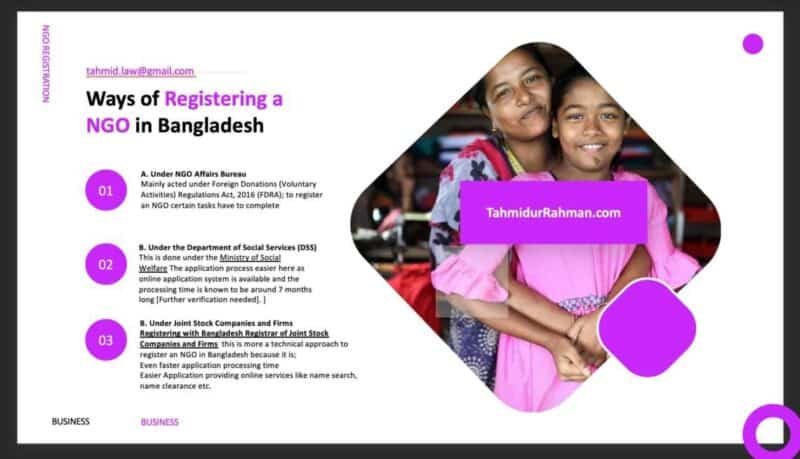
An NGO in Bangladesh can be registered in three ways:
A. Under NGO Affairs Bureau
B. Under the Department of Social Services (DSS)
C. Under Joint stock companies and firms

“Tahmidur Rahman – Tahmidur Rahman Remura Wahid Parnters is Considered as one of the leading firms in NGO and Non-profit Law in Dhaka, Bangladesh”
Carpe Noctem Bangladesh
Firstly, the registration of the INGO or the NGO must be carried out by the body of the NGOAB concerned. Application in the specified form shall be made to the NGOAB along with payment of the required fee and all related documents such as operation report, letter of intent, constitution, copy of the Treasury Challenge with respect to payment of registration fees, etc.
Upon submission of the application to the NGOAB, it shall be forwarded to the Ministry of Social Security and also to the Ministry of Home Affairs for review and inspection of the documents submitted.
Upon receipt of the papers, the Ministries concerned shall nominate the Special Branch of Police and National Security Intelligence to carry out a security check on the applicant and on such a matter of inspection as clearance forwarded to the Ministry of Home Affairs, provided that the approved bodies are pleased with their enquiries.
Once the approval has been issued to the NGOAB, it shall continue with the audit and final inspection of the documents. Acted mainly under the International Donations (Voluntary Activities) Regulations Act, 2016 (FDRA); to register an NGO, certain tasks must be completed; (as stated in section 4 of the FDRA) :
Note: AII documents from abroad should be notarized by Justice of peace or attested by Bangladesh Embassy.
Foreign Donations (Voluntary Activities) Regulations Act, 2016 (FDRA)
As per, Foreign Donations (Voluntary Activities) Regulations Act, 2016 (FDRA), under section 2(1) and foreign donations under section 2(5) which is very important to operate an NGO in Bangladesh.
Section 6 stipulated that the appointment of International Consultant, Advisor or Officer and International Tours must be notified by the Government of their security clearance.

This is done under the Ministry of Social Welfare The application process is simpler here as the online application system is available and the processing period is estimated to be about 7 months long [further verification needed]. But catch registration with DSS only allows you to work in Bangladesh only does it not allow you to receive foreign donations. Follow this link for more information and procedures. The main legal instruments are as follows:
1) SOCIAL WELFARE Organizations VOLUNTARY (REGISTRATION AND CONTROL) ORDINANCE, 1961
2) স্বেচ্ছাসেবী সমাজকল্যাণ সংস্থাসমূহ (নিবন্ধন ও নিয়ন্ত্রণ) বিধি ১৯৬২
An NGO or charity can be registered with the Ministry of Social Welfare’s Department of Social Services (DSS).
Registration, however, is only required for organizations that will provide welfare services to children, youth, women, families, physically or mentally handicapped, family planning, recreation, civic responsibility, released prisoners, juvenile delinquents, socially handicapped, beggars and the destitute, patients, the elderly or infirm, social work, or coordination of social welfare agencies.
Voluntary Social Welfare Agencies (Registration and Control) Ordinance, 1961, and related Rules, 1962.
Registration Procedure under Ministry of Social Welfare’s Department of Social Services (DSS):
Step 1: Obtaining name clearance from the appropriate office.
Step 2: Submit an application for registration to the authority using the prescribed form, ‘Form-B.’
Step 3: Submit all required documents, along with ‘Form-B.’
Step 4: Pay government fees such as Treasury challans, VAT, and so on.
Step 5: Application is forwarded to the appropriate Ministries.
Step 6: A security check is performed by a law enforcement agency, such as the Special Branch of Police or National Security Intelligence, among others.
Step 7: The Ministry inspects, monitors, and reviews the NGO.
Step 8: Review and final scrutiny by the DSS, followed by registration issuance if satisfied.
Step 9: The registration process with the Department of Social
Services may take 5-7 months, depending on the circumstances.
Registration with RJSC is a more formal approach towards registering an NGO in Bangladesh, but often deemed as more desirable because it offers:
1) Quicker response time for applications
2) Smoother application process:
The procedure is based on the SOCIETIES REGISTRATION ACT of 1860.The process of registration under the Societies Registration Act is as follows:
Seven or more persons associated in any literary, scientific, charitable, or other similar purpose may apply to the Bangladesh Registrar of Joint Stock Companies and Firms to form a society by subscribing to its memorandum of association, which must be accompanied by the society’s rules and regulations.
Step 1: First, you need to get a name clearance like a company name clearance. The next step in the process is the actual application for registration of the entity. This request must be submitted on paper along with all the necessary documentation (and the approval of the name clearance).
Step 2: Submit an application to RJSC for registration, along with the Memorandum of Association and a Clearance letter, as well as all other required documents.
Step 3: Payment of government fees is the third step.
Step 4: A security check is performed by a law enforcement agency, such as the Special Branch of Police or National Security Intelligence, among others.
Step 5: Inspection, monitoring, and evaluation of the NGO by the appropriate authorities.
Step 6: If all requirements are met, the authority will issue a registration.
According to Section 28 of the Companies Act, 1994, an association can be incorporated as a non-profit company conforming to the rules and regulations of a company with limited liability when it obtains a license from the concerned authority, namely the Bangladesh Registrar of Joint Stock Companies and Firms under the Ministry of Commerce.
The procedure for obtaining RJSC registration is nearly identical to that described above. The government will grant a license if it is satisfied that the association will promote commerce, art, science, religion, charity, or any other useful goals, and that its profits or income will be used to further those goals without paying any dividends to its members. These types of welfare-oriented businesses can be formed as limited liability companies under the Companies Act of 1994.
‘A trust may be established for any lawful purpose, including charitable activity,’ according to the law. The trustees are in charge of looking after and managing the trust property in order to achieve the goals stated in the trust deed.
A Trust can be established for any lawful purpose, such as the benefit of children, the public good, religious purposes, or any other purpose by interested persons, whether legal or natural, with specific property, whether moveable or immovable, or a fund for the benefit of the community. The trustee/s are responsible for the care and management of trust property in order to achieve the purposes stated in the trust deed.
Relevant Statutes: – The Trust Act of 1882:
Step 1: A trust can be created through a trust deed that specifies the author’s intention.
Step 02: In the trust deed, the author of the trust must state with reasonable certainty his intention to establish the trust, the purpose of the trust, the beneficiary, the trust-property, and transfers of trust property to the trustee.
Step 03: For the creation of a valid trust, certainty of words in unambiguous terms indicating intention, subject matter, and specific objective is required.
Step 04: The concerned organization can begin operations after the trust deed is registered. For example, trust deeds are registered at the Sub-Registrar Office where the NGOs’ headquarters are located.
This Act provides for the registration of foundations, trusts, and other charitable organizations.
There is currently no regulatory authority to which charitable trusts are required to report, so registration or license from other Non Profit Organization regulatory or registration authorities is required for their smooth operation. Trusts are required by law to report to that authority in such cases.
A Board of Trustees manages a trust by protecting the trust property and enhancing it to its maximum benefit, as defined in the trust deed.
The concept of Waqf in Muslim Law is similar to the concept of trust in English. In this case, the owner of a property, both movable and immovable, can create a waqf for the use of beneficiaries in perpetuity through a declaration in an instrument. In accordance with the terms of the waqf instrument, the waqf is administered by a trustee known as a mutawalli.
Concerning Legislation:
Waqfs Ordinance of 1962
Step 1: The Mutawallis waqf property must file an application with the Waqf Administrator’s office.
Step 2: Upon receipt of the application, the Administrator will proceed to register the waqf property, after which he will keep detailed information about it in his register, including the deeds, the name of the mutawalli, and the rules of succession to the office of mutawalli.
Shortcomings and Recommendations:
Various NGOs or charities have been formed and run under the aforementioned Acts, but these same Acts have been causing complications at this time.
It should be noted that there is no uniform law governing the formation of an NGO; rather, different types of laws, rules and regulations, and bodies govern the formation of the same, depending on its nature, objectives, purposes, constitution, resolutions, and so on. As a result, a consolidated uniform law is critical for the smooth formation, operation, and legalization of NGOs in Bangladesh.
“As per, Foreign Donations (Voluntary Activities) Regulations Act, 2016 (FDRA), under section 2(1) and foreign donations under section 2(5) which is very important to operate an NGO in Bangladesh.”

In regards to NGO registration in bangladesh people also ask these questions frequently, hence this FAQ content block is dedicated to answering your questions.
Every NGO in Bangladesh is legally mandated to document the Memorandum of Understanding. It includes the name and address of the NGO, the mission and goals, specifics of the governing body, information on human resources and personnel, rules and regulations, administrative laws and procedures.
3000+.
Currently, approximately 3000+ (including local and international) NGOs are registered under the legislation of Goverment of Bangladesh. A total of 240+ foreign Non-government organizations (NGO) of 30+ countries have been operational in the country
Based on the number of employees, BRAC is considered as the largest NGO (non-governmental development organisation) in the world not only in Bangladesh!
United Nations Model NGO Guide. Since the founding of the United Nations, NGOs have been core members of the policy and implementation process. NGOs or non-governmental organizations are non-profit organisations focused on humanitarian, human rights and sustainable development issues around the world.
The Board of Directors of the NGO is at the top. The NGO Board is a legal requirement in most countries to be formally registered with local authorities. Most NGOs stipulate that membership of the Board is voluntary and non-remunerative. Board meetings shall be held closed, while written processes, reports and minutes may be made available for the purposes of accountability.
The top management of an NGO consists of three entities –
The staff members of the NGO shall be responsible for the day-to-day operation and execution of its programs and projects. They report to the Executive Director, who is ultimately responsible for the operations of the NGO. (See Figure 3) The staff members of the NGO fall into three groups-responsible for activities related to (1) management, (2) advertisement and (3) programs / projects.
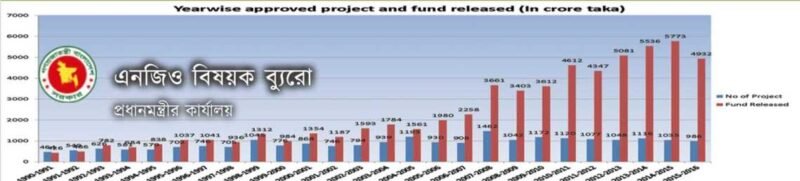
NGOs in Bangladesh may receive, coordinate and collect funds through a variety of sources, procedures, initiatives, ventures and activities: grants through funding agencies through ventures. Grant from the International Development Agency and Fund Raising from the Corporate Department under the CSR.
The NGO is a non-governmental organisation. A non-profit organization uses the excess funds for the benefit of the organization, rather than splitting them between the members and the owners of the company. Examples of NPOs are performing arts organisations, trade unions and charities.
NGO and INGO registration at Tahmidur Rahman TRW:
The legal team of Tahmidur Rahman, TR Barristers in Bangladesh TRW are highly experienced in providing all kinds of services related to registering NGO, non profit and charitable trust in Bangladesh . For queries or legal assistance, please reach us at:
E-mail: info@trfirm.com
Phone: +8801847220062 or +8801779127165
Address:
Email us anytime : info@trfirm.com
Or call — +8801847220062 or +8801779127165
Tahmidur Rahman | Law Firm in Dhaka
Affiliated with TR Barristers in Bangladesh, A full service multi-directional law firm in Dhaka.
© 2018-2023 Tahmidur Rahman Matte IT Ltd.
NEED HELP?
Privacy Policy
Disclaimer
Client Login
Sitemap

Tahmidur Rahman, Senior Associate, TR Barristers in Bangladesh
2 Jan 2020
Find the subsections below, If you want to jump through specific sections instead of reading the whole article.

This post in details will explain in details about charter shipping contract in Bangladesh. The Charter Party Shipping Contract is very important for all Admiralty and Maritime personnels, investors and to all those interested in this business. Parties to the Charter Process must be vigilant while drawing up such an agreement. The charter party must represent the interests of the parties and be free from ambiguity and confusion. This article offers an description of the general terms and conditions of the Charter Group Agreement.
In shipping it is often referred to as being on charter when a ship is contracted. The ship’s owner is always referred to as the owner and the charterer is referred to as the one who hires the ship or space thereof. The instrument of agreement is called the “charter party,” generally referred to as C / P.
There are common models for different types of charter developed by various foreign trade organizations and chambers of commerce including the ICC, BIMCO and the Baltic Exchange. C / P is usually drawn by mutual agreement (ship-owner and charterer or their agents) to separate clauses in each of the particular types with special conditions or exception / exemption indicated by lines.
Conventionally there are three major types of charter:
The charter party is a contract document by which the shipowner agrees to lease, and the charterer agrees to hire, a vessel or all cargo space, or part of it, on the terms and conditions of the charter party.
If this is permitted under the terms of the charter party, the charterer may do so, enter subcontracts with other shippers. If your vessel is chartered, it is of the utmost importance that you read the charter party carefully, in particular the added clauses, until it is fully understood. It is advisable for the officers to read it as a matter of information and instruction, and it will do no harm to discuss it with them, in particular with the Chief Officer.

Charter of the Bareboat Party. The shipowner, by this type of charter
Leases his entire vessel, and the charterer is responsible for
Operating it as if it were his own vessel.
The charterer operates the vessel (in lawful trade) in a manner as if s/he is the owner. The charterer can even put his/ her own marking on the funnel.
However, the charterer can not raise any cash / finance against the ship because he / she is still not the owner of the ship. Some countries also allow the registration of a ship under bare-boat charter for the charter period or if the C / P leads to the eventual sale of the ship to the charterer.
However, the C / P must have a clause allowing the charterer to register a ship under a different flag for the charter period. Obviously, the administration of the bare-boat registry will seek the consent of the primary registry before the vessel is registered under the bare-boat registry. (Charter Shipping contract in bangladesh)
The ship is chartered for a specific period , say about six months to one year, at a fixed rate (usually a daily rate) with the option of extending the period to complete the voyage. The Charter may be renewed or extended for a further period of time on mutual consent.
Charter hire is usually paid in advance, say about 15 or 30 days at a time. The owner keeps the master and the crew and keeps paying their wages.
The owner continues to pay for the insurance from companies like staveley head (hull and machinery and crew P&I). The charterer may take advantage of the P&I coverage for freight or other claims. There are special P&I charter clubs to provide coverage of the charterer ‘s requirements. (Charter Shipping contract in bangladesh)
It is, in fact, an agreement between the owner (carrier) and the charterer (shipper) to transport a certain quantity of cargo from point A to point B at the agreed rate of freight per ton. It usually refers to a quantity with a + /-2 per cent option for either party.
The ship will serve the “Notice of Readiness” upon arrival at the loading port when it is ready for loading. If it is on liner terms, the owner (carrier) uses stevedores at both ends and pays for them.
However, the charterer must deliver the cargo to the loading hook and away from the hook at the discharge port. In most travel charters, however, loading and unloading is done by the charterer. (Charter Party Shipping contract in bangladesh)

“Tahmidur Rahman Remura Wahid Parnters is Considered as one of the leading firms in Shipping Law in Dhaka, Bangladesh”
Carpe Noctem Bangladesh
If applicable, these are the terms that should be present in a Charter Party shipping contract.

OWNERS’ OBLIGATIONS: A detailed list of the obligations of the shipowner must be mentioned.


Either party should be allowed to cancel the Agreement on the outbreak of war or hostilities during the period of the Charter Party.
It has to be clarified who bears responsibility in the event of accident, danger, damage or disaster before or after the commencement of the voyage.
It must be mentioned which law governs the Charter Party Agreement and where the dispute will be resolved.

In regards to Charter Shipping contract in bangladesh people also ask these questions frequently, hence this FAQ content block is dedicated to answering your questions.
FAQ
Charter party, contract by which the owner of a ship allows it to be used by others for the transport of a cargo. The shipowner continues to control the navigation and management of the vessel, but the charterer is responsible for its carrying capacity.
A charter party (sometimes a charter party) is a maritime contract between a shipowner and a charterer to hire either a passenger ship or a cargo ship or a pleasure yacht. The charter party is a contract for the transport of goods in the case of the employment of a tramp.
There are three major types of charter parties: i) Voyage charter parties, ii) time parties, iii) bare boat parties.
A voyage charter is to hire a vessel and a crew to move between a load port and a discharge port. Time charter is the hiring of a vessel for a fixed period of time; the owner still owns the vessel, but the charterer chooses the ports and guides the vessel where to go.
Differences Between the Charter Party Bill of Lading and the Marine Bill of Lading: Charter Party Bill of Lading includes a rule specifying that it is subject to a Charter Party. The Marine bill of charge does not contain such a clause or a similar wording.
"Freight" means the remuneration owed by the charterers to the owners for the performance of the contract. In the contract, it may be referred to as charter party freight. "Freight" is always payable in part in advance under the terms of the charter party, e.g. on loading or on the issue of bills of lading.
Legislation can be specified as the amount of time permitted for a ship in a charter for the loading and unloading of cargo at a port. If the ship fails to complete the work within this allocated time and the ship is forced to remain at the port for a longer period of time, then the ship owner will be liable to demolition (fine).
Charter party bill of lading is another form of bill of lading used in the maritime mode of transport. If a shipper or group of shippers arranges for their goods to be chartered to their final destination, a vessel shall be chartered. This chartered vessel is intended to carry the goods solely for certain shippers or shippers.
A bill of lading is a legally binding document issued by a carrier to a shipper that specifies the type, quantity, and destination of the goods being transported. This document must be signed by an authorized representative from the carrier, shipper, and receiver and must accompany the shipped goods.
Charter Party Shipping Contract at TRW:
The legal team of TR Barristers in Bangladesh TRW are highly experienced in providing all kinds of services related to Admiralty and Maritime legal services. For queries or legal assistance, please reach us at:
E-mail: info@trfirm.com
Phone: +8801847220062 or +8801779127165
Address:
Email us anytime : info@trfirm.com
Or call — +8801847220062 or +8801779127165
Tahmidur Rahman | Law Firm in Dhaka
Affiliated with TR Barristers in Bangladesh, A full service multi-directional law firm in Dhaka.
© 2018-2023 Tahmidur Rahman Matte IT Ltd.
NEED HELP?
Privacy Policy
Disclaimer
Client Login
Sitemap

Tahmidur Rahman, Director and Senior Associate
12 Nov 2019
This post in will explain in details about the process of Liquidation or winding up a company in Bangladesh – This article will explain the step by step process of winding up a company office in Bangladesh, Declaration of solvency , accounts and audit, extraordinary general meeting, declaration of solvency and everything you need to know and to be aware of.
Liquidation or Winding up a company in Bangladesh- Find the subsections below, If you want to jump through specific sections instead of reading the whole article.

Winding up is the process of dissolving a company. A business organisation stops doing business as normal when it winds up. Its conventional aims are to sell off stock, pay off creditors and transfer to partners or shareholders any remaining assets. The term is used mainly in UK where liquidation is synonymous with the process of turning assets into cash. In other terms, this mechanism generates a monetary fund in which a business pays its debts, outstanding bills, and splits the remainder and distributes to shareholders, members of the corporation, investors, or any other investor. A receiver may be designated to control such asset distribution (known as “Liquidator”) process.
Before we deep dive into the process of winding up a company in Bangladesh, it is pertinent to note the term used here is Company but not businesses, as sole proprietorships or partnership business in Bangladesh do not follow the equivalent pathway or practice such as liquidation or winding-up. Therefore, to continue with the liquidation process one must have or have an operating company, properly incorporated / registered under Bangladesh law.
Under the company law 1994, there are three modes of winding up a company in Bangladesh. The winding up of a company may be either:
A winding-up petition can be filed jointly or separately by a creditor, the business or the company (i.e. shareholders) or lender under section 245 of the Companies Act 1994. In the event of a company winding up, section 235 of the Companies Act notes that each of the company’s current and former owners will be liable to contribute to a amount adequate to cover the company’s debts, liabilities, costs and liquidation expenses. Section 237 describes the term contributory; it means that in case of wound up each individual is liable to contribute to the assets of a corporation. (For Liquidation or Winding up a company in Bangladesh)
Hence to summarise,
A petition for winding up can be filed by:
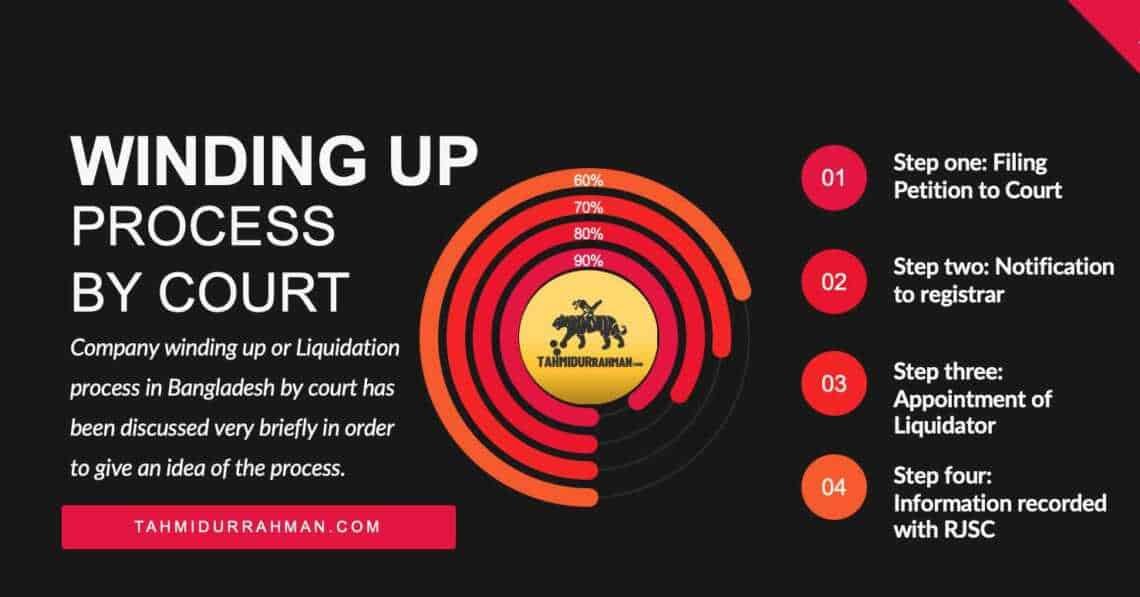
Winding Up of a company by court may be done in certain circumstances which are:
Company winding up or Liquidation process in Bangladesh by court has been discussed very briefly in order to give an idea of the process.
In order to wind up a company by the court, a petition has to be filled the company court of High Court Division of Supreme Court . It is to be noted that winding up of a company by the court shall be deemed to commence from the time of presentation of petition for winding up. Upon hearing the application the court will pass an order for winding up of the company.
In issuing a winding-up order, the petitioner and the corporation are obliged to file a copy of the order with the Registrar within 30 ( thirty) days from the date of the request. The Registrar shall register a summary in his company related books upon filing a copy of a winding-up order. The registrar then notifies the official Gazette that such an order has been made. Such an order shall be considered to be a discharge notice to the company’s employees, except when the company’s business is continued.
The court will then appoint an official liquidator and the liquidator will perform its duties as per the Companies Act 1994. In case of winding up by the court, all the property and effects of the company shall be deemed to be in the custody of the Court as from the date of the order for the winding up of the company.
Once a company’s affairs have been completely wound up, the Court shall make an order to dissolve the company from the date of the order, and the company shall be dissolved accordingly. Official liquidator shall report the order to the registrar within 15 (fifteen) days of the order. The registrar shall record a minute of the company’s dissolution in his books.

“Tahmidur Rahman Remura Wahid is Considered as one of the leading firms in Company Law in Dhaka, Bangladesh”
Bdlawfirms & Carpe Noctem Bangladesh
A company may be winded up voluntarily:
It is to be noted that commencement of voluntary winding up shall be deemed to commence at the time of the passing of the resolution for voluntary winding up. (Liquidation or Winding up a company in Bangladesh)
When a company has by special or extraordinary resolution resolved to wind up voluntarily the court may make an order that the voluntary winding up shall continue but subject to supervision of court and such terms as the court thinks just.
Section 242 of the Companies Act 1994 takes into account whether a corporation is found to be unable to pay its debts. This will be the case if a creditor to whom the company is indebted for a sum and the company fails to pay the sum for three weeks or if the execution or other proceedings issued under a decree or order of any court in favor of a company creditor are returned unsatisfied in whole or in part or if it is demonstrated to the court’s satisfaction that the company is unable to pay its debts and the court is to take account of them.
Section 316-321 of the 1994 Companies Act deals with turning up being subject to court oversight. If a company has agreed to wind up voluntarily through special or exceptional means, the court may make an order that the voluntary winding up must proceed but be subject to court oversight and such conditions as the court considers appropriate. Where an order for winding up is made subject to supervision, the liquidator may exercise all the powers, subject to any limitation imposed by the court, as if the company were being wound up voluntarily entirely. (Liquidation or Winding up a company in Bangladesh)
Click here and go to the post, Tahmidur Rahman speaks in details about Trade License in Bangladesh | Fees, Processing and Renewal!
This is the liquidator ‘s responsibility in any voluntary winding-up to settle the company’s debts and change the creditors’ right among themselves. Here is the comprehensive step-by – step method of voluntary wind-up of a bangladesh company.
The first step on the process of winding up is to prepare documents. The documents that need to be prepared are:
The above mentioned documents will have to be approved by the majority directors of the company.
The next step is to file the approved Declaration of Solvency to the RJSC within 5 (five) weeks from the approval by directors.
The third step requires the Extraordinary General Assembly to pass a special resolution. This is to approve the company’s decision to wind down and the liquidator appointment. It should be noted that the meeting ‘s content is also to be filed with the RJSC. The special resolution will then be published in the official Gazette, and in a newspaper circulated in the district where the company’s registered office is located. It will be achieved within 10 ( ten) days of the special resolution passing it.
Once the chosen liquidator has been approved by the extraordinary general meeting and the liquidator has accepted the appointment, such must be notified to the RJSC. In addition, the Deputy Commissioner of Taxes will also be informed of the same within 30 (thirty) days of the said appointment.
At this stage the liquidator need to prepare a Final Account. The Final Account must have the details of how the winding up has been conducted and the assets distributed. Thereafter, the liquidator will call an extraordinary general meeting and the notice for that must be circulates by advertisement in the official Gazette, and in a newspaper. Such a notice must be given not less than one month before the meeting.
The special resolution will be passed in the extraordinary general meeting with regards to the disposal of the books and papers of the company.
Lastly, a final meeting must be hold and a return of the meeting must be submitted to the RJSC upon which the company will be winded up. The submission must be made within one week of the meeting.
For voluntary winding up, the petition to the court is made at this stage. All the documents relevant to the winding up of the company are submitted to the court. The court being satisfied, declares that the company has been dissolved. This stage is essential to avoid any allegation of fraud later on.

Here are the minimal required government fees for the company winding up process (Liquidation or Winding up a company in Bangladesh):
1. For Private and Public Company: BDT 20.00
2. For Trade Organization and Foreign Company: BDT 10.00
Tahmidur Rahman | TR Barristers in Bangladesh, a leading Company law firm can provide following the legal services: The Law firm will assist in arranging the actual consent and interest of each company share. Furthermore, TRW will provide a complete road map for winding up processes. Team TRW may also help in the disposal of company properties and make use of the proceeds to pay creditors. In addition , the team will assist in holding creditors’ meetings, settling legal disputes and settling all the company’s pending obligations. TRW will be responsible for sending the documents to RJSC and preparing all documents in Bangladesh for the termination or liquidation of the company. On top, the company law department will provide the complete legal services in relation to Company winding up or Liquidation process in Bangladesh.
For queries or legal assistance, please reach us at:
E-mail: info@trfirm.com
Phone:+8801847220062 or +8801779127165 (WhatsApp also available)
Address: .
Liquidation or Winding up a company in Bangladesh.


Want new articles before they get published?
Subscribe to our Awesome Newsletter.
The page you requested could not be found. Try refining your search, or use the navigation above to locate the post.

This post in will explain in details about Branch office registration in Bangladesh – This article will explain the step by step process for setting up a branch office in Bangladesh. In addition, people want to know the required cost and documents for a branch office registration in Bangladesh. This article will explain everything you need to know about branch office with directions and infographics.
Email us for assistance: info@trfirm.com
A branch serves as an extension of its parent company, meaning, there will be no separate legal entity established. Its parent company is liable for the branch office’s debts or any other obligations and activities.
No operation in Bangladesh that is not expressly authorised by BIDA can be conducted by a Branch Office. A Branch Office is also expected to register with the Joint Stock Companies and Company Registrar and to comply with other legal formalities prescribed by the Companies Act 1994.
A Branch Office offers the advantages of ease of service and uncomplicated closing. Nevertheless, as the operations are strictly controlled by the guidelines for exchange control, a Branch May may not provide the best framework for its expansion / diversification plans to a foreign firm.A foreign company’s branch office can engage in commercial activities with prior BIDA approval. A branch office may have a local source of revenue from the approved business sector in Bangladesh and with the prior approval of the Inter-Ministerial Committee and sufficient justification and supporting documentation.
One of the major differences between a branch and a liaison / representative office is that a branch may engage in commercial activities with a prior approval from the Bangladesh Investment Development Authority (BIDA). The branch office, for example, can:
A Branch or Liaison Office is a proper legal body in Bangladeshonce it is registered with the BIDA. It is called a multinational company extension, and not a separate legal entity. Unlike a Bangladeshi subsidiary, a Branch or Liaison Office parent company is indirectly responsible for all branch or liaison office debts and liabilities.
As per the guideline of BIDA, following papers/documents are required for application for opening of branch office. (4 copies of all documents).
1. Application in prescribed form signed by the authorized person for establishment of Branch office registration in Bangladesh.
3. Name and nationality of the directors/promoters of the principal company. (Attested by the concern Bangladesh Embassy)
4. Audited Accounts of last financial year of the principal company. (Attested by the concern Bangladesh Embassy)
5. Company’s board of director’s resolution regarding opening of office in Bangladesh. (Attested by the concern Bangladesh Embassy)
6. Proposed organogram of the office showing the posts to be occupied by both expatriates and local personnel.
7. Furthermore, Details of activities to be performed through the proposed branch/liaison/representative office in Bangladesh.
8. Finally, Any other documents BIDA, may ask for after primary reviewing
In addition, you must translate any documents that are not stated in English before submission. (Branch office registration in Bangladesh)
When the documents are issued, they will be thoroughly reviewed by the BIDA Inter-Ministerial Committee. When the committee is content with the verification then they may give the approval or can obtain additional documentation. Hence it is important to carefully prepare the papers.
The average time needed for submission and getting the approval is one month. However, BIDA may seek physical representation of the documents as such this may make the process lengthier. (Branch office registration in Bangladesh.)
The government cost for getting the approval from BIDA is USD 300 (three hundred dollar)

“Tahmidur Rahman Remura Wahid is Considered as one of the leading firms in Company Law in Dhaka, Bangladesh”
Bdlawfirms & Carpe Noctem Bangladesh
CLICK HERE TO MAIL US IF YOU HAVE ANY LEGAL QUERIES REGARDING THIS
OR CALL US ON : +8801847220062 OR +8801779127165
Following approval from BIDA, the next move is to open a Bangladesh Bank Account. It is because while no minimum paid-up capital is needed for the establishment of a branch office, a remittance of US$ 50,000 must be deposited within 2 ( two) months from the date of issuance of the BIDA letter of authorisation. (Branch office Registration in Bangladesh )
The documents required for opening bank account are:
Also in regards to Branch office registration in Bangladesh, Parliament of Bangladesh revised the 1947 ForeignExchange Regulatory Act. Now, however, Bangladesh Bank’scriteria for 18B approval has been withdrawn. In addition, according to the amendment, the branch office will report to the Bangladesh Central Bank after receiving approval from BIDA. Such a report with 30 ( thirty) days to approve should be made.
Click here and go to the post, Tahmidur Rahman speaks in details about Trade License in Bangladesh | Fees, Processing and Renewal!
After obtaining approval from both Bangladesh Bank and BIDA, registration with the RJSC is required. The following documents will be required for this purpose (for Branch office registration in Bangladesh):
In order to get trade license an application need to be made to the concerned city corporation. Along with the application, the following information and documents need to be submitted:
It usually takes 3 to 4 working days to get a trade license. In order to know more about how to get trade license in Bangladesh.
The government for trade license is USD 100 (hundred dollar).
After setting up the branch office, it is important that the branch office has a unique Business Identification Number (BIN) to carry out normal business operations in Bangladesh. Therefore a VAT registration certificate must be obtained from the Department of the National Revenue Board (NBR) to obtain a business identification number. It’s free to register for the VAT registration.
In order to carry out normal business operations in Bangladesh after setting up the branch office, it is essential that the branch office has a unique Business Identification Number (BIN). Therefore, to get a Business Identification Number, a VAT registration certificate need to be obtained from the Department of the National Board of Revenue (NBR).

Sponsors may apply for Private Investors Visa. Foreign employees can appointment. Appointment can be made by foreign employees. International workers need to get a work permit to be able to operate in Bangladesh. This is a multiple entry visa and it is only valid for 3 months but can be extended later.
A branch manager may be a foreigner but he / she should be a Bangladesh citizen. Remember also that a cap of 5 percent (five percent) of foreign employees in a branch is restricted by Bangladeshi law. In addition, it should be noted that as per the Bangladesh Investment Development Authority Handbook 2011, the
current maximum ratio of foreign to local employees is 1:5 for commercial offices and 1:20 for industrial enterprises. (Branch office Registration in Bangladesh)

The approval is usually provided to establish a branch for a period of three years and it has to be extended/ renewed. You have to apply for renewal or extension at least 2 (two) months before the expiry of the current term.
There is not minimum capital requirement in Bangladeshfor branch office. However, there is a requirement for a minimum of US$ 50,000 inward remittance for registration of branches offices in Bangladesh as this inward remittance should cover the cost of initial establishment and six months’ expenses for operation.
To set up a branch office in Bangladesh, conventionally it takes from 60 days (sixty) to 90 days (ninety) in total. Other formalities are consequential and will take about 2 weeks.
“Sponsors may apply for Private Investors Visa. Foreign employees can appointment.Appointment can be made by foreign employees. International workers need to get a work permit to be able to operate in Bangladesh. This is a multiple entry visa and it is only valid for 3 months but can be extended later.”
Branch office does not have its own independent legal body. This is because it functions as an extension of its parent company. Hence the parent company is entirely responsible for its branch office ‘s operations, debts and responsibilities.
Unlike liaison office, a branch office can engage in commercial activities. However, in order to do so, prior approval from the Bangladesh Investment Development Authority (BIDA) is required.
Activities that a Branch office can engage in are:
In the approval letter issued by BIDA, the activities of a Branch office shall remain confined to the areas and for the time specified and authorized. Unless the organization wishes to extend its Office past the approval period, they will have to apply for the required renewal / extension in the specified form with correct documentation at least 2 ( two) months prior to the expiry of the current term. In addition to that the Branch office should also maintain the following compliances:
Foreign capital invested in Bangladesh for industrial projects with government approval is permitted to be repatriated from Bangladesh, along with any capital appreciation, provided Bangladesh Bank approval is first obtained.
Remittance of dividends and profits is now permitted with fewer restrictions. Before profits from foreign subsidiaries can be transferred back to the parent company, Bangladesh Bank approval is required. First, taxes must be paid. Profit remittance requests must be submitted to the Bangladesh Bank via the applicant’s bank.
Repatriation of investments made in Bangladesh with the approval of the government of Bangladesh / Bangladesh Bank is permitted (except in cases where the investment was permitted on the specific condition that it would not be eligible for repatriation), provided the disinvestment was also made with approval.
Actual remittances will be permitted subject to the satisfaction of such conditions as to repatriation amount and installments, etc., as may be applicable from time to time.
With prior permission from Bangladesh Bank, foreign nationals temporarily residing in Bangladesh may transfer to their home countries current assets such as salary, dividend, etc. savings.
There are currently no restrictions on the receipt of remittances through proper banking channels from any foreign nation in Bangladesh. Additionally, there are no restrictions on the importation of foreign currency checks. Drafts in any foreign currency may be freely converted by authorized dealers.
Traveler’s checks and foreign currency notes / coins may be exchanged for taka at money-changers authorized by the Bangladesh Bank to conduct such transactions.
Agreements for the remittance of fees for the purposes of royalties, technical know-how, and technical assistance do not require the prior approval of the BIDA if the total fees and other expenses associated with technology transfer (service fee, marketing commission, etc.) fall within the following limits.
Such fees and other expenses should not exceed six percent of the commercial value of imported machinery for new projects.
Recurring annual fees for royalties and other expenses, such as fees for technical know-how, technical assistance, operational services, marketing of products, etc., should not exceed a limit of 6 percent of the previous year’s sales reported on the tax return of the company.
Once the above-mentioned technical transfer agreements have been signed, they must be submitted to the BIDA for registration.
Proposals that fall within the prescribed limits will require the BIDA’s prior approval, for which an application must be submitted along with the required documentation and a copy of the relevant draft agreement.
| Question | Answer |
|---|---|
| What is the legal process for registering a branch or subsidiary office in Bangladesh? | The legal process for registering a branch or subsidiary office in Bangladesh involves obtaining various approvals and registrations from different government bodies, including the Registrar of Joint Stock Companies and Firms, the Bangladesh Investment Development Authority, and the National Board of Revenue. |
| What is the difference between a branch office and a subsidiary office? | A branch office is an extension of the parent company, while a subsidiary office is a separate legal entity owned by the parent company. The legal process for registering a branch office and a subsidiary office is different in Bangladesh. |
| What are the documents required for registering a branch or subsidiary office in Bangladesh? | The documents required for registering a branch or subsidiary office in Bangladesh include a certified copy of the parent company’smemorandum and articles of association, a board resolution approving the establishment of the branch or subsidiary office, and other documents as required by the government bodies. |
| How long does it take to register a branch or subsidiary office in Bangladesh? | The registration process for a branch or subsidiary office in Bangladesh usually takes around 2-3 months, depending on the completeness and accuracy of the application and the workload of the government bodies involved. |
| What are the registration fees for a branch or subsidiary office in Bangladesh? | The registration fees for a branch or subsidiary office in Bangladesh vary depending on the capital investment and other factors.It is advisable to consult a lawyer or a business consultant to get an estimate of the fees. |
| Can a foreign company register a branch or subsidiary office in Bangladesh? | Yes, a foreign company can register a branch or subsidiary office in Bangladesh subject to compliance with the relevant laws and regulations. |
| What are the tax implications of registering a branch or subsidiary office in Bangladesh? | A branch office is taxed on its worldwide income, while a subsidiary office is taxed only on its Bangladesh-sourced income.The tax rates and regulations may vary depending on the nature and size of the business. |
| What are the reporting and compliance requirements for a branch or subsidiary office in Bangladesh? | A branch or subsidiary office in Bangladesh is required to file annual tax returns, audited financial statements, and other compliance reports with the government bodies.Non-compliance may result in penalties and legal consequences. |
| Can a branch or subsidiary office in Bangladesh conduct business activities outside Bangladesh? | A branch or subsidiary office in Bangladesh can conduct business activities outside Bangladesh subject to compliance with the relevant laws and regulations of the countries involved. |
| What are the legal implications of registering a branch or subsidiary office in Bangladesh? | Registering a branch or subsidiary office in Bangladesh creates legal obligations and responsibilities for the parent company, including compliance with local laws, regulations, and business practices.It is advisable to consult a lawyer or a business consultant before proceeding with the registration process. |
The Barristers, Advocates, and lawyers at TRW Law chamber in Gulshan, Dhaka, Bangladesh are highly experienced at assisting clients in dealing with and registering branch offices in Bangladesh. For queries or legal assistance to set up a branch office in Bangladesh, please reach us at:
E-mail: info@trfirm.com
Phone: +8801847220062 or +8801779127165
House 410, Road 29, Mohakhali DOHS
CLICK HERE TO MAIL US IF YOU HAVE ANY LEGAL QUERIES REGARDING THIS